
Prof. Dr. Thorsten Jungmann (last updated 2026-10-03)
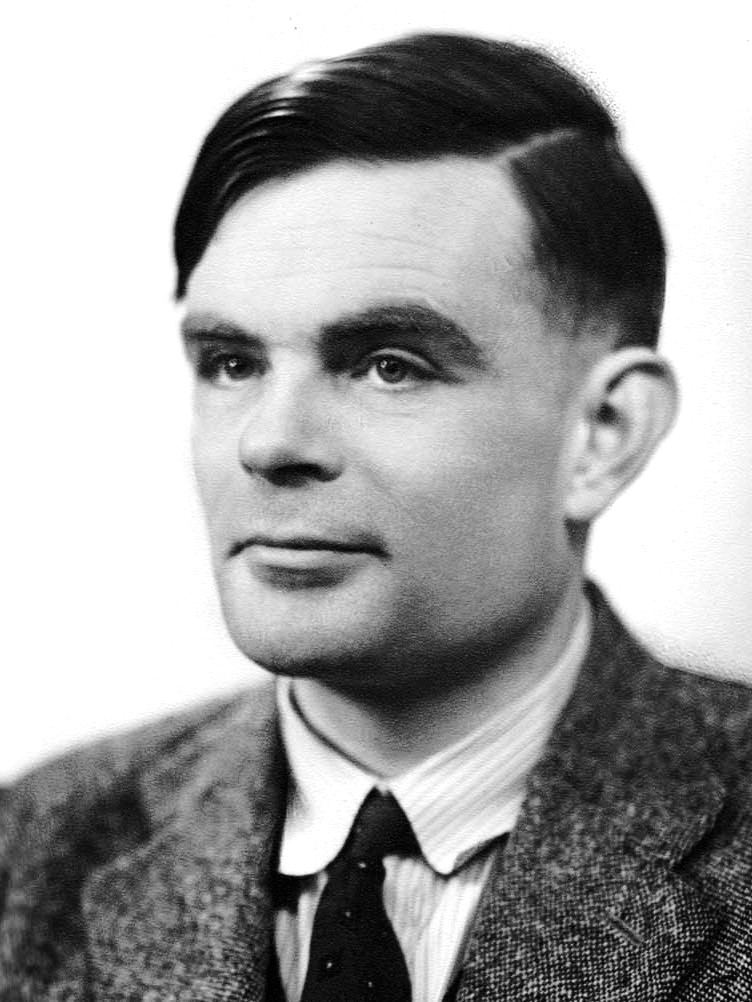
Alan Turing (1912–1954) was an English mathematician and logician, widely regarded as the father of theoretical computer science. He was born in London, graduated from King’s College, Cambridge, and earned a doctorate from Princeton University in 1938. During World War II he worked at the Government Code and Cypher School at Bletchley Park, where his techniques hastened the cryptanalysis of the German Enigma ciphering system. After the war he joined the National Physical Laboratory, and in 1948 he joined the Computing Machine Laboratory at the University of Manchester.
In 1936 Turing published the paper ‘On Computable Numbers, with an Application to the Entscheidungsproblem’, in which he introduced the Turing machine (German: Turingmaschine). It is a mathematical model of computation that describes an abstract machine which manipulates symbols on a strip of tape according to a table of rules. The tape is divided into cells, each holding a single symbol from a finite alphabet. At each step the head reads the symbol in its cell; depending on this symbol and on the present state, which is selected from a finite set of states, the machine writes a symbol into the same cell and moves the head one step to the left or to the right, or it halts the computation. A finite table specifies what to do for each combination of state and symbol. Despite its simplicity, the model is capable of implementing any computer algorithm. Turing used it to prove that there is no solution to the Entscheidungsproblem (decision problem), and so showed fundamental limits of mechanical computation.
A Turing machine that can simulate any other Turing machine is called a universal Turing machine. A system that can simulate a Turing machine is Turing complete; this property is called Turing completeness (German: Turing-Vollständigkeit), and nearly all programming languages have it if the limits of finite memory are ignored. Real computers are not built like Turing machines, whose minimalist design makes them too slow in practice. Between 1945 and 1947 Turing worked at the National Physical Laboratory on the design of the Automatic Computing Engine (ACE). The paper that he presented on 19 February 1946 was the first detailed design of a stored-program computer. Von Neumann’s incomplete First Draft of a Report on the EDVAC had predated it but was much less detailed; according to his Los Alamos colleague Stanley Frankel, von Neumann emphasized that the fundamental conception was due to Turing’s paper of 1936.
Reference and further reading:
https://en.wikipedia.org/wiki/Alan_Turing
https://en.wikipedia.org/wiki/Turing_machine
Image source: Wikimedia Commons (public domain, Elliott & Fry)
