
Prof. Dr. Thorsten Jungmann (last updated 2026-10-03)
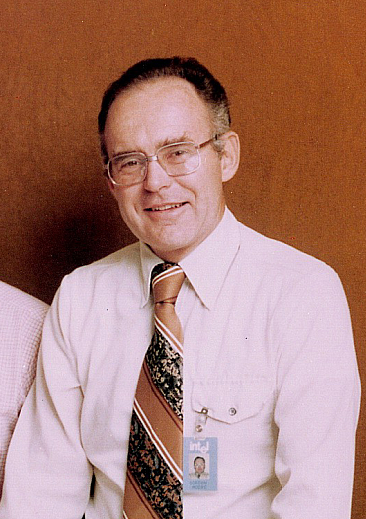
Gordon Earle Moore (1929–2023) was an American businessman, scientist and engineer, and the co-founder and chairman emeritus of Intel Corporation. He studied chemistry, graduated from the University of California, Berkeley, in 1950 and received his doctorate in chemistry from the California Institute of Technology in 1954. After postdoctoral research at the Applied Physics Laboratory at Johns Hopkins University, he joined William Shockley at the Shockley Semiconductor Laboratory, a division of Beckman Instruments. He left with the ‘traitorous eight’ when Sherman Fairchild agreed to back them and created Fairchild Semiconductor.
In 1965 Moore was director of research and development at Fairchild Semiconductor. The magazine Electronics asked him to predict what might happen in the semiconductor components industry over the next ten years. In an article published on 19 April 1965 he observed that the number of components (transistors, resistors, diodes or capacitors) in a dense integrated circuit had doubled approximately every year, and he speculated that this would continue for at least the next ten years. In 1975 he revised the forecast rate to approximately every two years. This observation is known as Moore’s law (German: Mooresches Gesetz); Carver Mead popularized the name. Today the law is usually stated as follows: the number of transistors in an integrated circuit doubles about every two years, with minimal increase in cost. Despite its name it describes an empirical relationship, not a scientific law. The semiconductor industry has used it to guide long-term planning and to set targets for research and development.
In July 1968 Noyce and Moore founded NM Electronics, which later became Intel Corporation. In 1975 he succeeded Noyce as head of the company until 1997.
Reference and further reading:
https://en.wikipedia.org/wiki/Gordon_Moore
https://en.wikipedia.org/wiki/Moore%27s_law
Image source: Wikimedia Commons (CC BY-SA 2.0, Intel Free Press)
