
Prof. Dr. Thorsten Jungmann (last updated 2026-05-05)
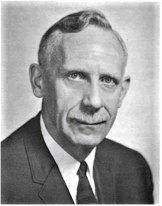
Hendrik Wade Bode (1905–1982) was an American electrical engineer and mathematician of Dutch descent. He received his doctorate in physics from Columbia University in 1935 and spent most of his career at the Bell Telephone Laboratories in New Jersey, where he worked on the theory of electrical networks and the stability analysis of feedback amplifiers.
Bode’s most important contribution to electrical engineering is the graphical representation of the frequency response that is named after him – the Bode plot (German: Bode-Diagramm). In two plots drawn one above the other, the amplitude response (in decibels) and the phase response (in degrees) are each plotted over a logarithmic frequency axis. This representation makes the composition of complex transfer functions from simple factors immediately visible: in the amplitude plot, the contributions of the individual poles and zeros add up, each as an asymptotic straight line with a slope of per decade. Bode plots are still a standard tool in electronics, control engineering and communications engineering today.
His book ‘Network Analysis and Feedback Amplifier Design’, published in 1945, shaped the stability analysis of feedback systems. It is also the origin of the Bode stability criterion (German: Bode-Stabilitätskriterium) and of the theorems named after Bode on the relationship between the amplitude response and the phase response of minimum-phase systems.
Reference and further reading:
https://en.wikipedia.org/wiki/Hendrik_Wade_Bode
Image source: Wikimedia Commons (public domain, IEEE History Center)
