
Prof. Dr. Thorsten Jungmann (last updated 2026-03-02)
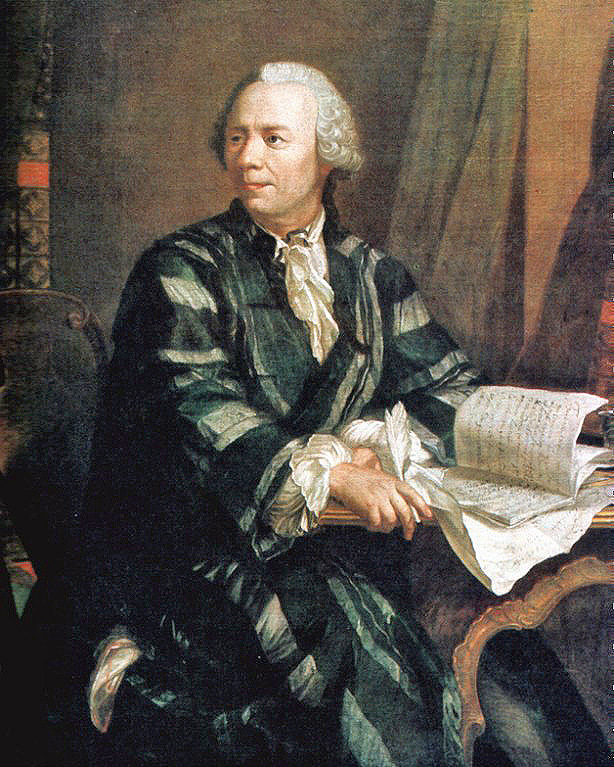
Leonhard Euler (1707–1783) was a Swiss mathematician and physicist who is regarded as one of the most productive and influential mathematicians of all time. He was born in Basel, spent most of his working life at the academies in St. Petersburg and Berlin, and left behind a body of work of more than 800 publications – more than any other mathematician before or after him.
For electrical engineering, Euler is significant above all for Euler’s formula (German: Euler’sche Formel), which is named after him and establishes the relationship between the exponential function and the trigonometric functions:
This formula is the mathematical foundation of complex AC analysis: it allows you to represent sinusoidal AC quantities as rotating phasors in the complex plane and thus to reduce amplitude and phase calculations to simple algebraic operations. Without Euler’s formula, the modern analysis of AC circuits – from the calculation of impedance to the frequency response of filters – would hardly be conceivable.
Beyond this, Euler shaped numerous symbols and conventions that are still used in electrical engineering today: the number as the base of the natural exponential function, the notation for the ratio of a circle’s circumference to its diameter, and the function notation . His most famous result, Euler’s identity (German: Euler’sche Identität) , links the five fundamental mathematical constants , , , and in a single equation and is often called the most beautiful formula in mathematics.
In physics, Euler made fundamental contributions to mechanics (Euler’s equations of rigid-body rotation, Euler–Bernoulli beam theory) and to fluid mechanics (Euler’s equations for ideal fluids). His ability to apply abstract mathematics to practical problems makes him a role model for the engineering way of thinking.
Reference and further reading:
https://en.wikipedia.org/wiki/Leonhard_Euler
Image source: Wikipedia – painting by Jakob Emanuel Handmann, 1753
