
Prof. Dr. Thorsten Jungmann (last updated 2026-10-03)
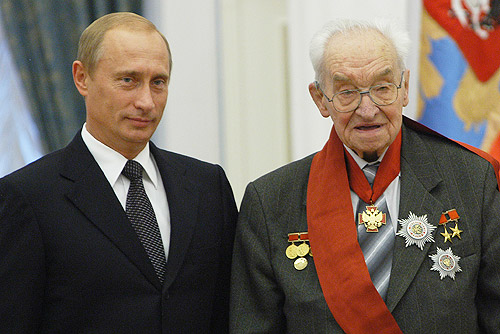
Vladimir Aleksandrovich Kotelnikov (1908–2005) was an information theory and radar astronomy pioneer from the Soviet Union. From 1926 to 1931 he studied radio telecommunications at the Bauman Moscow State Technical University and the Moscow Power Engineering Institute (MEI). He worked at the MEI from 1931, with an interruption from 1941 to 1944 in the telecommunication industry, and was full professor there from 1944 to 1980. In 1953 he was elected a member of the Academy of Sciences of the USSR (today the Russian Academy of Sciences), and from 1954 he directed its Institute of Radio-engineering and Electronics. From 1973 to 1980 he was chairman of the Supreme Soviet of the RSFSR.
Kotelnikov independently discovered the sampling theorem in 1933, before Shannon’s publications. In Russian literature it is known as Kotelnikov’s theorem; elsewhere it is called the Nyquist–Shannon sampling theorem (German: Nyquist-Shannon-Abtasttheorem, in newer literature also WKS-Abtasttheorem). It states that a signal containing no frequencies above can be reconstructed exactly from its samples if the sample rate is higher than . The underlying result of Fourier analysis had been known since the end of the 19th century; the name of Nyquist is attached to the theorem together with that of Shannon. Kotelnikov was also a pioneer in the use of signal theory in modulation and communications.
In 1961 Kotelnikov oversaw one of the first efforts to probe the planet Venus with radar, and in 1962 he led the first radar probe of Mercury. In cryptography he proved the absolute security of the one-time pad in a report of 1941 that apparently remains classified; Shannon reached the same conclusion independently. In 2000 he received the IEEE Alexander Graham Bell Medal.
Reference and further reading:
https://en.wikipedia.org/wiki/Vladimir_Kotelnikov
https://en.wikipedia.org/wiki/Nyquist–Shannon_sampling_theorem
Image source: Wikimedia Commons (CC BY 4.0, Presidential Press and Information Office)
