
Prof. Dr. Thorsten Jungmann (last updated 2026-10-03)
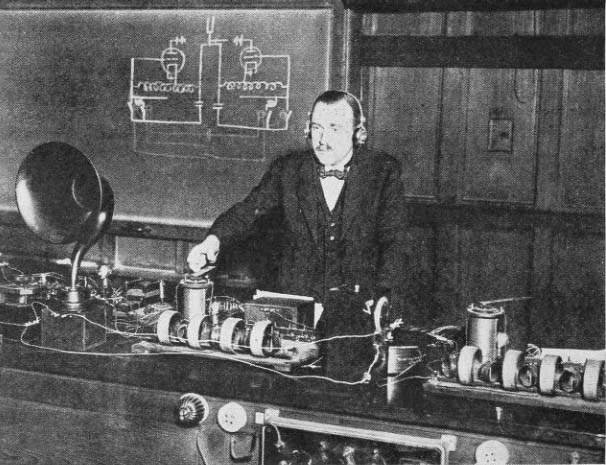
William Henry Eccles (1875–1966) was an English physicist and a pioneer in the development of radio communication. He was born in Barrow-in-Furness, Lancashire, studied at the Royal College of Science in London, graduated from the University of London in 1898 and became an assistant to Guglielmo Marconi. In 1901 he received the degree of Doctor of Science from the University of London. Eccles coined the term ‘diode’ for an evacuated glass tube containing two electrodes, an anode and a cathode.
During and after the First World War, Eccles’ main interest was electronic circuit development. In 1918 he and Jordan applied for a patent for the flip-flop circuit, which became the basis of electronic memory in computers. The circuit was initially called the Eccles–Jordan trigger circuit (German: Eccles-Jordan-Schaltung) and consisted of two active elements, vacuum tubes. It is regarded as the first electronic latch. Flip-flops and latches are circuits that have two stable states and can therefore store one bit; the flip-flop (German: bistabile Kippstufe) is the basic storage element in sequential logic.
In 1919 Eccles became vice-chairman of the Imperial Wireless Committee, and he helped to design the high-power long-wave station at Rugby. Eccles was a Fellow of the Royal Society, President of the Institution of Electrical Engineers in 1926 and President of the Physical Society from 1928 to 1930. He died in Oxford.
Reference and further reading:
https://en.wikipedia.org/wiki/William_Eccles_(physicist)
https://en.wikipedia.org/wiki/Flip-flop_(electronics)
Image source: Wikimedia Commons (public domain, uncredited photograph from Radio Broadcast, June 1925)
