
Prof. Dr. Thorsten Jungmann (last updated 2025-08-07)
1 What does it look like?
A breadboard (German: Steckbrett) is a rectangular plastic board, usually white or light grey, with a large number of small holes arranged in rows and columns. Along the long sides run two continuous rows of holes that are colour-coded – usually red for plus and blue for minus – and serve as power rails. In the middle there are rows of holes running crosswise, which are separated by a central ridge. This separation makes it possible to insert integrated circuits in the centre so that their terminals are not connected to each other.
For orientation, the rows are numbered and the columns are labelled with letters. In this way the positions of individual terminals can be identified unambiguously. The breadboard often has an adhesive foil on its back and mechanical grooves on its sides, so that it can be fixed to a surface or connected to further breadboards.
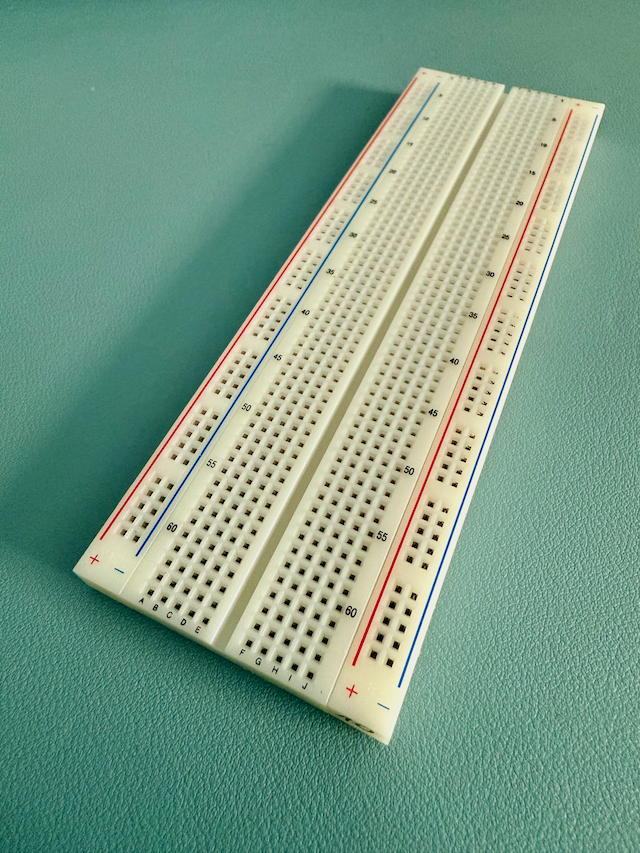
Breadboard
with modules for the supply voltage at the sides
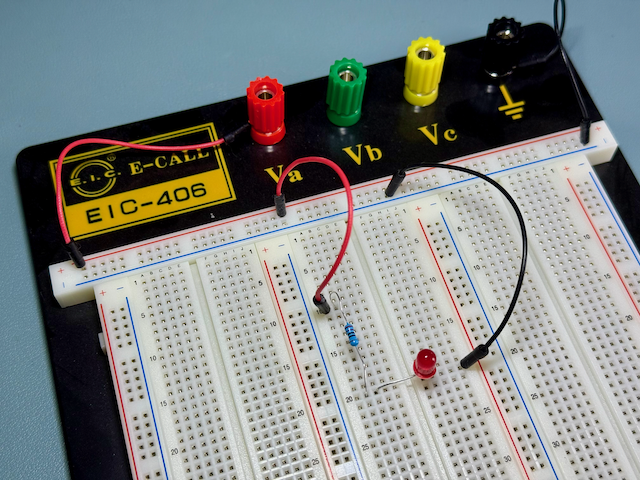
Breadboards on a metal plate
with additional banana jacks for connection to a supply voltage
2 What can it do?
A breadboard like the one shown in the picture is an indispensable tool for building and testing electronic circuits in the laboratory or in training. It allows components – such as resistors, capacitors, light emitting diodes or integrated circuits – to be plugged in quickly and flexibly without soldering.
3 How does it work?
The component leads and jumper wires are simply plugged into the spring-loaded metal contacts of the holes.
4 What does it look like inside?
Breadboards typically consist of:
- Two bus strips at the sides (usually marked red and blue, as in the picture) for the power supply (plus and minus).
- A central divider, which allows components with several pins, such as ICs, to be plugged in clearly.
- Many small rows of contacts (64 rows in the picture), each of which is electrically connected horizontally to the left and to the right of the divider, so that components can be conveniently connected to one another.
In the picture, the positions A-F and G-J in each individual row are electrically connected to each other. The left and right sides are separated from the middle not only visually but also electrically.
5 What role does it play in teaching?
Breadboards make it easier to develop, modify and check electric circuits, because all connections are reversible and easy to adapt. They are ideal for students, learners and everyone who is curious and wants to try out electric circuits with simple means.
6 What role does it play in practice?
In practice, breadboards are used, e.g., for building prototypes of electric circuits.
Symbols
For a breadboard and the jumper wires there are no standardized letter designations in classical schematic symbols
Calculations
No calculations are carried out for the breadboard in the EE fundamentals.