
Prof. Dr. Thorsten Jungmann (last updated 2026-10-05)
1 What does it look like?
A jumper wire (German: Steckbrücke) is a short, usually flexible insulated electric line with a metallic contact at each end. Typical designs are:
- Pin to pin (male-male): two straight connectors, e.g. for breadboards.
- Jack to pin (female-male): a sleeve on one side, a pin on the other, for transitions from circuit boards to breadboards.
- Jack to jack (female-female): both ends as sleeves, e.g. for connecting modules with pin headers.
Jumper wires usually have coloured insulation to make it easier to keep track of the set-up.
They also occur in electric circuits in the form of small switches or permanently soldered jumper wires.
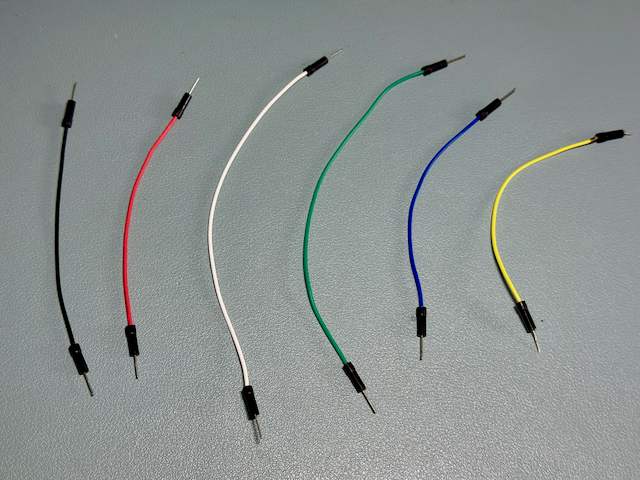
Jumper wires in different colours and lengths
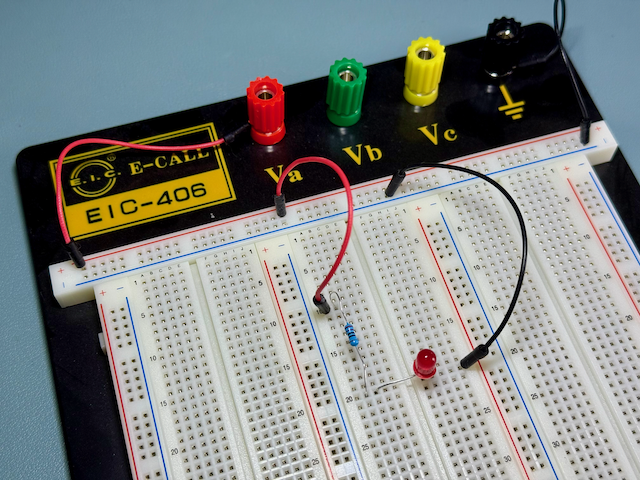
Jumper wires on a breadboard
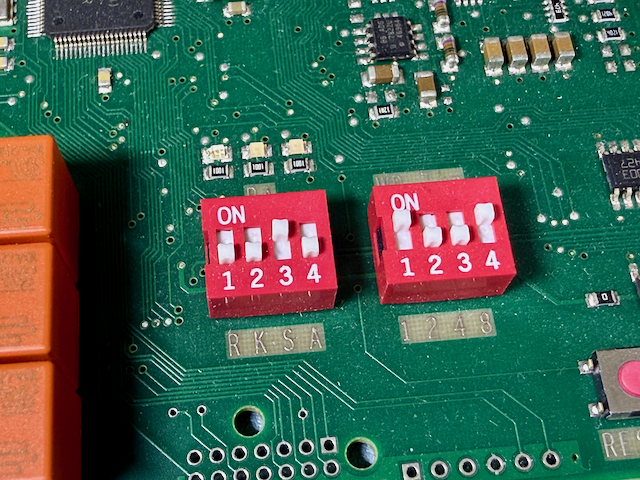
Switchable jumper wires
DIP switches for configuring the control board
2 What can it do?
Jumper wires establish quickly detachable electrical connections between two contacts. They are used above all in experiments, prototypes and training in conjunction with a breadboard to build electric circuits without soldering.
3 How does it work?
The metallic contacts at the ends of the jumper wire engage in matching jack or pin contacts. The contact force ensures a low contact resistance. Electrically, a jumper wire is nothing other than a short conductor.
4 What does it look like inside?
Beneath the plastic insulation there is a thin copper conductor (usually stranded wire), which is attached to the contact pins or sleeves so that it is electrically conductive. The end pieces are often crimped (squeezed) or soldered.
5 What role does it play in teaching?
Jumper wires are standard in the laboratory and in experiments on the breadboard. They allow quick changes to electric circuits and promote the understanding of current paths, parallel connections and short circuits. The colour coding makes the set-up clearer.
6 What role does it play in practice?
In practice, jumper wires are used above all in development and in prototype construction. In series-produced devices they are uncommon; fixed traces or connectors are used there. An exception are small jumpers or jumper switches on circuit boards, which bridge contacts in a targeted way in order to set configurations (e.g. operating voltage, address selection).
Symbols
For a breadboard and the jumper wires, there are no standardized letter designations in classical schematic symbols. They are represented as a detachable electrical connection.
Calculations
No calculations are carried out for the jumper wire in the fundamentals of electrical engineering.