
Prof. Dr. Thorsten Jungmann (last updated 2025-09-03)
A conductor (German: Leiter) serves to conduct the electric current. It is characterized by a very low resistivity or, equivalently, a very high conductivity.
1 What do they look like?
A conductor consists of an electrically conductive material such as copper or aluminium and can be made solid as a wire or from many fine individual wires as a stranded wire.
An electric line (German: Leitung) consists of one or more insulated conductors that are run together in a sheath. Electric lines can be designed to be flexible or for fixed installation.
A cable (German: Kabel) is similar to an electric line, but is mechanically particularly robust and often provided with additional protection against moisture, UV radiation or mechanical stress.
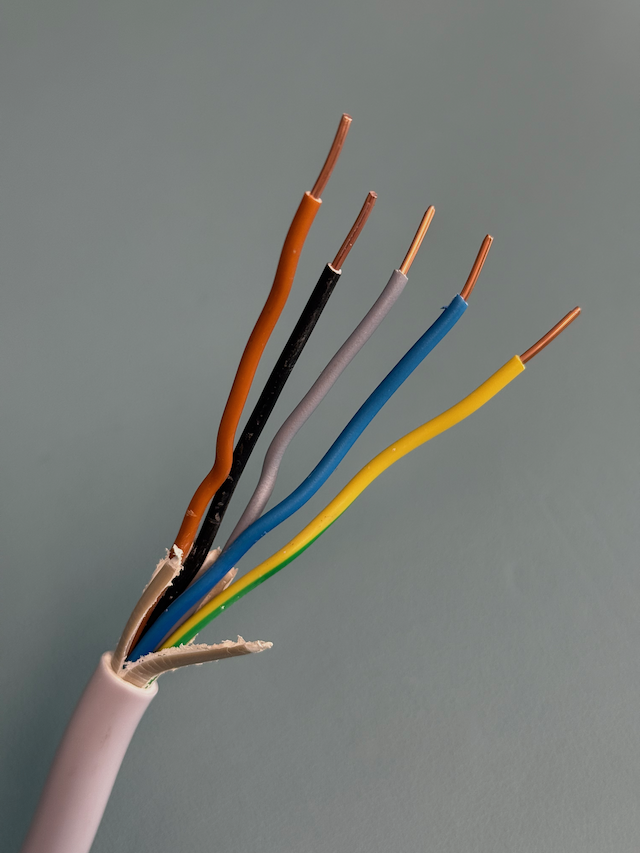
Multi-core, rigid electric line
here: five-core, rigid sheathed cable (NYM-J 5×1.5 mm², also: ‘installation cable’)
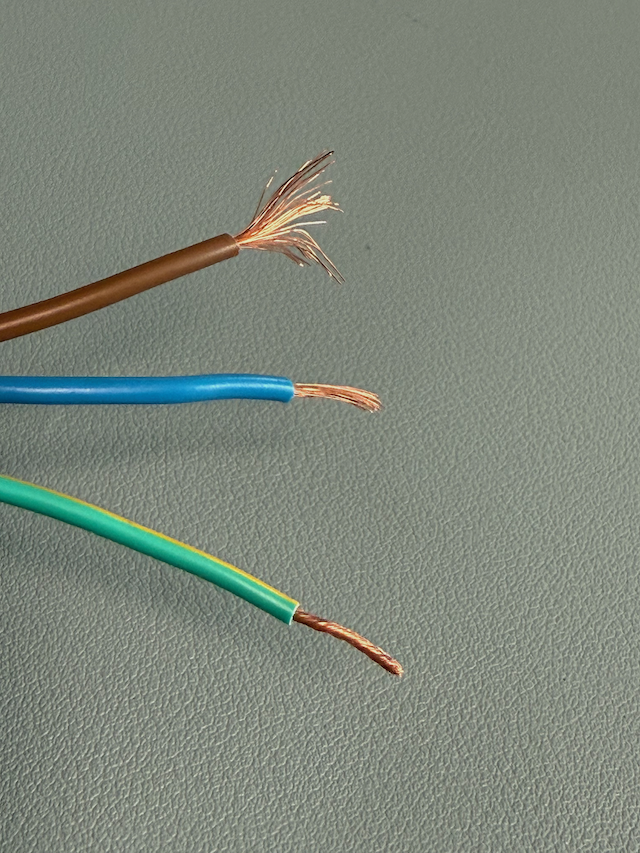
Multi-core, flexible electric line
here: 3-core PVC sheathed cable H05VV-F 3G1.5
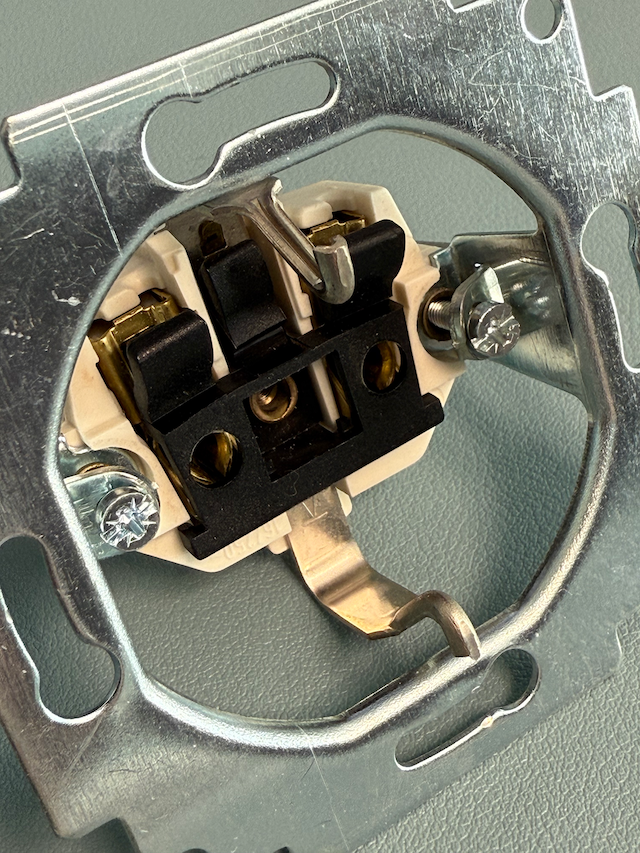
Conductors (contacts of a protective-contact socket-outlet)
2 What can they do?
Conductor, electric line and cable serve to transmit electrical energy or signals, but differ in their field of application:
- Conductor: conducts current in general, e.g. within devices (as a trace on a circuit board) or in components.
- Electric line: connects devices or assemblies to one another, both in portable and in permanently installed applications.
- Cable: for fixed installation, often outdoors, in the ground, in damp rooms or in harsh industrial environments.
3 How do they work?
The conductor transports electrical energy through the movement of free electrons in the metal.
In an electric line, the conductor is protected by insulation against electrical contact with other conductors or the surroundings and is given mechanical support.
In addition to insulation and sheath, the cable offers further protective layers or armouring that make it suitable for special environmental conditions – also for shielding against electromagnetic and electrostatic influences.
4 What do they look like inside?
- Conductor: only the metallic, electrically conductive material. There are two basic forms:
- Rigid (wire): a solid conductor, mechanically stable, but bendable only to a limited extent, typically for fixed installations.
- Flexible (stranded wire): many thin individual wires stranded into one conductor, easily bendable and suitable for movable connections.
- Electric line: consists of one or more cores (single-core or multi-core), each of which is insulated and which are enclosed together by a sheath.
- Cable: one or more cores with insulation, an additional sheath and, where applicable, a further mechanical or chemical protective layer.
5 What role do they play in teaching?
On the one hand, it is important to be able to distinguish conductors from insulators and semiconductors. In addition, you should know the relationship between conductor material, cross-section, length and electrical resistance or conductance, and you must be able to calculate the corresponding quantities. Furthermore, knowledge of the various designs of conductors, electric lines and cables is necessary in order to assess their suitability for particular applications and to use the terms correctly.
6 What role do they play in practice?
In practice, selecting the right electric line or the right cable is decisive for the safety, reliability and economic efficiency of an electrical installation. Cross-section, material, type of insulation, mechanical strength and environmental conditions must be taken into account.
- Copper is used universally (high conductivity, good solderability, mechanical stability).
- Aluminium is used above all in power engineering and overhead power lines (lower weight, lower price).
- Silver is the best electrical conductor, but expensive – therefore only in special applications (contact materials, high-frequency engineering).
Symbols
- Conductors are drawn as a line in schematics and sketches. Letter code: W
- Permanent electrical connections (soldered, crimped) are marked by a solid dot at the connection point.
- Detachable electrical connections (screwed, clamped) are marked by a hollow dot at the connection point. Letter code: X
- The crossing of two conductors without electrical connection can be shown as a small arc in one of the two lines for clarity.
- Mechanical connections, e.g. in a relay between electromagnet and switching contact, are symbolized by a dashed line.
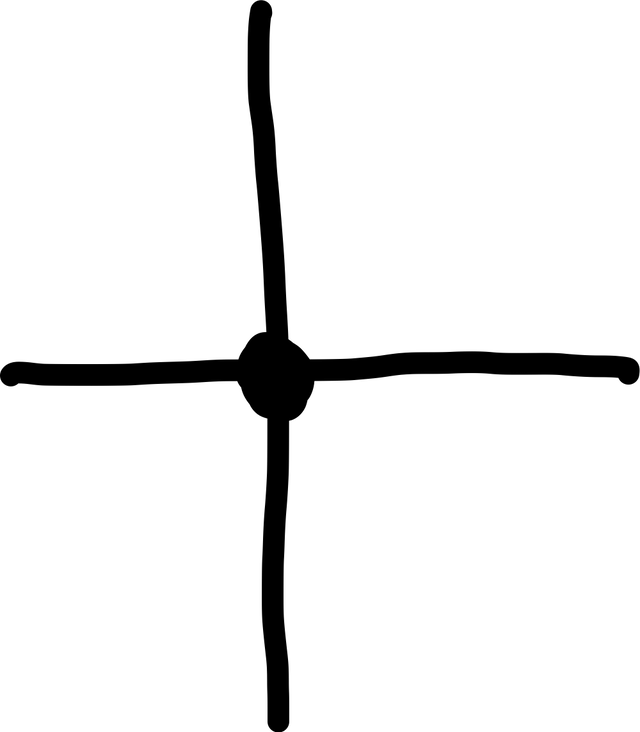
Conductors with permanent electrically conductive connection
e.g. soldered or crimped
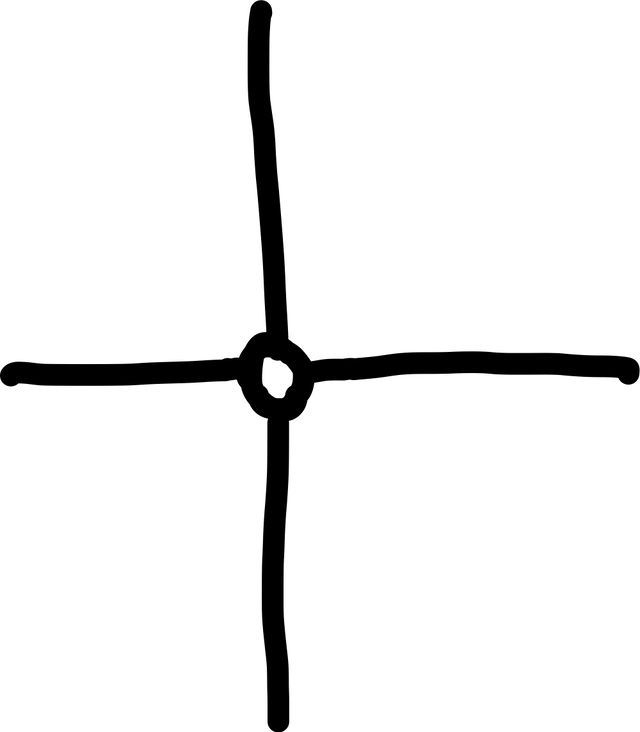
Conductors with detachable electrically conductive connection
e.g. screw terminal or spring terminal
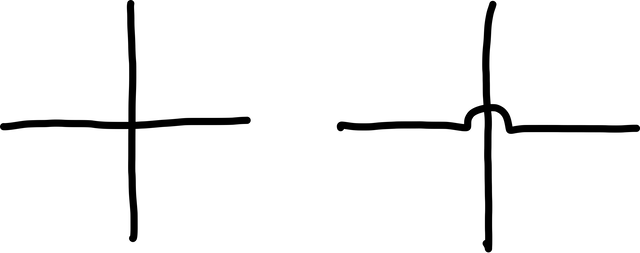
Conductors without electrically conductive connection
Calculations
Material properties (German: Materialkennwerte):
| Resistivity in | Conductivity in | Temperature coefficient of resistance in | |
|---|---|---|---|
| Silver | |||
| Copper | |||
| Gold | |||
| Aluminium | |||
| The values are rounded and apply at room temperature () and atmospheric pressure (). |