Prof. Dr. Thorsten Jungmann (last updated 2025-09-02)
In electrical engineering, the inductor (German: Spule) is also referred to as an inductance. However, this name for the component carries the risk of being confused with inductance as a technical property of the component and as a physical phenomenon. In this script, I therefore speak of the inductor when I mean the component, and of inductance when I mean the phenomenon.
1 What does it look like?
An inductor consists of a wound wire, which is usually laid in several turns around a former or a core. It can be air-cored or have a core. Small inductors look inconspicuous, like wire windings or electronic components on printed circuit boards; large inductors in mechanical engineering and power engineering are massive windings made of copper wire or copper strip.
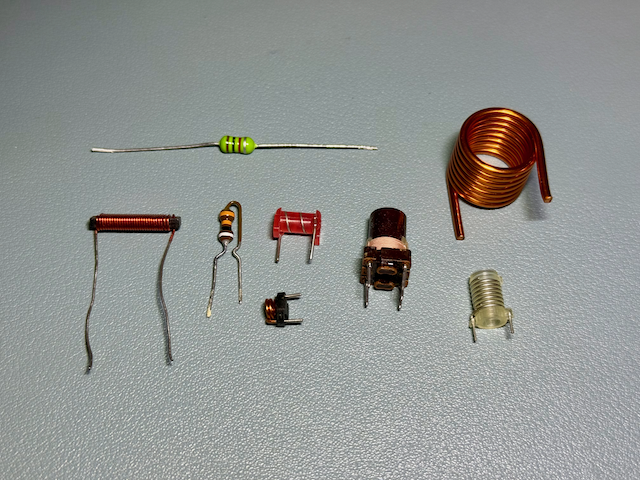
Inductors and chokes
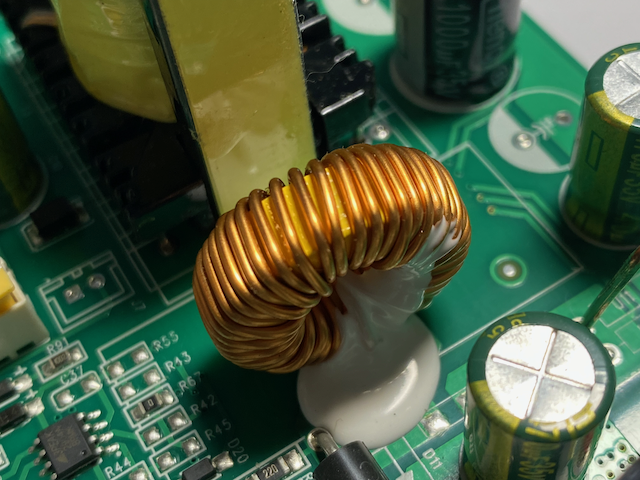
Toroidal inductor
It sits on the secondary side, after the transformer and before the output electrolytic capacitors of the power supply, and forms an LC low-pass filter with them. The inductor stores energy in each switching period and turns the pulsed rectifier current into an almost continuous output current. It damps current peaks and improves the regulation.
2 What can it do?
The inductor stores energy in a magnetic field when current flows through it. It can influence electric currents by inducing voltages, generating magnetic fields or delaying changes in current.
Examples:
- In electric motors, coils generate magnetic fields that drive rotary motion.
- In generators, it is the coils in which voltages are induced by motion in the magnetic field.
- In the transformer, coils serve as the primary and secondary winding for transferring energy by electromagnetic induction.
- In relays and contactors, the coil generates a magnetic field that closes or opens a mechanical contact.
- As a component, the inductor is part of filters (low-pass filter, high-pass filter, band-pass filter) or, used as a choke, absorbs current peaks.
3 How does it work?
The function of an inductor is based on the laws of electromagnetism:
- When current flows through the wound conductor, a magnetic field is created.
- If the current is changed, the magnetic field changes as well, which induces a voltage according to the law of induction.
- The magnitude of the induced voltage depends on the number of turns, the change in current and the core material.
- The energy that flows into building up the magnetic field is stored in the inductor. After the current is switched off, it cannot simply ‘fizzle out’, but then flows back into the electric circuit.
4 What does it look like inside?
Inside an inductor is the wound conductor. Often a magnetically active core (e.g. iron, ferrite) is fitted, which increases the magnetic flux density and the inductance. The winding can consist of enamel-insulated copper wire or of solid copper strip. Depending on the design, there are air-core inductors, iron-core inductors or special windings for high currents and voltages. For tuning resonant circuits, the inductance of special inductors can be adjusted by means of a screw.
5 What role does it play in teaching?
The inductor is a central component for understanding electromagnetic relationships. It illustrates the relationship between current, magnetic field, electromagnetic induction and stored energy. Magnet coils are also referred to as solenoids. In teaching, it is treated as the basis for understanding electric motors, generators, transformers, relays and contactors.
6 What role does it play in practice?
Inductors are part of virtually every electrical device and every installation. They are found in electrical machines (electric motors, generators), in power engineering (transformers), in switching and control technology (relays, contactors) and in filters, chokes and storage chokes (e.g. in the power supplies of sensitive electronic devices). They are an indispensable component for converting, storing and controlling electrical energy.
Symbols
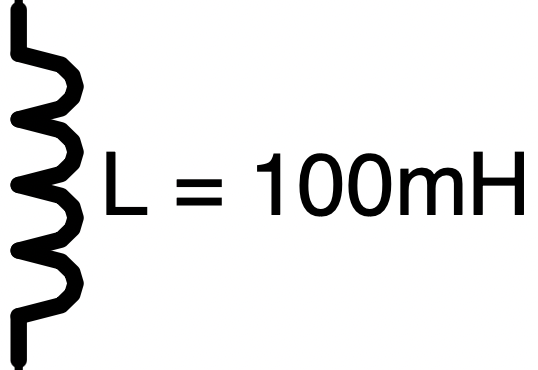
- Letter code in schematics: L (strictly speaking not standard-compliant, but very common)