
Prof. Dr. Thorsten Jungmann (last updated 2025-09-01)
1 What does it look like?
An electromagnet (German: Elektromagnet) consists of a coil that is usually wound around an iron core. From the outside, often only the housing is visible, from which the terminals for the electrical supply are led out. Depending on the size, its appearance ranges from small components in relays to large magnets on lifting cranes or in radiology.

Lifting magnet
Source: LEEROY Agency on Pixabay
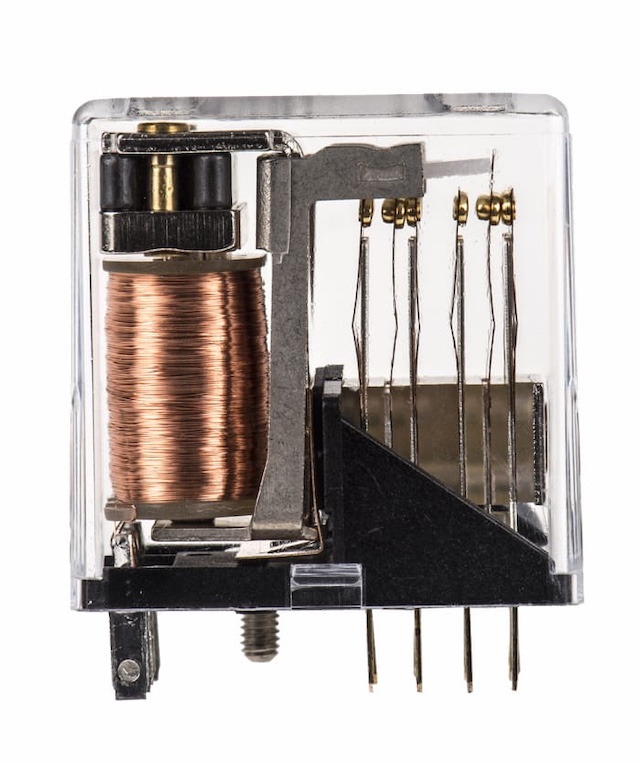
Electromagnet in a relay
Signal relay, 24V DC coil (1.44 W), 2 change-over contacts, max. switching current 3A, max. switching power 70 W/50 VA; source: RS components
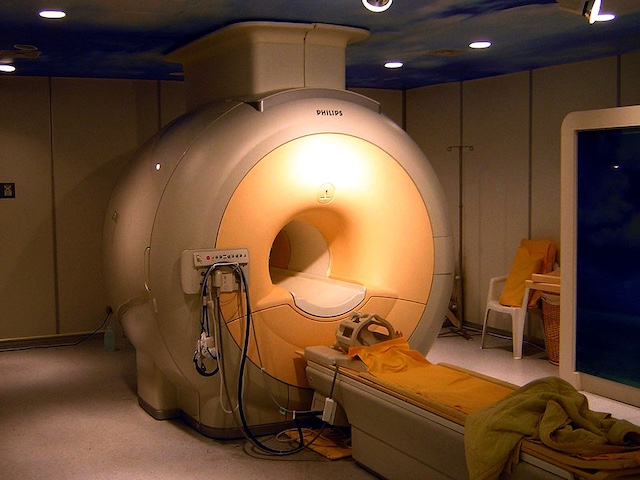
Magnetic resonance imaging (MRI) scanner
Source: KasugaHuang, CC BY-SA 3.0 http://creativecommons.org/licenses/by-sa/3.0/, via Wikimedia Commons

2 What can it do?
When a voltage is applied, the electromagnet generates a magnetic field through the current flow in the coil – direct current generates a static magnetic field, alternating current a magnetic alternating field. This magnetic field can exert forces on ferromagnetic materials and thus produce movements or holding forces. Examples:
- in a relay or contactor, an armature is moved, which actuates switching contacts,
- on a lifting crane, scrap or steel is attracted and held by the magnetic field,
- in electromagnetic clutches, drive shafts are connected by friction locking,
- in the electric motor, electromagnets in the stator or rotor form the necessary magnetic field, which interacts with the respective other field sources (electromagnet or permanent magnet) and produces a torque,
- in the generator, electromagnets in the rotor or stator generate a magnetic field whose change due to motion induces a voltage in the wire loops of the other machine part,
- in a magnetic resonance imaging (MRI) scanner, superconducting electromagnets generate extremely strong, homogeneous magnetic fields (typically 1.5 to 7 tesla), which excite the nuclear magnetic resonance of hydrogen nuclei in the human body and thus make imaging possible.
3 How does it work?
The function of the electromagnet is based on the inductor inside. When current flows through the coil, a magnetic field is created. The iron core multiplies the magnetic flux density, because the magnetic flux is concentrated better in iron than in air. When the current is switched off, the magnetic field disappears and the magnetic effect ceases immediately. The energy stored in the magnetic field discharges into the connected electric circuit when it is switched off. This usually requires a protective device, e.g. in the form of a freewheeling diode with a sufficient rating, to protect sensitive components against the relatively high flyback voltage.
4 What does it look like inside?
Inside is the wire coil, usually wound from enamel-insulated copper wire. It is arranged around an iron core or an iron yoke, which guides the magnetic flux. Depending on the application, spring mechanisms, movable armatures or large magnet plates are integrated.
5 What role does it play in teaching?
The electromagnet clearly shows the relationship between electric current and magnetic field. It illustrates how a coil in combination with an iron core can produce forces. In teaching, it provides an important link to components such as relays, contactors, electric motors and generators.
6 What role does it play in practice?
Electromagnets can be used in many ways. In relays and contactors, they actuate switching contacts. On lifting cranes, they move steel parts weighing tonnes; in electromagnetic clutches and brakes, they ensure controlled power transmission. In electric motors and generators, they are central components for generating or converting kinetic and electrical energy. They are therefore indispensable both in precision engineering and in heavy industry.
To fulfil safety-relevant functions, e.g. in safety brakes of lifts, an electromagnet can be integrated in a housing with a permanent magnet, e.g. a neodymium magnet. The holding force then exists in the de-energized state, and in the switched-on state the electromagnet ‘neutralizes’ the magnetic effect of the permanent magnet, so that it loses its holding force for the moment.
Symbols
Letter codes in schematics:
- Lifting magnet and clutches: M
- Relay or contactor: K