
Prof. Dr. Thorsten Jungmann (last updated 2025-09-03)
1 What does it look like?
A contactor (German: Schütz) is an electromechanical switching device in a robust housing, often intended for installation on a mounting rail. From the outside, you can see terminals for the coil and for the load contacts. Contactors are considerably larger and more powerful than relays and are usually designed with screw terminals or spring terminals for connecting electric lines.
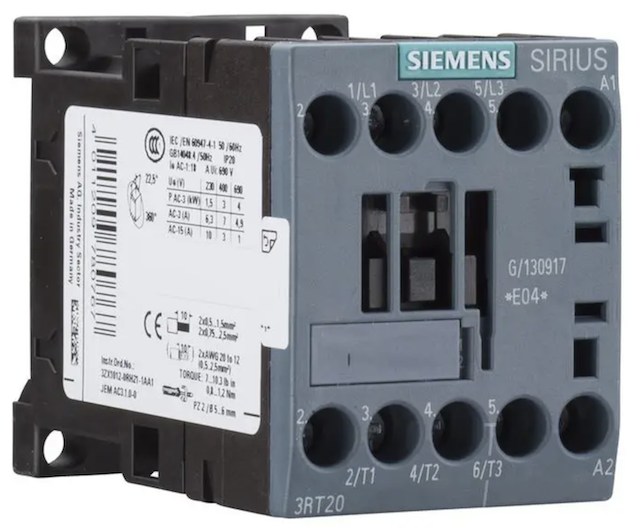
Power contactor
Siemens Sirius 3RT2015-1AP01, size S00, 3 kW/400 V, auxiliary contact: 1 x normally open contact, control voltage: 230 V AC 50/60 Hz, screw connection, installation on mounting rail
2 What can it do?
A contactor switches large electrical loads on and off safely. It allows high currents and voltages to be switched with a comparatively small control current. Contactors therefore serve as central components in power and drive engineering.
3 How does it work?
Like the relay, a contactor uses a coil that generates a magnetic field when a voltage is applied. This magnetic field attracts a movable armature, which actuates the switching contacts.
The difference from the relay lies in the dimensioning: contactors are designed for high currents, have larger contact surfaces and are built to be mechanically robust for many switching cycles. They usually have auxiliary contacts for control and feedback circuits.
4 What does it look like inside?
Inside are the coil with its iron core, the movable armature, sturdy main contacts for the load and smaller auxiliary contacts for control purposes. A strong return spring ensures that the contacts open when the coil is not energized. The contacts are often protected by arc chutes so that no damage occurs when high currents are switched.
5 What role does it play in teaching?
Contactors illustrate the practical difference between the control circuit and the load circuit. In teaching, they are used to explain the structure of contactor circuits such as the latching circuit, star-delta starting or the reversing circuit. Students use them to learn the principle of automation and the importance of galvanically isolated control of large loads.
6 What role does it play in practice?
Contactors are standard components in drive and power engineering. They are used in machines, control cabinets and building services to switch electric motors, heaters or lighting systems safely. Thanks to their robustness, high switching power and the possibility of integrating auxiliary contacts, they are indispensable in industrial automation.
Symbols
Letter codes in schematics:
- Auxiliary contactor: K
- Power contactor: Q
Calculations
as for the relay