
Prof. Dr. Thorsten Jungmann (last updated 2025-09-03)
PLC = programmable logic controller
(German: SPS = speicherprogrammierbare Steuerung)
1 What does it look like?
A PLC is usually housed in a rectangular enclosure that is mounted on a mounting rail in the control cabinet. Depending on its design, it consists of one compact unit or of modular assemblies that are lined up side by side. Typical visible elements are slots for I/O modules, terminals, status light emitting diodes for operation and signals, interfaces for communication and programming and, where applicable, operating elements such as buttons or small displays.
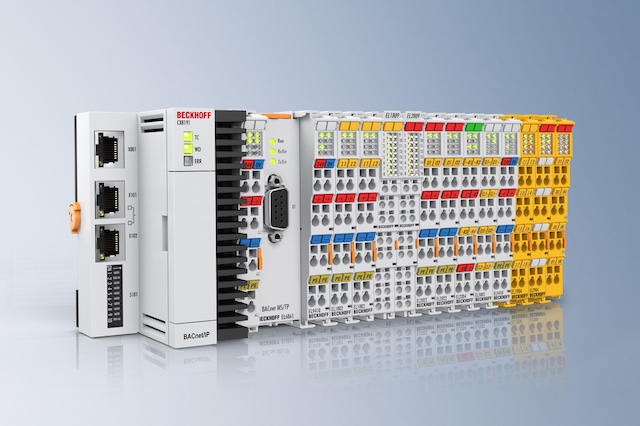
Beckhoff PLC
Modular Beckhoff PLC (EtherCAT I/O system). On the left an embedded PC/bus coupler with Ethernet ports (CX8191) ; next to it the power supply terminal for refreshing the E-bus (EL9410) and two DI terminals (EL1002), lined up on the right several EL terminals: e.g. EL1809 (digital inputs), EL2809 (digital outputs) and yellow TwinSAFE safety I/Os (e.g. EL1904/EL2904). Source: Beckhoff.com
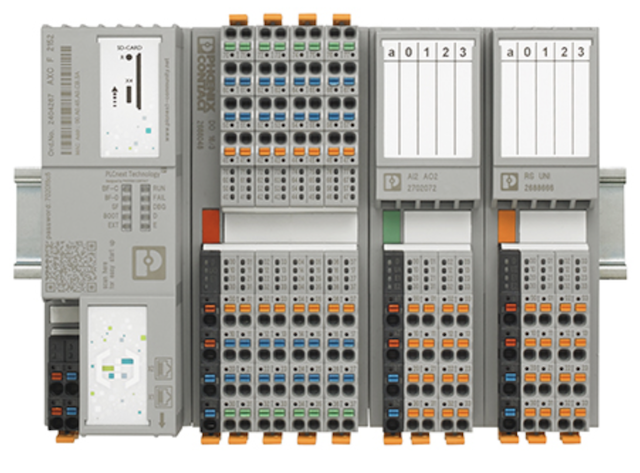
Phoenix Contact PLC
Phoenix Contact PLCnext Control, controller AXC F 2152 with Axioline F I/O modules (DI/DO, AI/AO). Source: Automation.com
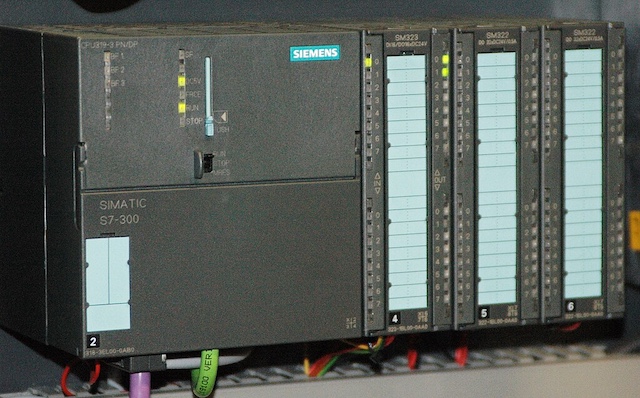
Siemens PLC
SIMATIC S7-300 with one DI/DO module (SM323) and two DO modules (SM322)
Source: Ulli1105, CC BY-SA 2.5 https://creativecommons.org/licenses/by-sa/2.5, via Wikimedia Commons

2 What can it do?
A PLC consists of several central electronic components that together make it possible to control and automate machines and plants in real time. It is based on computer technology and is programmable. The PLC offers a more flexible alternative to the connection-programmed (‘hard-wired’) control system. Thanks to its modular design, it can be extended with interfaces with digital and analogue inputs and outputs and with interfaces to fieldbus systems such as Industrial Ethernet, Profibus or ASi bus.
3 How does it work?
The basic principle of a PLC follows the IPO principle:
- Input: acquiring process data via sensors.
- Processing: program execution in the CPU.
- Output: driving actuators to influence the process[7].
This structure makes the PLC a universal and flexible control system for industrial automation.
4 What does it look like inside?
The most important parts of PLCs are:
- Central processing unit (CPU):
- The ‘brain’ of the PLC, which executes the control program and takes care of all logical and arithmetic operations.
- Memory:
- This is where the user program (control program) and operating data are stored. Typical memory types are RAM (random access memory), ROM (read-only memory) and EEPROM (electrically erasable programmable read-only memory).
- Input and output modules (I/O):
- These interfaces provide the connection to the real world. Input modules acquire signals from sensors (e.g. push-buttons, limit switches), output modules control actuators (e.g. electric motors, valves).
- Bus system: Internal system for data transmission between the modules (system bus, K-bus, backplane).
- Power supply:
- The power supply provides all assemblies of the PLC with the necessary direct voltage, supplemented where applicable by additional supply modules
- Communication interfaces:
- They serve to connect the PLC to other systems, e.g. via Ethernet, Profibus, ASi bus or Modbus. They make it possible to network it with operator panels (HMIs, human machine interface), SCADA systems (supervisory control and data acquisition) or other PLCs.
- Operating and programming interface: Makes it possible to load and change the user program, usually via a PC or a special programming device.
- Special modules: For special tasks such as analogue signal processing, counters, timers, controllers or positioners.
5 What role does it play in teaching?
PLCs are a central topic in the training of mechatronics technicians and electrical engineering students. They illustrate the connection between electrical engineering, computer science and automation engineering. PLCs allow fundamental concepts such as cyclic program execution, logic operations, timers and counters to be taught in a vivid way. In laboratories, you work with training PLCs or simulations in order to practise hands-on programming and troubleshooting.
6 What role does it play in practice?
PLCs form the backbone of industrial automation. They control machines, production lines, robots, conveyor systems, process plants and building automation systems. Thanks to their modularity and programmability, they can be adapted flexibly and can easily be reprogrammed when the processes change. Through the connection to a network, they also enable remote monitoring and remote diagnostics.
Important fields of application are:
- Mechanical engineering: Control of machine tools, conveyor, packaging and assembly systems.
- Process engineering: Closed-loop control of temperature, pressure and flow in the chemical or food industry.
- Building and utilities engineering: Control of heating, ventilation and air-conditioning systems.
- Infrastructure: Traffic control, waterworks, energy distribution.
Well-known PLC systems are:
- TwinCAT from Beckhoff
- PLCnext from Phoenix Contact
- SIMATIC S7 from Siemens
- Allen-Bradley ControlLogix from Rockwell Automation
- Modicon PLC from Schneider Electric
- IndraControl from Bosch Rexroth
Symbols
- Letter code in schematics: K
Calculations
No calculations are carried out for the PLC in the fundamentals of electrical engineering.