
Prof. Dr. Thorsten Jungmann (last updated 2025-09-03)
1 What does it look like?
A control board (German: Steuerplatine) is a printed circuit board with numerous electronic components. From the outside, pin headers, terminals or jacks for sensors, actuators and the voltage supply are visible. Depending on the application, the board is populated with transformers, capacitors, resistors, semiconductors, relays, microprocessors and further components. In the example of the heat pump you can recognize, among other things, orange relays, a black power supply module with transformer, electrolytic capacitors and red DIP switches for configurations.
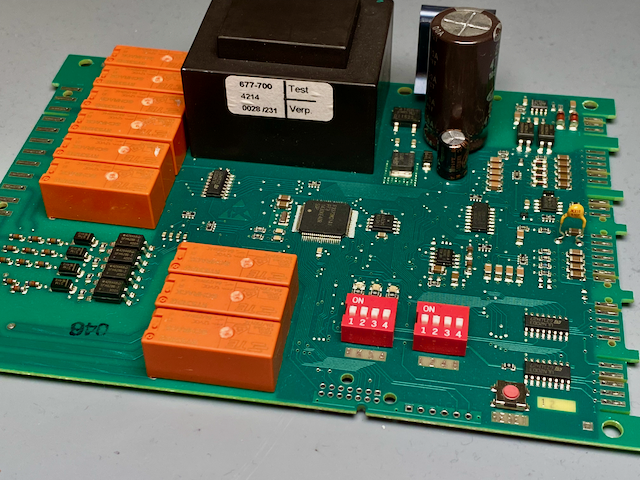
Control board of a heat pump
You can recognize: transformer (black block), electrolytic capacitors (black cylinders), behind them a voltage regulator with heat sink, relays (orange cuboids), integrated circuits (ICs), DIP switches (red with white levers), terminals (power side on the left, control side on the right), circuit board with traces and further components such as resistors, capacitors and diodes.
2 What can it do?
The control board is the ‘brain’ of the device or the installation. It coordinates all connected sensors and actuators and takes over the closed-loop and open-loop control of the system.
- It supplies the electronics via its own power supply (transformer, rectifier, voltage stabilization).
- It processes sensor signals (e.g. temperature sensors, pressure sensors).
- It controls loads via relays or electronic outputs.
- It enables communication with operator control units or external interfaces.
3 How does it work?
The control board works according to the IPO principle:
- Input: analogue and digital sensor values are acquired via A/D converters or digital inputs.
- Processing: a microprocessor or microcontroller evaluates the data on the basis of a program and makes decisions.
- Output: control commands are passed on via D/A converters, relays or transistor outputs to pumps, valves, heating rods or other actuators.
The power supply provides stable operating voltages (e.g. 5 V for logic, 12 V or 24 V for relays and sensors).
4 What does it look like inside?
Inside (or rather on the circuit board) you find the various functional groups:
- Power connections and power supply: transformer, rectifier, voltage regulator.
- Signal processing (German: Signalverarbeitung): A/D and D/A converters, operational amplifiers, filters.
- Control logic: microcontroller or processor with memory.
- Switching elements: relays or semiconductor switches for actuators.
- Communication: interfaces (UART, RS485, CAN, Ethernet) and configuration components such as jumpers or DIP switches.
5 What role does it play in teaching?
The control board is not a generic component, but a complex assembly. It is particularly suitable for demonstrating the interaction of many basic components in a practical application. Using the example of the heat pump, students can trace the signal paths from the sensor via the electronics to the actuator and get to know the structure of real industrial electronics.
6 What role does it play in practice?
Control boards can be found in all modern devices and machines – from household appliances (washing machines, heat pumps, refrigerators) through vehicles to industrial control systems. They integrate power supplies, signal conditioning, control logic and power switches on a single circuit board and thereby enable compact, reliable and low-cost control systems.
Symbols
- Letter code in schematics: K
- In schematics, the control board is usually represented as a rectangular function block with its inputs and outputs.
Calculations
No calculations are carried out for plug-in connections in the fundamentals of electrical engineering.