
Prof. Dr. Thorsten Jungmann (last updated 2025-09-03)
1 What does it look like?
The design of a sensor (German: Sensor) depends strongly on the type and the field of application:
- Push-button: usually a small plastic or metal housing with a mechanical actuating surface.
- Rotational frequency sensor: cylindrical housing with plug or cable, often with a mounting flange.
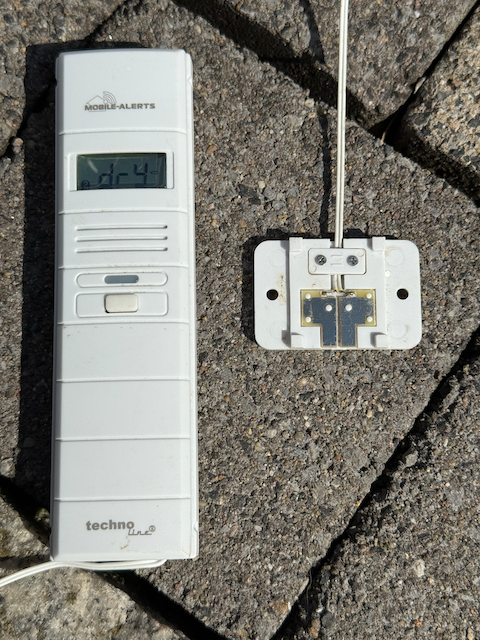
- Temperature sensor: metal sleeve or plastic housing, frequently with cable or connector.
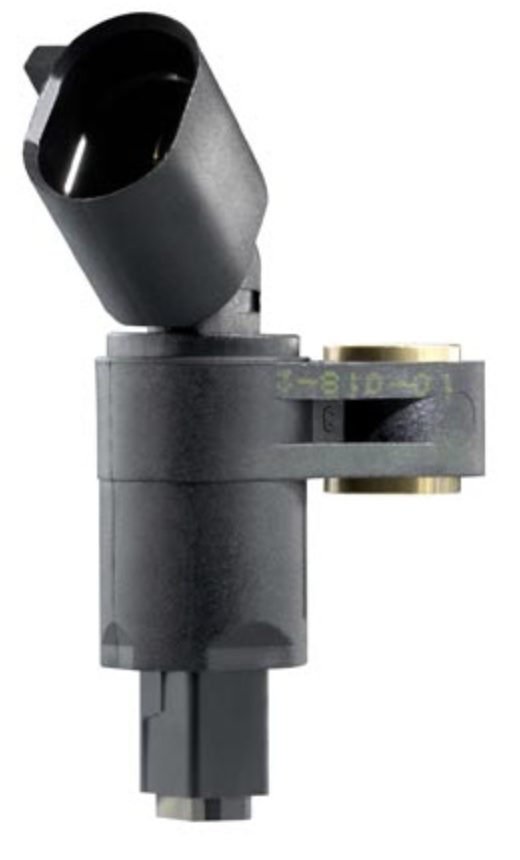
Wheel rotational frequency sensor
Bottom: Hall-effect sensor for magnetoresistive detection of the rotational frequency in conjunction with an encoder disc located on the axle or on the wheel, top: connecting plug as the interface to the vehicle electronics, right: mounting flange
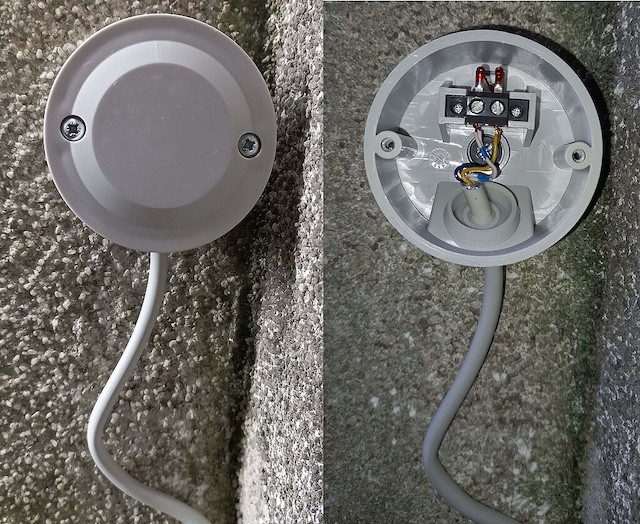
Temperature sensor
Electronic outdoor sensor (PTC temperature sensor) in a heating system
Source: Asurnipal, CC BY-SA 4.0 https://creativecommons.org/licenses/by-sa/4.0, via Wikimedia Commons

2 What can it do?
A sensor converts non-electrical quantities into electrical quantities (signals). It is therefore sometimes also called a signal transducer or, for short, a transducer.
Examples:
- Push-button: force (mechanical quantity) → change in resistance (from high resistance to almost )
- Rotational frequency sensor (e.g. on a case fan, e-bike electric motor, vehicle wheel): rotational frequency (mechanical quantity) → voltage
- Temperature sensor: temperature → voltage or resistance (depending on the design, e.g. thermocouple, NTC/PTC)
3 How does it work?
Sensors make use of different physical operating principles:
- Hall effect (rotational frequency sensors)
- Thermoelectric effect (thermocouples)
- Change in resistance with a change in temperature (PTC resistors)
- Mechanical spring force (push-buttons, micro push-buttons)
4 What does it look like inside?
So that a sensor can deliver an electrical output signal proportional to the measured quantity, it is in many cases supplied with an operating voltage.
Internally, sensor elements (e.g. Hall plate, thermocouple, resistive layer, spring) detect the measured quantity and convert it into a raw signal. This is often conditioned electronically directly in the sensor, so that a technically usable signal (voltage, current or digital signal) is available at the output.
5 What role does it play in teaching?
In the narrower sense, ‘sensor’ denotes only the actual measuring component (e.g. Hall plate, thermocouple, NTC/PTC).
In the broader sense, the term also covers the complete assembly with housing, connection and mounting technology as well as integrated signal conditioning.
In this script, ‘sensor’ is understood in the sense of the broader definition.
6 What role does it play in practice?
Sensors are indispensable for detecting physical quantities and making them usable for open-loop and closed-loop control. They are found in automation engineering, automotive engineering, medical engineering, home automation and consumer electronics – wherever real quantities have to be detected and converted into signals.
Symbols
- Letter code in schematics: B
Calculations
No calculations are carried out for sensors in the fundamentals of electrical engineering.