
Prof. Dr. Thorsten Jungmann (last updated 2025-09-03)
1 What does it look like?
A switch (German: Schalter) is an electromechanical component in a usually small housing made of plastic or metal. It has actuating elements such as buttons, rockers, levers or rollers. From the outside, you can see terminals for electric lines or connectors. Differences in design result from the type of construction and the field of application – from the simple light switch in the wall box to the rugged emergency switch in machine installations.
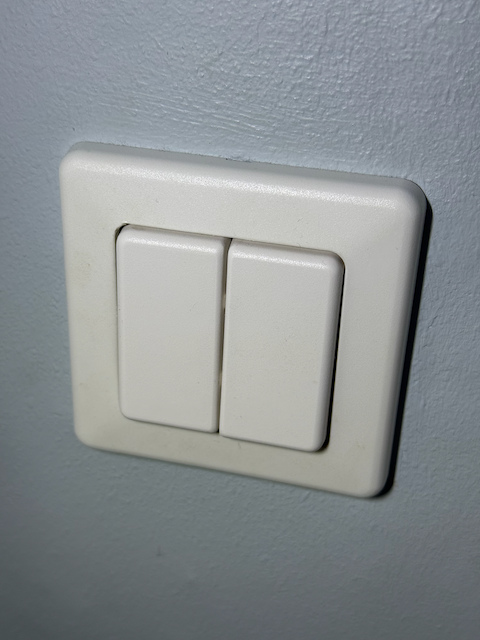
Two-circuit switch
Flush-mounted model of a two-circuit switch for building services, here: switching two lamps in one room independently of each other
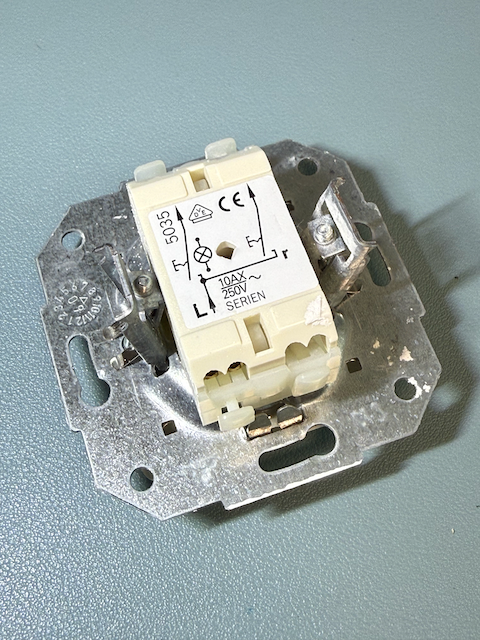
Terminals of the two-circuit switch
Connection of the line conductor (L, live core of the installation cable), which is switched through to the two outputs by manual operation, latching
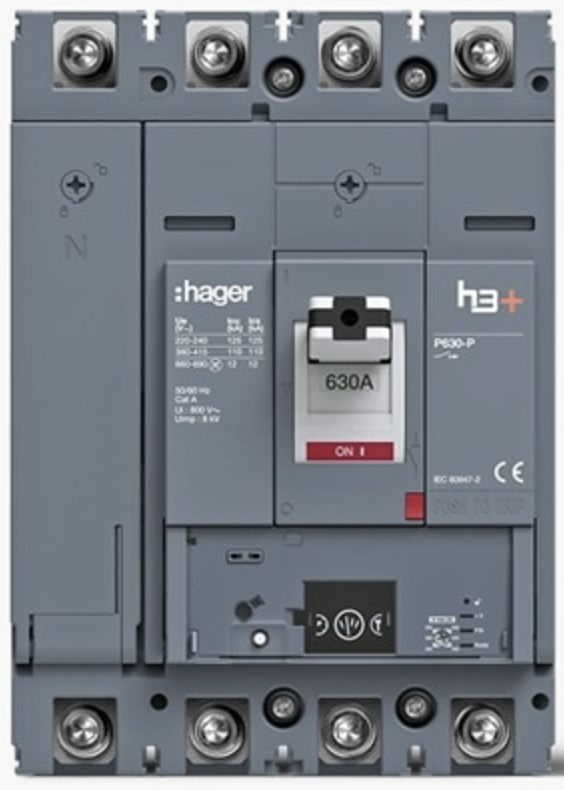
Power circuit breaker
Rated current 630 A, 4-pole version, breaking capacity 110 kA
Source: hager.com
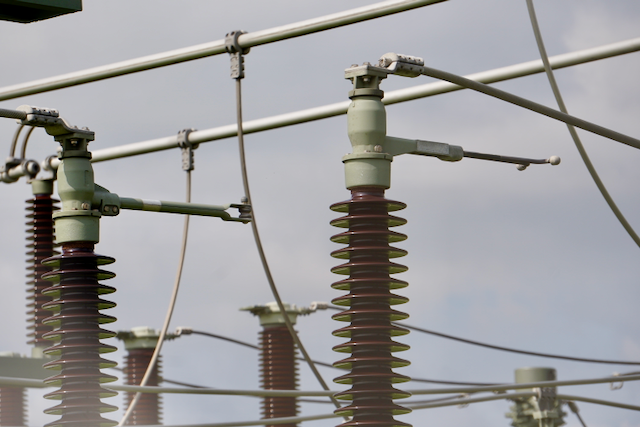
High-voltage disconnector (open)
Function: visible galvanic isolation of a part of an installation for maintenance/protection; it must not interrupt any load current or short-circuit current. First the power circuit breaker is switched off, then the disconnector is opened; for earthing, an earthing switch is then closed separately before work is carried out on the installation.
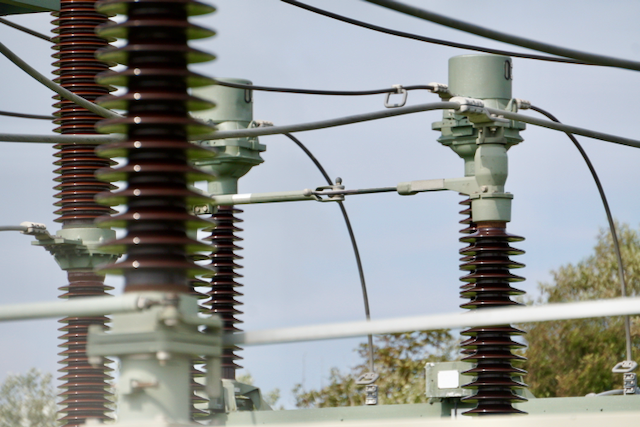
High-voltage disconnector (closed)
2 What can it do?
A switch opens or closes an electric circuit mechanically. In this way, a voltage can be applied or interrupted. Switches allow you to switch devices on and off, control machines or implement safety circuits. Electronic components such as transistors can also serve as switches, but they are not counted among the mechanical switches. Push-buttons and switches can be understood as sensors when they serve to convert mechanical states into electrical signals, e.g. limit switches in conveyor systems.
3 How does it work?
In the open state, the electrical resistance of the switch is very large (), and no current flows. In the closed state, the resistance is almost zero (), and the current can flow unhindered. The change between the states takes place by mechanical actuation or by a control signal.
A switch keeps its position until it is actuated again (latching, e.g. light switch).
A push-button (German: Taster), by contrast, returns to its initial position after it is released (non-latching, e.g. doorbell push-button).
A practical problem is contact bouncing: when switching, the contacts briefly strike each other several times as a result of the spring action before they are stably closed. In analogue electric circuits this is hardly noticeable, but in digital electric circuits it can lead to spurious pulses. Electronic or mechanical debouncing circuits provide a remedy.
4 What does it look like inside?
Inside there are movable metallic contacts that are opened or closed by an actuating element. Depending on the design, springs act for the return (push-button), mechanical detents (light switch) or locks (key switch). Electromagnetic drives (relays, contactors) or cam/roller mechanisms can also trigger the movement. In special types, e.g. circuit breakers or power circuit breakers, there are arc-quenching devices, e.g. an arc chute and/or a particularly strong spring, in order to achieve the rapid separation of the contacts and to prevent an arc from forming.
5 What role does it play in teaching?
Switches illustrate the basic control of electric circuits. They are a central example of the relationship between mechanical movement and electrical signal. In teaching, they also serve to introduce you to different contact types (normally open contact, normally closed contact, change-over contact) and types of actuation. In the laboratory, they serve to open or close electric circuits and to switch signals through as required.
6 What role does it play in practice?
Switches are indispensable in all areas of electrical engineering – from the lighting circuit in buildings and control push-buttons on electrical appliances to safety-relevant cut-off switches in industrial plants and entire switching substations in power engineering. The main variants:
- Switching action: normally open contact (NO), normally closed contact (NC), change-over contact.
- Types of actuation: manually operated (toggle switch, push-button), mechanical (roller, cam), electromagnetic (relays, contactors), pneumatic/hydraulic, key.
- Control actuators: automatic return (push-button), latching (light switch), with lock (emergency stop, ignition lock), delayed (staircase lighting, toaster).
The problem of contact bouncing (German: Prellen) plays an important role in digital electronics: with simple push-buttons or switches, spurious pulses can occur. For this reason, debouncing is often provided in practice in control systems and digital electric circuits.
Symbols
- Letter code in schematics: S
- Schematic symbols can be drawn with or without dots at the movable points.

Normally closed contact

Normally open contact

Change-over contact
Calculations
- Voltage drop across the open switch
- Current through the closed switch