
Prof. Dr. Thorsten Jungmann (last updated 2026-05-04)
Electrical resistance (German: elektrischer Widerstand) describes the property of a component or material to oppose the electric current, that is, to slow down the flow of electrons. It is one of the most important quantities in electrical engineering and largely determines the behaviour of electric circuits.
1 Quantity symbol and unit
The quantity symbol of electrical resistance is .
Its dimension (unit) is the ohm, named after Georg Simon Ohm, abbreviated with the Greek capital letter (‘omega’) as the unit symbol:
The ohm is a derived SI unit.
2 Practical and worked examples
2.1 Conductor resistance of a copper wire
The resistance and the conductance depend on the material, the length and the cross-sectional area :
where:
- the resistivity
- the conductivity
- the effective length of the conductor (add the outgoing and return conductors if applicable)
- the cross-section of the conductor
Typical resistivities:
- Copper
- Aluminium
- Silver
- Gold
The resistance of a copper wire with a cross-section and a length :
2.2 Series resistor for a light emitting diode
To limit the current through a light emitting diode, a series resistor is used, which sets the voltage drop across the light emitting diode to the forward voltage when it is connected to the operating voltage :
Example: , ,
2.3 Resistance at the operating point
The relationship between current and voltage at non-linear resistors, e.g. a diode or a light emitting diode, can be represented by characteristic curves, among other things. From the I/U characteristic curve, you can read off the unknown quantity in each case, provided the other one is known. This means that the resistance of the non-linear component at this operating point is also known.
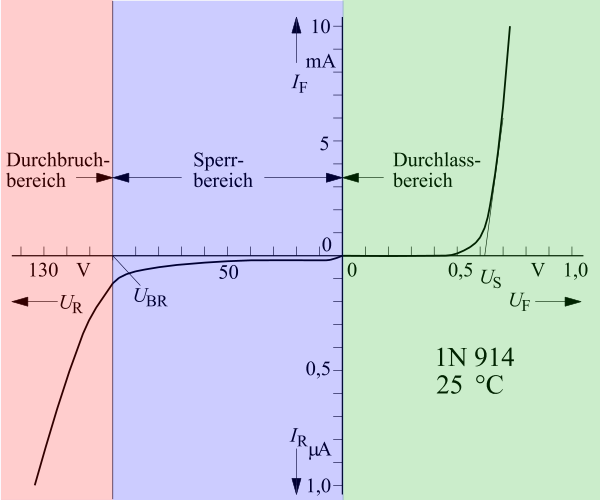
At the forward voltage , you can read off the current . This gives the resistance:
3 Typical orders of magnitude
- Conductor resistances: to (milliohms to ohms)
- Shunt resistors (shunts): to
- Series resistors for light emitting diodes: to (depending on colour and applied operating voltage)
- Resistors in electronics: to
- Insulation resistances: to (megohms to teraohms)
- Input resistance of a multimeter:
- Human body: to (depending on moisture)
4 Example phrasings
- ‘The copper wire has a resistance of .’
- ‘A series resistor of is required for the light emitting diode.’
- ‘The insulation resistance must be at least .’
- ‘At the operating point, the differential resistance is .’
- ‘An increase in temperature raises the resistance by 20 %.’
5 Related quantities
- The resistance is the reciprocal of the conductance:
- The electric power at the resistor:
- The resistance of a material depends on the temperature:
Temperature coefficient of resistance :
- Silver:
- Copper, gold:
- Aluminium:
6 Related components
- Conductor: conductor resistance determines losses and voltage drop
- Resistor: components for targeted current limiting and voltage division
- Switch: contact resistance affects losses
- Inductor: winding resistance causes ohmic losses
- Multimeter: measurement of resistances