
Prof. Dr. Thorsten Jungmann (last updated 2025-08-28)
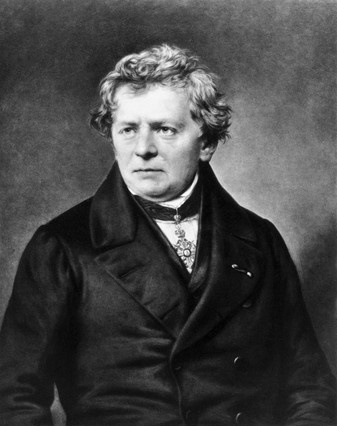
Georg Simon Ohm (1789–1854) was a German physicist and mathematician. Ohm was born in Erlangen and showed an early interest in mathematics and physics. At the age of only 16, he began his studies at the Friedrich-Alexander University Erlangen. In 1826, he published his fundamental work on the relationship between voltage and current. His name is inseparably linked with Ohm’s law, which is named after him – one of the most important foundations of electrical engineering. With this formula, Ohm created the basis for understanding electric circuits, as it describes the relationship between voltage, current and resistance exactly.
Ohm demonstrated experimentally that the electric current in a metallic conductor is proportional to the applied voltage and inversely proportional to the resistance of the conductor.
In 1881, the unit of electrical resistance, the ohm (), was officially named after him.
Ohm’s life’s work had a lasting influence on electrical engineering: without his discoveries, today’s electric circuits, electronic components and network analysis would be unthinkable, as they are based on an understanding of the interaction between voltage, current and resistance. To this day, Ohm’s law plays a central role in school, university studies and practice in all engineering and physics disciplines.
Reference and further reading:
https://en.wikipedia.org/wiki/Georg_Ohm
Image source: Wikipedia