
Prof. Dr. Thorsten Jungmann (last updated 2025-08-28)
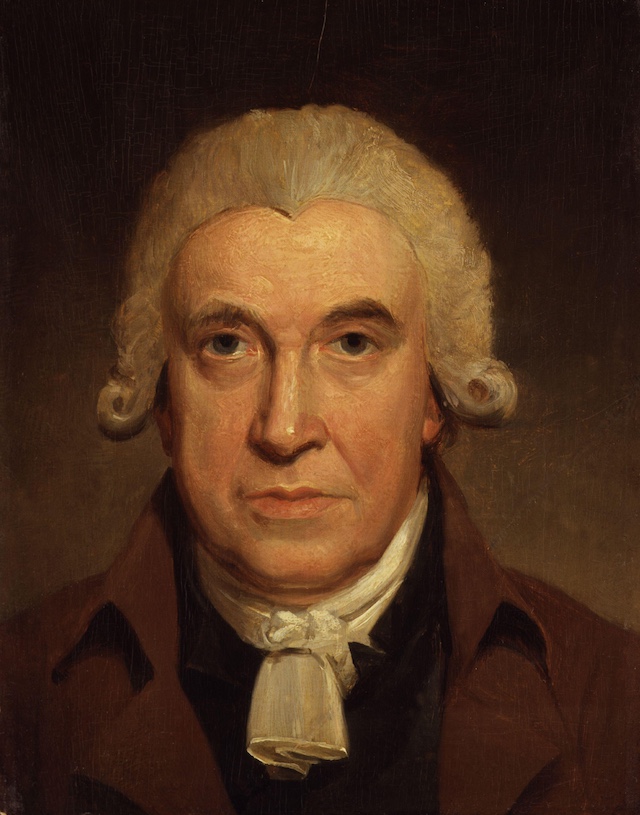
James Watt (1736–1819) was a Scottish engineer, inventor and one of the key figures of the Industrial Revolution. Contrary to widespread belief, he did not invent the steam engine, but improved it decisively: his most important innovation was the separate condenser, which made it possible to keep the main cylinder of the steam engine hot at all times and thus to increase the efficiency drastically. This improvement turned the steam engine into an economically viable prime mover for the first time and gave decisive impetus to the mechanization of factories, mines and transport.
Watt’s other inventions include the so-called Watt’s parallel motion, which made a more uniform movement possible, centrifugal governors for stabilizing the rotational frequency, and numerous measuring instruments. Together with his business partner Matthew Boulton, he founded a factory in Birmingham that produced advanced steam engines in series – a milestone for automation and mass production.
Watt also introduced the concept of ‘horsepower’ (hp) for rating the power of technical installations. In his honour, the international SI unit of power, the watt (W), was later named after him. His work advanced the development of thermodynamics and paved the way for other scientists such as Faraday, Ohm or Volta – and thus also for modern electrical engineering.
Reference and further reading:
https://en.wikipedia.org/wiki/James_Watt
Image source: Wikipedia