
Prof. Dr. Thorsten Jungmann (last updated 2025-08-28)
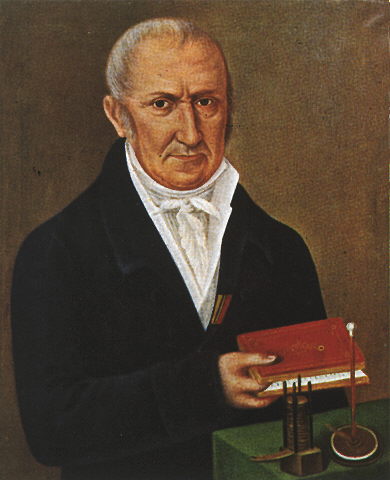
Alessandro Volta (1745–1827) was an eminent Italian physicist who went down in the history of electrical engineering as the inventor of the first working battery, the voltaic pile. With this invention he made it possible for the first time to generate and store electrical energy continuously, which enabled fundamental experiments and applications in electrodynamics, chemistry and later also in everyday life.
Volta grew up in Como as the son of a wealthy family and early on developed a strong interest in electricity, which he deepened through self-study. Even as a young scientist he invented devices such as the electrophorus for generating static electricity and a sensitive electroscope, and carried out numerous experiments with methane. His most important discovery resulted from his engagement with Luigi Galvani’s research on ‘animal electricity’. Volta recognized that in the famous frog-leg experiments it was not the animal tissue but the metals used that were the source of the voltage. This finally led to the development of his battery around 1800, which consisted of alternately stacked copper and zinc discs, separated by cloths soaked in brine.
Volta coined the terms electric voltage and electrochemical series. The international unit of electric voltage, the volt (V), was later named after him. For his groundbreaking discoveries Volta was showered with the highest scientific honours during his lifetime; Napoleon even made him a count and senator. Volta’s inventions and insights laid the foundation for numerous further developments in physics and technology and remain central to electrical engineering to this day.
Reference and further reading:
https://en.wikipedia.org/wiki/Alessandro_Volta
Image source: Wikipedia