
Prof. Dr. Thorsten Jungmann (last updated 2025-10-23)
A battery (German: Batterie) is a non-rechargeable electrochemical energy storage device (a primary cell or a combination of several primary cells). In contrast to the rechargeable battery (secondary cell), it cannot be returned to its initial state once it has been discharged.
1 What does it look like?
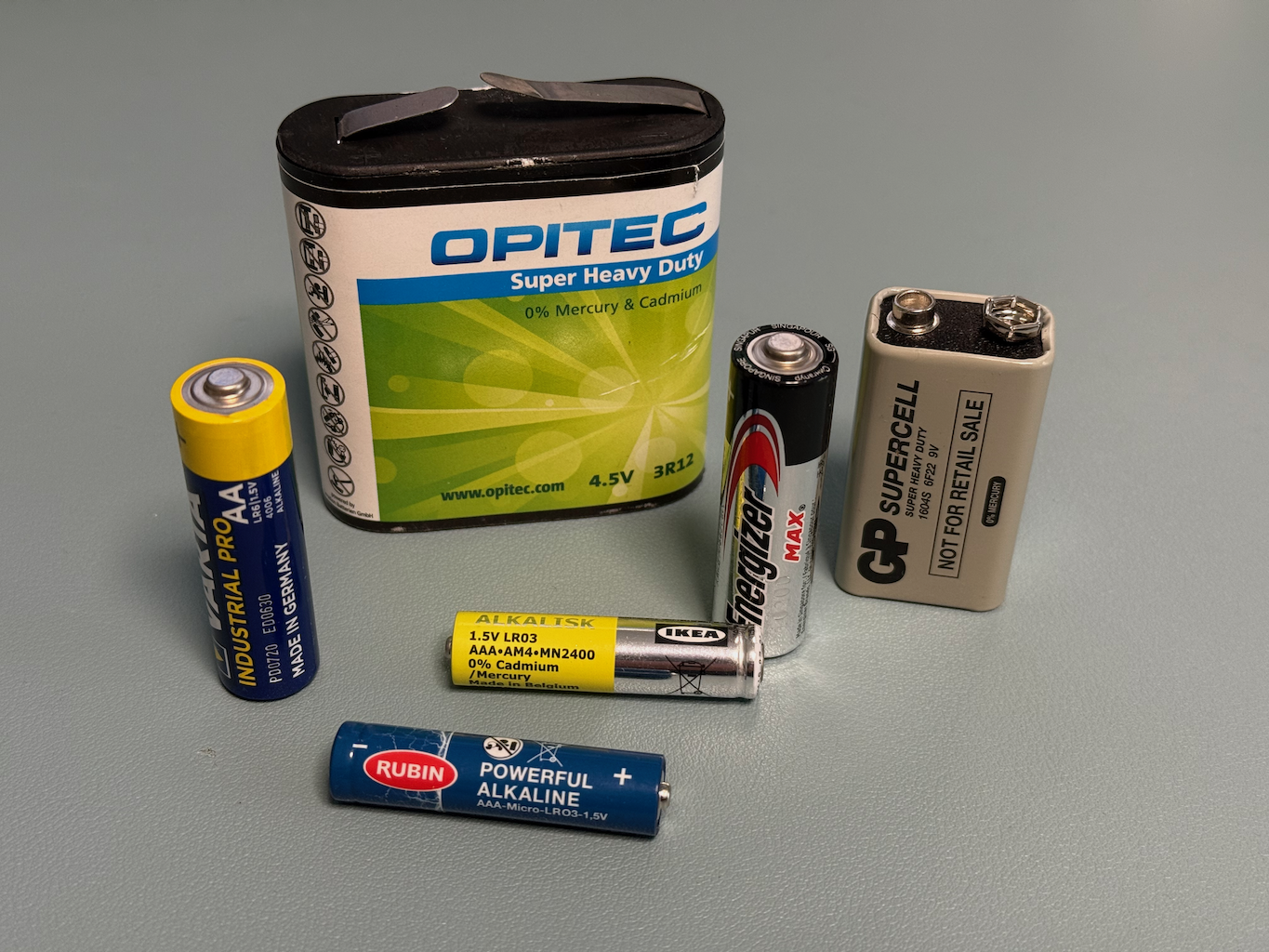
A cylindrical, rectangular or flat housing made of metal or plastic. Often with two clearly marked terminals (+/−) and information on voltage, capacity, chemistry type and manufacturer. Examples: AA, AAA, C, D, 9 V block, button cells.
2 What can it do?
Stores electrical energy chemically and delivers it over a defined period of time when needed. It is disposed of or recycled after discharge.
The ‘capacity’ (the technically correct term would be electric charge) of a battery is usually given in ampere-hours (Ah). One ampere-hour corresponds to 3 600 coulombs (C) of electric charge. To illustrate this: a typical alkaline battery with a ‘capacity’ of 2.5 Ah could theoretically supply a current of 1 ampere for 2.5 hours before it is exhausted.
3 How does it work?
During operation, an oxidation takes place inside the cell at the anode (–) (electrons are released), and a reduction takes place at the cathode (+) (electrons are taken up). In the connected electric circuit, the electrons flow from the negative terminal (–) to the positive terminal (+).
Well-known chemical systems are, for example, zinc-carbon, alkaline (zinc-manganese oxide) and lithium-manganese dioxide.
4 What does it look like inside?
A battery consists of one primary cell or of several primary cells connected in series. The cells consist of electrodes and electrolyte. Depending on the design, the electrodes are rods, foils or plates. Between the electrodes is the electrolyte, which enables the flow of ions. The housing holds the cells together and protects against mechanical impact and the leakage of electrolyte.
Batteries, too, have a small internal resistance, which leads to voltage drop and power loss – it increases with the discharge and the age of the battery.
COMMON TECHNOLOGIES
1. Alkaline-manganese batteries
- Components: Anode made of zinc powder and cathode made of manganese dioxide.
- Properties: Good energy density, long shelf life and a high load capability at medium to high currents.
- Areas of application: Remote controls, toys, torches and many other household devices. They are the standard for most AA and AAA batteries.
2. Zinc-carbon batteries (German: Zink-Kohle-Batterie)
- Components: Zinc can as the anode and a carbon rod surrounded by a manganese dioxide powder as the cathode.
- Properties: Inexpensive to manufacture, but considerably lower energy density and power output than alkaline-manganese batteries.
- Areas of application: Simple devices with low current consumption, such as clocks or simple torches.
3. Lithium primary cells
This family of batteries is characterized by a very high energy density and a long shelf life.
- Lithium-iron disulfide (Li-FeS2):
- Properties: High energy density and performance, good performance at low temperatures.
- Areas of application: Handheld GPS devices, camera flash units and other devices that require high currents for short periods.
- Lithium-manganese dioxide (Li-MnO2):
- Properties: High energy density and stable operation over a wide temperature range.
- Areas of application: Typical button cells for watches, pocket calculators or car keys.
- Lithium-thionyl chloride (Li-SOCl2):
- Properties: Exceptionally long shelf life and high energy density. They are optimized for low to medium currents.
- Areas of application: Industrial applications, such as wireless sensors, measuring instruments or emergency equipment.
4. Silver oxide batteries
- Components: Anode made of zinc, cathode made of silver oxide.
- Properties: High and very stable voltage level, good capacity and high safety.
- Areas of application: High-quality wristwatches and other precise small electronic devices.
5. Zinc-air batteries
- Components: Anode made of zinc and an air-permeable cathode that takes up oxygen from the ambient air.
- Properties: Very high energy density. They are often only activated by contact with the air.
- Areas of application: Hearing aids, as they combine a small design with high capacity.
5 What role does it play in teaching?
The battery serves as an example of a voltage source with a limited service life. In electrical engineering, it is often modelled as a real voltage source, i.e. an ideal voltage source with an additional internal resistance.
It is suitable for experiments and thought experiments with a simple voltage supply in which no charging cycles are required.
6 What role does it play in practice?
Batteries are widely used in devices with low to medium energy demand, e.g. remote controls, wall clocks, torches, medical devices. They are popular because they are easy to handle, can be stored for a long time and are almost maintenance-free.
Symbols
- Letter code in schematics: G
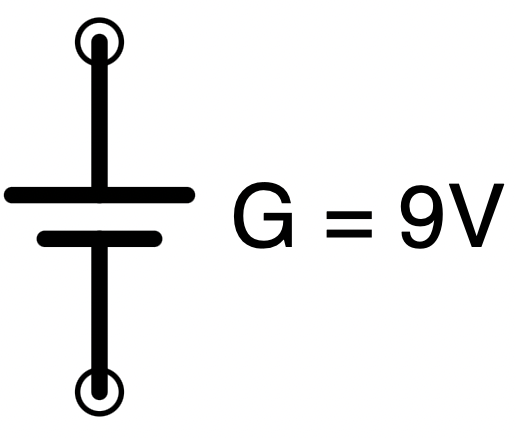
The marking at the terminals (small circles) and the representation of the voltage are not standardized. Here they belong to the representation in iCircuit.
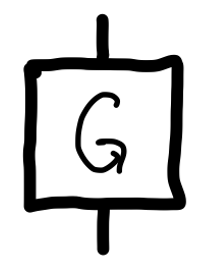
The battery can also be represented as a simple DC current source:
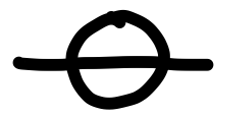
Or simply as an ideal voltage source (if the other properties are not relevant):
Calculations
- Electric charge
- Discharging
- Internal resistance