
Prof. Dr. Thorsten Jungmann (last updated 2025-09-02)
1 What does it look like?
A generator (German: Generator) consists of a solid housing that contains the rotating and stationary parts. Typical features are a shaft connection or a coupling for the drive, cooling openings or fans, and electrical terminals. Small generators can be handy and portable; large machines are several metres in size and permanently installed.
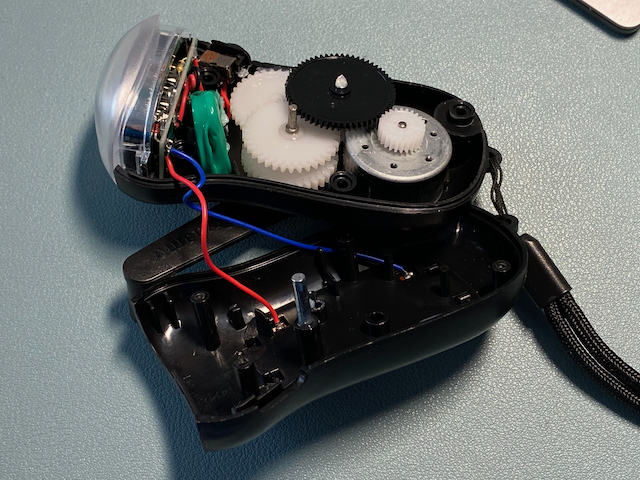
Dynamo in an LED torch
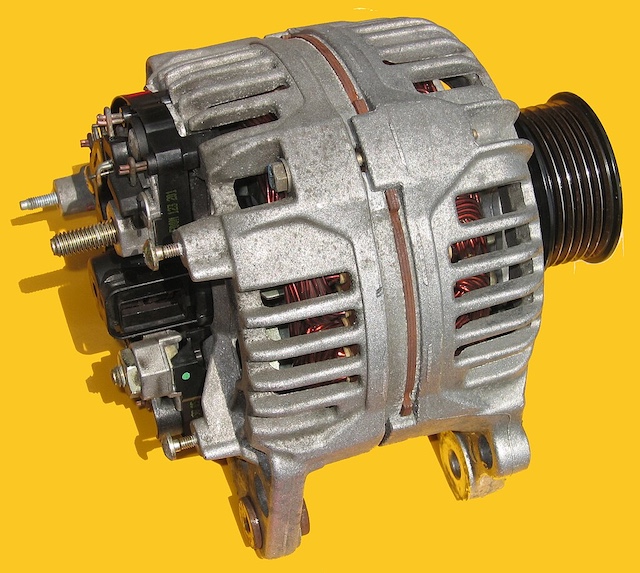
Alternator
Source: Hans Haase, CC BY-SA 4.0 https://creativecommons.org/licenses/by-sa/4.0, via Wikimedia Commons

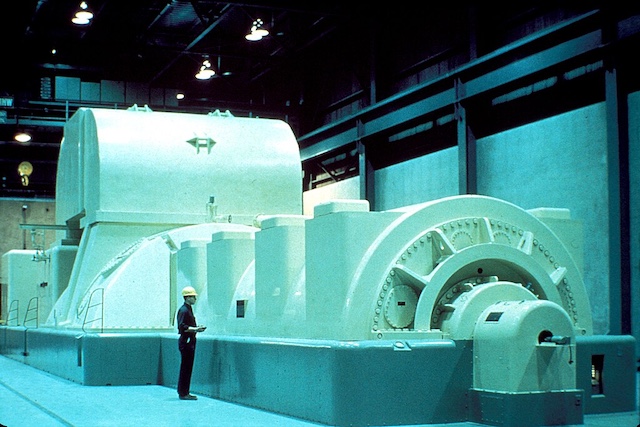
Generator on a steam turbine
Source: NRC, Public domain, via Wikimedia Commons

2 What can it do?
The generator converts mechanical energy (e.g. from a flowing medium such as water or steam, or from a rotating shaft) into electrical energy. It serves as a source of electrical energy and is used in power stations, in vehicles or as an emergency generator.
Solar cells, which convert light energy into electrical energy by means of the photovoltaic effect, can also be called generators. The following explanations, however, refer to the generator that converts mechanical energy into electrical energy.
3 How does it work?
Generators work on the principle of electromagnetic induction (EE1-10): if a conductor moves in a magnetic field, or if the magnetic field in a wire loop changes, a voltage is induced.
- Direct-current generators (DC generators) use a commutator, which rectifies the induced alternating voltage.
- Alternating-current generators (AC generators) deliver a sinusoidal alternating voltage directly, e.g. in a power station or in vehicle alternators.
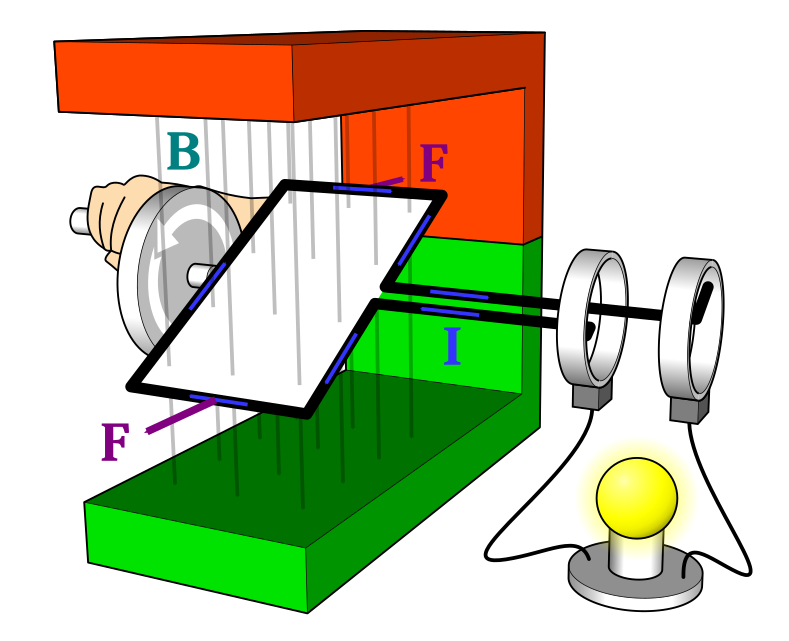
Generator principle
Source: MikeRun, CC BY-SA 4.0 https://creativecommons.org/licenses/by-sa/4.0, via Wikimedia Commons

4 What does it look like inside?
Inside you will find:
- the rotor (German: Rotor) (rotating part, generates or carries the magnetic field),
- the stator (German: Stator) (stationary part, contains the windings in which the voltage is induced),
- the excitation (German: Erregung) (e.g. permanent magnets or electromagnets),
- contacts and conductors,
- mechanical components such as bearings and fans for cooling.
5 What role does it play in teaching?
Generators are central examples of energy conversion. They illustrate Faraday’s law of induction and the importance of magnetic fields, speed of motion, number of turns and change in magnetic flux. In teaching, models of generators are used to make the fundamental relationships between mechanical work and electrical energy easy to understand.
6 What role does it play in practice?
In practice, generators supply the major part of the electrical energy generated worldwide. They are used in power stations (hydropower, wind power, thermal power stations), in vehicles (alternator) and in emergency power systems. Their reliability and efficiency are crucial for the energy supply of modern societies.
Symbols
- Letter code in schematics: G
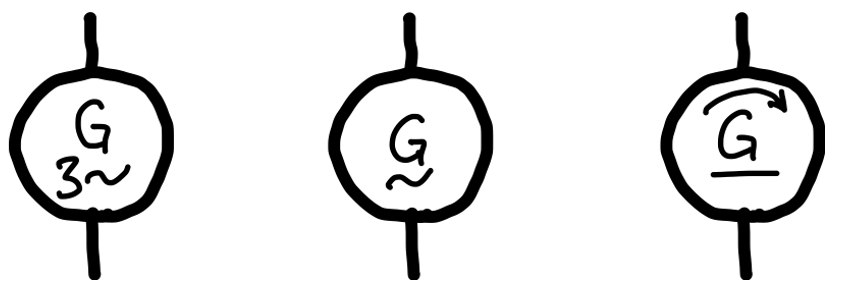
Three-phase generator, AC generator and DC generator
Calculations
No calculations on the generator are carried out in this script.