
Prof. Dr. Thorsten Jungmann (last updated 2025-09-02)
1 What does it look like?
Power supplies (German: Netzgeräte) are stand-alone devices, often in a rectangular housing, with front connections (plug-in terminals, jacks or cables) and a mains connection. Some power supplies have displays for voltage and current, buttons or rotary knobs for setting them, and power-on light emitting diodes or switches. Depending on the type, they can be compact plug-in power supplies, chargers or larger laboratory devices with a display and heat sinks.
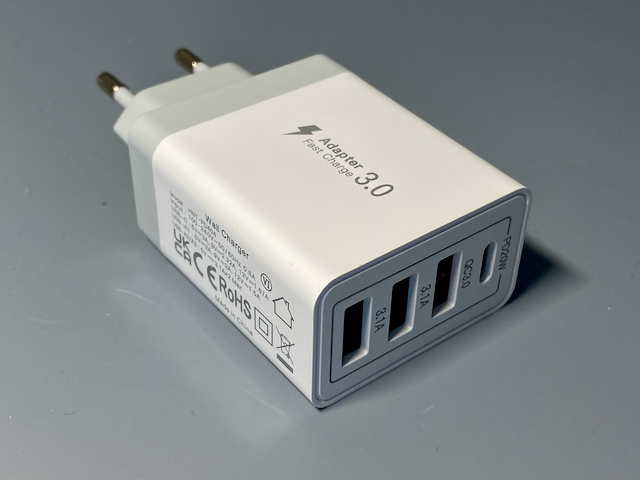
USB charger
Output voltage: , output current: ; max. output power:
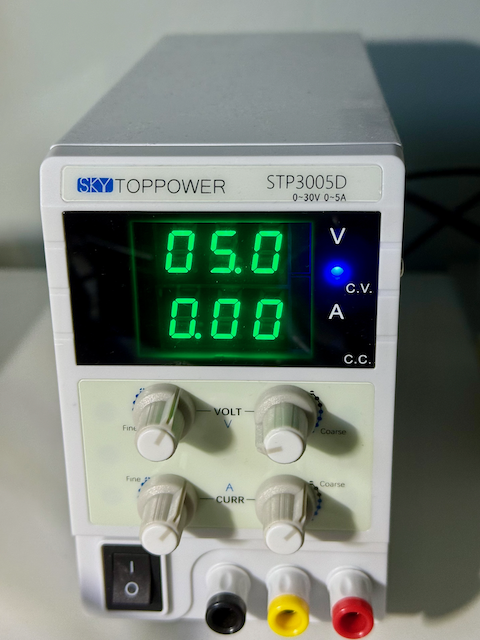
Laboratory power supply
Voltage range (adjustable): , current limiting (adjustable): , max. output power:
2 What can it do?
A power supply converts AC mains voltage into a defined output voltage or a defined output current.
- Fixed-voltage power supplies deliver a fixed direct voltage (e.g. 5 V, 12 V) and are used to supply electronic devices.
- Chargers (German: Ladegeräte) are special power supplies that provide a constant current or a specific charging characteristic matched to the rechargeable battery.
- Laboratory power supplies (German: Labornetzteile) allow continuous adjustment of output voltage and current limiting, so that experimental set-ups can be supplied flexibly and safely.
3 How does it work?
The power supply converts the AC mains voltage to the desired voltage level by means of a transformer or a switch-mode power supply, and rectifies and smooths it. An electronic control stabilizes the output voltage and limits the current if required.
- CV mode (Constant Voltage): The voltage remains constant, the current depends on the load.
- CC mode (Constant Current): The current is kept constant, the voltage adjusts accordingly.
4 What does it look like inside?
Depending on the design, you will find inside:
- transformer or switch-mode power supply for voltage conversion,
- rectifier and smoothing capacitors, where applicable an LC low-pass filter
- control circuit (linear or switching regulator),
- where applicable, control electronics with a microcontroller,
- displays and operating elements,
- heat sinks and/or fans for heat dissipation.
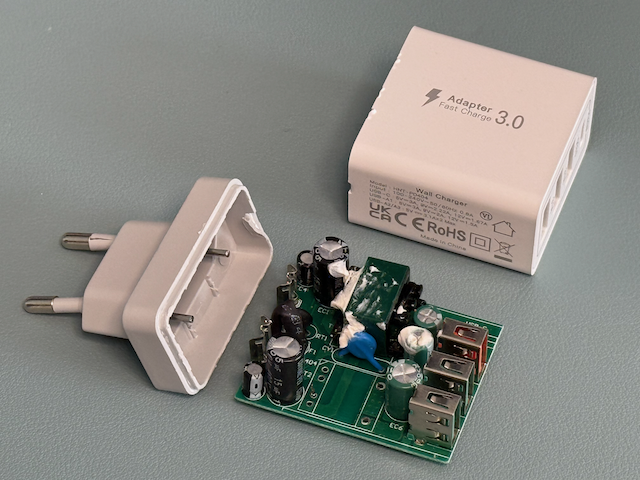
USB charger from the inside
From left to right: input side with filter, transformer, smoothing and stabilization, USB jacks on the output side
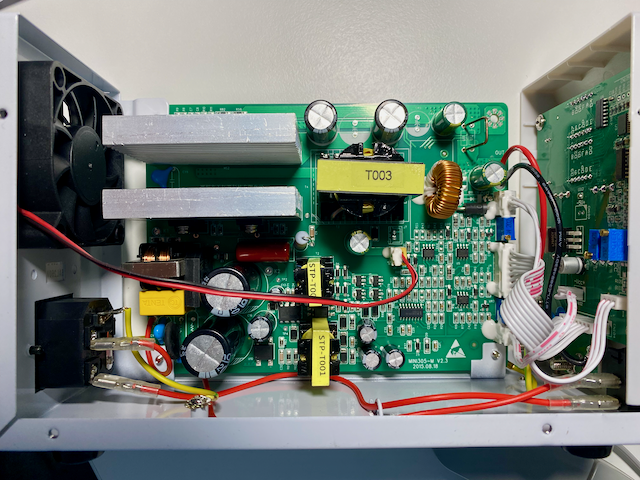
Laboratory power supply from the inside
From left to right: mains connection with switch and fan, heat sinks and smoothing capacitors, transformer(s) and LC filter, control panel
5 What role does it play in teaching?
Power supplies are real sources. They are also indispensable tools in the laboratory. Fixed-voltage devices are used to operate standard assemblies, while laboratory power supplies enable safe experimenting with freely adjustable voltage and current limiting. Chargers illustrate operation with constant current and changing voltages. In this way, students get to know different operating modes of sources.
6 What role does it play in practice?
Power supplies provide a stable and safe energy supply, adapted to the respective application.
- Fixed-voltage power supplies are found in almost all electrical devices. They are permanently integrated, e.g. on the control board, where they provide the stable operating voltage for the control system.
- Chargers are ubiquitous wherever devices are powered by rechargeable batteries. For tools there are, as a rule, separate chargers, whereas in electric vehicles they are permanently installed.
- Laboratory power supplies are standard in development and test laboratories.
Symbols
- Letter code in schematics: G
- also common for voltage sources: U

Power supply, generator
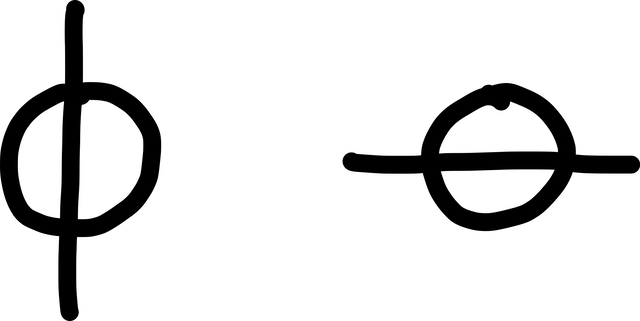
Voltage source (general, ideal)
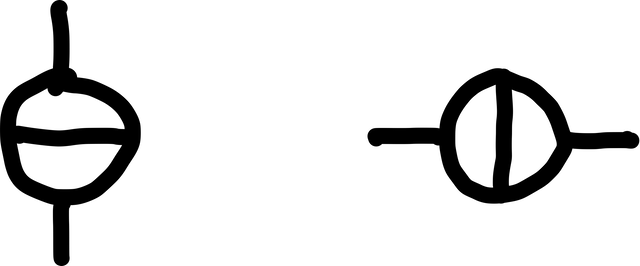
Current source (general, ideal)