
Prof. Dr. Thorsten Jungmann (last updated 2025-10-25)
A rechargeable battery (German: Akkumulator, also Akku or Sekundärzelle) is a battery that can be charged again. It differs from a conventional battery (primary cell) in that, after it has been discharged, it can be returned to its original state of charge by supplying electrical energy.
1 What does it look like?
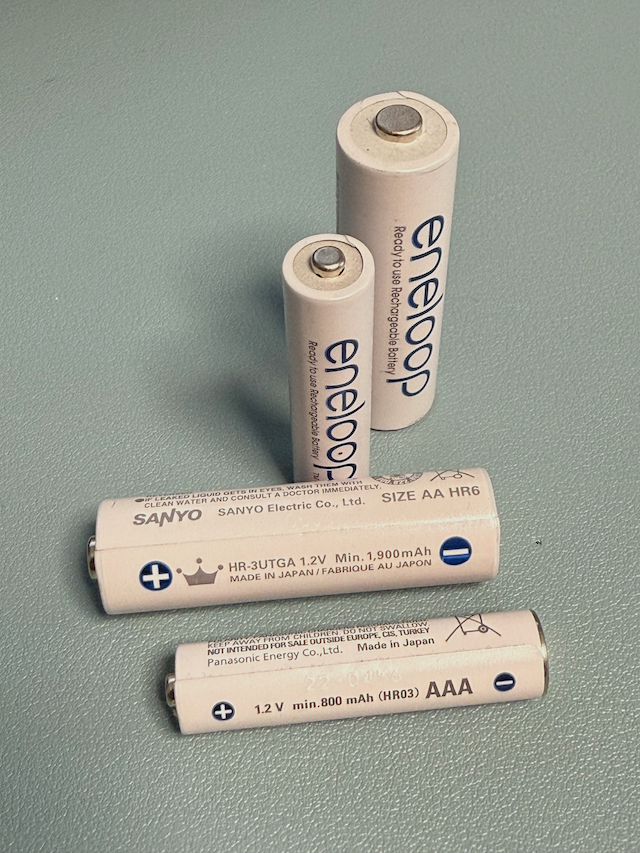
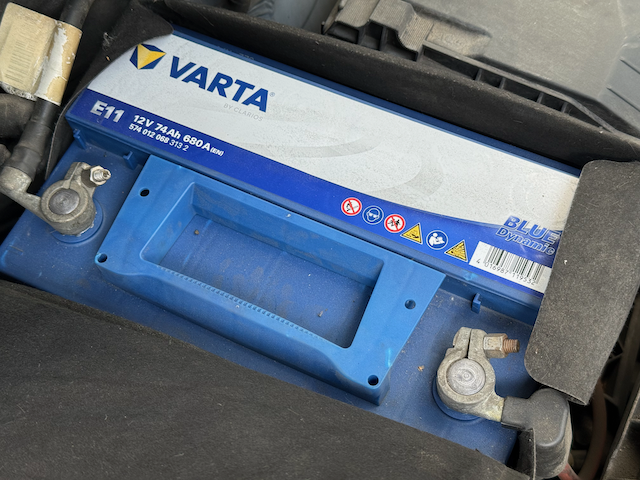
A cylindrical or block-shaped housing made of metal or plastic, often with two clearly marked terminals (+/−). Frequently printed with details of voltage, capacity and manufacturer.
2 What can it do?
Stores electrical energy chemically and releases it again when needed. Unlike a battery, it can be recharged repeatedly.
3 How does it work?
A rechargeable battery converts electrical energy into chemical energy during charging (electrochemical reaction) and back again during discharging. Depending on the type (e.g. lead, nickel–metal hydride or lithium-ion rechargeable battery), different electrode and electrolyte materials are used.
4 What does it look like inside?
Inside there are two electrodes (anode and cathode) and an electrolyte, which enables the flow of ions. The design determines whether these take the form of wound foils (cylindrical cells) or plates (older lead rechargeable batteries). The housing and seals prevent electrolyte from escaping and protect against mechanical impact.
The current that flows from the rechargeable battery into the connected electric circuit also flows through these internal components. In the process, an internal resistance occurs, which causes a small voltage drop and heat losses.
COMMON TECHNOLOGIES
- Lithium polymer rechargeable battery (LiPo): Uses a gel-like or solid polymer electrolyte instead of a liquid electrolyte solution. This allows flexible designs and makes LiPo rechargeable batteries particularly light.
- Constituents: Lithium metal oxides (cathode, e.g. cobalt oxide), graphite (anode), polymer electrolyte.
- Lithium iron phosphate rechargeable battery (LFP): A variant of the lithium-ion rechargeable battery with a cathode made of lithium iron phosphate (LiFePO4).
- Advantages: Particularly durable, safe and low in cost.
- Constituents: Lithium iron phosphate (cathode), graphite (anode).
- Lithium nickel manganese cobalt oxide rechargeable battery (NMC): A technology with a cathode made of nickel, manganese and cobalt.
- Advantages: Very high energy density.
- Constituents: Nickel manganese cobalt mixed oxides (cathode), graphite (anode).
- Lithium nickel cobalt aluminium oxide rechargeable battery (NCA): Another cathode technology with properties similar to NMC, but with added aluminium.
- Advantages: High energy density and performance.
- Constituents: Nickel cobalt aluminium oxide (cathode), graphite (anode).
- Lithium titanate rechargeable battery (LTO): A technology that uses lithium titanate as the anode material.
- Advantages: Extremely fast charging capability and long service life.
- Constituents: Lithium titanate (anode), lithium metal oxide (cathode).
Older technologies:
- Lead–acid rechargeable battery: Older car batteries use lead plates and a sulfuric acid solution.
- Nickel and cadmium (NiCd) or nickel and metal hydride (NiMH): Older rechargeable battery technologies, which today are mostly replaced by the more powerful lithium-based batteries.
5 What role does it play in teaching?
Serves as an example of rechargeable energy storage devices and illustrates the differences between primary cells and rechargeable batteries. In electrical engineering, the rechargeable battery is often modelled as a real voltage source: an ideal voltage source with an internal resistance in series. In addition, it is used in experiments or thought experiments on charging, discharging and measuring its capacity.
6 What role does it play in practice?
Rechargeable batteries serve as stores of electrical energy and are found, for example, in small electrical appliances, tools and electric vehicles, and as storage in photovoltaics systems. They are indispensable whenever electrical energy is needed independently of the power grid.
Symbols
- Letter code in schematics: G
- The rechargeable battery is modelled as a DC voltage source. Its equivalent circuit diagram is that of a battery:
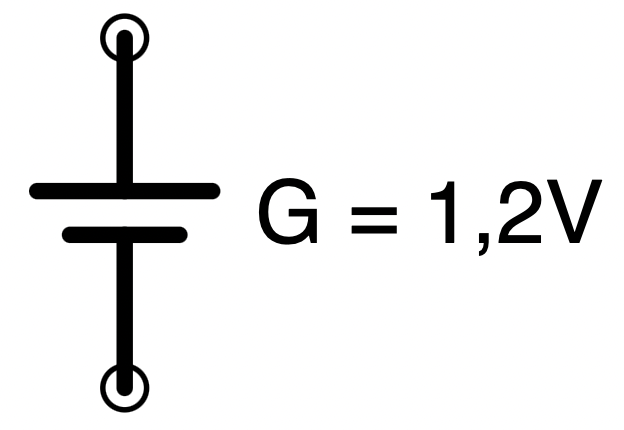
The marking at the terminals (small circles) and the representation of the voltage are not standardized. Here they are part of the representation in iCircuit.
The rechargeable battery can also be represented as a simple DC current source:

Or simply as an ideal voltage source (if the other properties are not relevant):

Calculations
- Electric charge
- Charging and discharging
- Internal resistance