
Prof. Dr. Thorsten Jungmann (last updated 2025-09-01)
1 What does it look like?
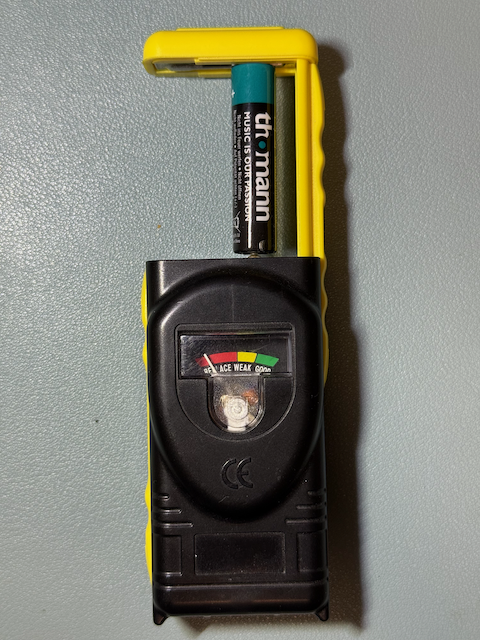
A battery tester (German: Batterieprüfer) is usually a small handheld device made of plastic with a display unit (scale with pointer, light emitting diode or digital display) and two contacts for connecting the battery. Some devices have fixed holders for button cells or 9 V block batteries.
2 What can it do?
A battery tester shows the state of charge or the residual voltage of a battery. It helps you to decide whether a battery is still usable or has to be replaced.
3 How does it work?
A battery tester applies a defined load to the battery and measures the terminal voltage while doing so. If the voltage is below a certain value, the device indicates that the battery is largely discharged.
4 What does it look like inside?
In simple battery testers, there is merely a resistor wired to the moving-coil instrument (voltmeter with display) inside. This combination allows a voltage measurement under load.
Somewhat more elaborate variants have additional components or a small electronic circuit to show different voltage ranges on light emitting diodes or a display.
5 What role does it play in teaching?
In teaching, the battery tester serves as a clear example of the practical use of voltage measurement under load. It shows why open-circuit voltages alone are not sufficient to assess the condition of a battery reliably.
6 What role does it play in practice?
In practice, the battery tester is a simple aid in the household, in the laboratory or in the workshop. It is used to check the condition of individual batteries or rechargeable batteries quickly. For more precise measurements or safety-relevant applications, professional measuring instruments are used.
Symbols
- Letter code in schematics: P
- Series connection of source with internal resistance, load resistor and voltmeter
Calculations
- Real source, I/U characteristic curve