
Prof. Dr. Thorsten Jungmann (last updated 2025-09-03)
1 What does it look like?
A solar cell (German: Solarzelle) is a thin, usually square or round wafer of semiconductor material (e.g. silicon), a few centimetres in size and covered with metallic contact strips. Several cells are interconnected in a photovoltaic module (German: Solarmodul) and protected by glass, films and a frame. Several modules together form a photovoltaic generator (German: Solargenerator; also: photovoltaic system, PV system), which supplies the electrical energy for entire installations.
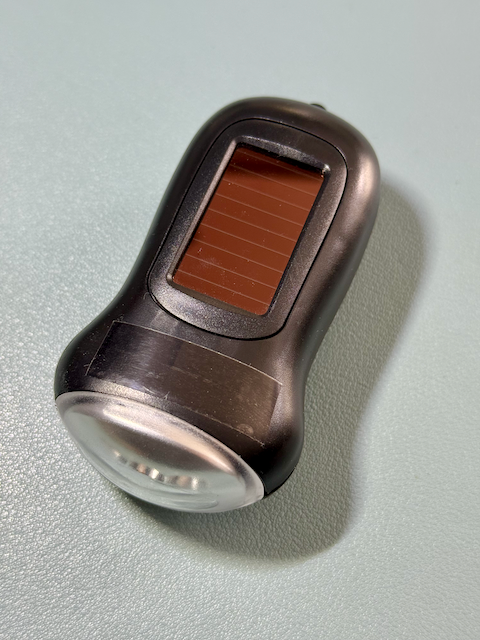
Solar cells of a torch
The solar cells make it possible to charge the built-in rechargeable battery with sunlight. Depending on the solar irradiance, the torch is fully charged in 8–16 hours.
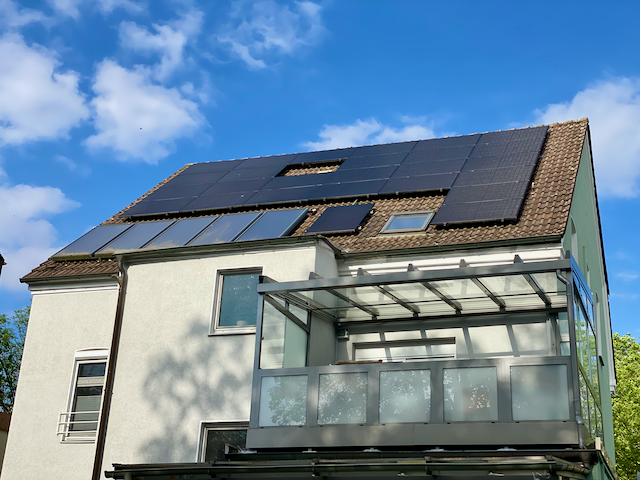
Photovoltaic modules on the roof of a house
The system shown (42 modules including the other side of the roof) has a rated power of 17 kWp. At high solar irradiance, the system delivers a power of approx. 10–12 kW.
The five solar thermal modules (bottom left) do not belong to the PV system. (Location: 51°30′42″ N 7°9′16″ E)
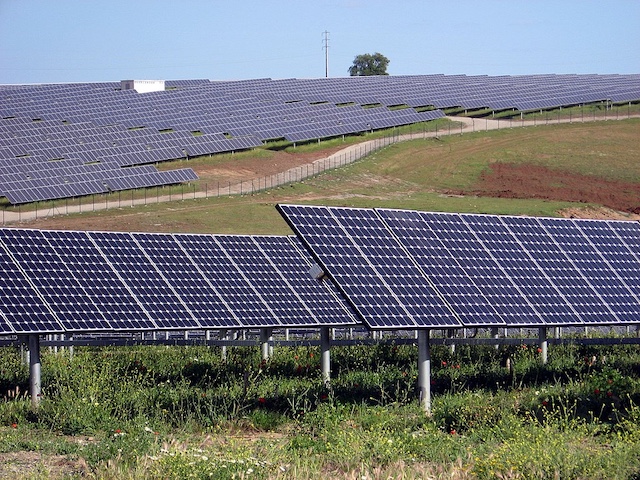
Solar power plant in Serpa, Portugal
Source: Ceinturion, CC BY-SA 3.0 http://creativecommons.org/licenses/by-sa/3.0/, via Wikimedia Commons

2 What can it do?
The solar cell converts the radiant energy of sunlight directly into electrical energy. Typical characteristic quantities are:
- open-circuit voltage of a cell: approx. 0.5–0.7 V,
- current depending on area and irradiance,
- typical power: a single cell reaches approx. 1–5 Wp, a module with 60–72 cells about 250–400 Wp, modern large modules up to more than 600 Wp.
A module reaches voltages of 30–40 V; several modules in series can be connected together to give system voltages of several hundred volts.
3 How does it work?
The solar cell uses the photovoltaic effect (German: photovoltaischer Effekt):
- Sunlight generates electron–hole pairs in the semiconductor.
- The electric field at the pn junction separates these charge carriers.
- A voltage arises at the contacts, which makes a current flow possible in the external electric circuit.
4 What does it look like inside?
Inside, the solar cell consists of a silicon layer with a pn junction region. On the front there are fine metallic traces (fingers), which carry the current away, while the back carries a continuous metal layer. The component is embedded in transparent protective layers.
5 What role does it play in teaching?
Solar cells are a vivid example of the application of semiconductors and of the photovoltaic effect. They illustrate the conversion of radiant energy into electrical energy and offer a direct link to the topics of energy conversion, efficiency and renewable energies.
6 What role does it play in practice?
Solar technology is used in many areas:
- supply of small devices such as pocket calculators or garden lamps,
- grid-connected photovoltaic systems on the roofs of residential and commercial buildings,
- off-grid systems for huts, boats or remote regions without a grid connection,
- large-area solar fields and solar power plants for feeding into the public grid,
- special applications such as the supply of satellites and portable chargers.
Symbols
- Letter code in schematics: G (generator in general)
- also common: PV
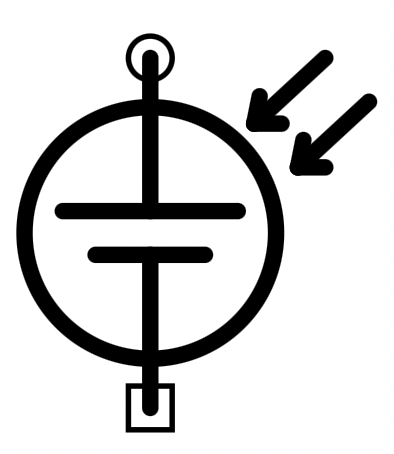
The marking at the terminals (small circle and square) is not standardized. Here it belongs to the representation in iCircuit.