
Prof. Dr. Thorsten Jungmann (last updated 2025-09-02)
Semiconductors (German: Halbleiter) are a class of materials with electrical properties between those of conductors and insulators. Typical semiconductor materials are silicon (Si), germanium (Ge) or gallium arsenide (GaAs). They form the basis of almost all modern electronic components. Through targeted doping – the introduction of minute quantities of foreign atoms, e.g. boron or phosphorus – their conductivity and their electrical behaviour can be set precisely. Semiconductors are made into components such as diodes, transistors, light emitting diodes or integrated circuits.
1 What does it look like?
Pure semiconductor material usually comes as a crystal with a silvery sheen or as a thin, circular wafer (the starting workpiece of chip fabrication), which can have a diameter of several centimetres up to more than 30 cm. The surface appears smooth and mirror-like.
Finished semiconductor devices, by contrast, are packaged in small plastic, glass or ceramic housings from which contact pins or metal pads are led out. Their appearance ranges from tiny glass diodes through transistors in a round metal or TO package to cuboid ICs with many pins.
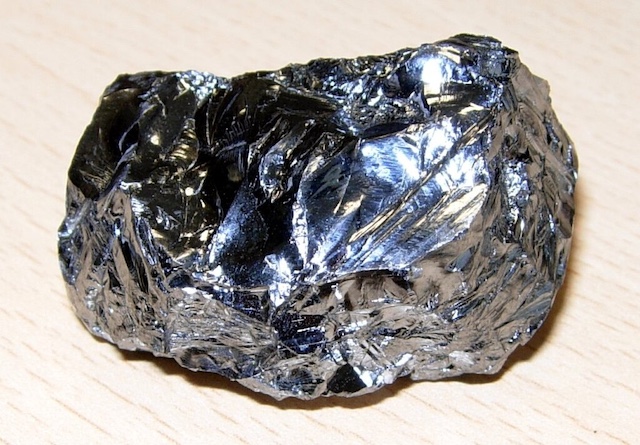
Silicon crystal
Enricoros at English Wikipedia, Public domain, via Wikimedia Commons

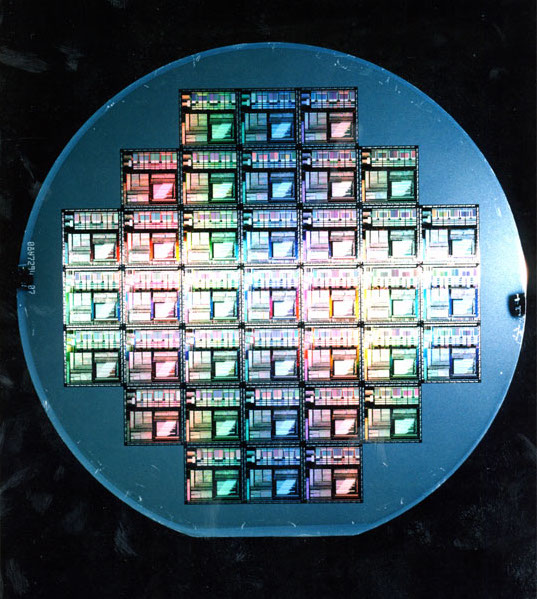
Wafer with integrated circuits
(Source: RbkJnkRt, Public domain, via Wikimedia Commons)

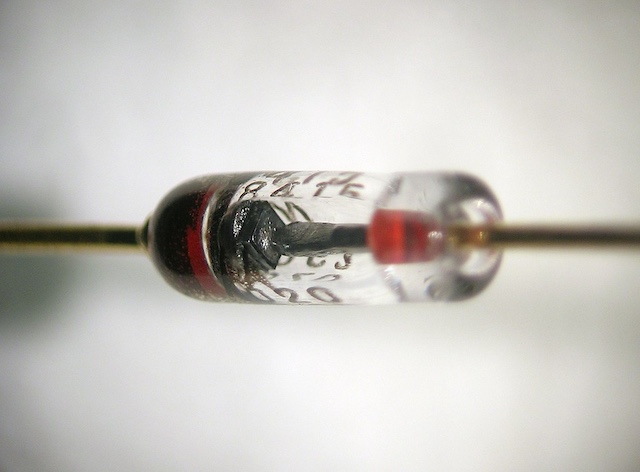
Run-of-the-mill diode
Close-up of a silicon diode. The anode (+) is on the right-hand side, the cathode (-) on the left-hand side (marked by a black stripe). Between the two terminals you can see a square silicon crystal.
(Source: John Maushammer; The original uploader was Morcheeba at English Wikipedia., CC BY-SA 2.5 https://creativecommons.org/licenses/by-sa/2.5, via Wikimedia Commons)

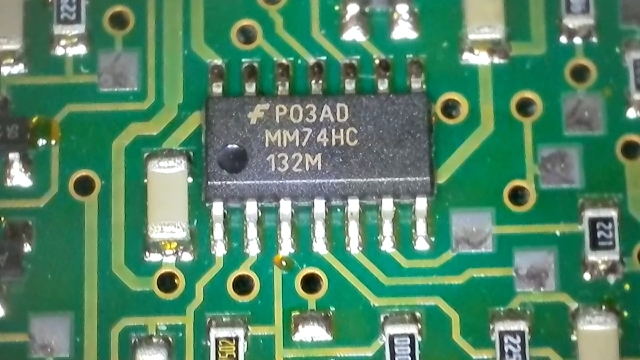
Integrated circuit (IC)
A 74HC132 in an SOIC-14 package. Function: 4 × 2-input NAND with Schmitt-trigger inputs (CMOS logic). Purpose: debouncing, signal conditioning with hysteresis.
2 What can it do?
Depending on their doping, semiconductors can conduct or block current. In each case not quite as well as a conductor or an insulator, but certainly well enough for technical use. They thus take on control and switching functions, rectification, gain or light emission. Examples:
- Diodes conduct current in one direction only.
- Transistors amplify signals or switch currents.
- Light emitting diodes convert current into light.
- Integrated circuits contain millions of such functions in the smallest of spaces.
3 How does it work?
The function is based on the special band structure of semiconductors. In the pure state, the number of free charge carriers is small. Doping deliberately creates an excess of electrons (n-type conduction) or a lack of electrons, that is, ‘holes’ (p-type conduction). At interfaces (pn junction), an electric junction forms whose electrical behaviour can be controlled from outside. This makes rectifier diodes, light emitting diodes or the control paths of transistors possible.
4 What does it look like inside?
Inside a semiconductor device there is a small crystal chip (die), usually made of silicon. It is provided with doping zones and, where applicable, metallized contact pads. The chip is mounted on a carrier material and connected to the leads via fine bond wires or metal contacts. A housing protects the chip against moisture, dust and mechanical influences.
5 What role does it play in teaching?
Semiconductors are indispensable for understanding modern electronics. They show how functional components can be made from one material through targeted physical changes. In teaching, they are the starting point for topics such as rectification, transistor circuits, logic gates or microprocessors. In the fundamentals of electrical engineering, their role is limited to their property as a non-linear resistor and to the light emitting diode.
6 What role does it play in practice?
Almost every electronic device contains semiconductors: from the charger through computers and smartphones to photovoltaic modules and power electronics in power engineering. Today, semiconductors determine how small, powerful and energy-efficient devices are. Without semiconductors there would be no modern information and communication technology, no renewable energies in their current form and no automation engineering.
Symbols
Letter codes in schematics
- Diode, also light emitting diode: D
- Integrated circuit (IC): K
- Power switch, IGBT: Q
Calculations
- Series resistor of a light emitting diode
- non-linear resistor
Material properties (German: Materialkennwerte):
| Resistivity in | Conductivity in (intrinsic conduction) | Temperature coefficient of resistance in | |
|---|---|---|---|
| Germanium | negative, non-linear | ||
| Silicon | negative, non-linear | ||
| The values are rounded and apply at room temperature () and atmospheric pressure (). |