
Prof. Dr. Thorsten Jungmann (last updated 2025-09-02)
1 What does it look like?
An LED (Light Emitting Diode; German: Leuchtdiode) is usually a small, transparent or coloured plastic package in which the semiconductor chip is embedded. Typical designs are:
- through-hole light emitting diodes with a cylindrical package and two connecting wires (anode (+) longer, cathode (-) shorter),
- SMD LEDs as flat, rectangular packages with metallic contact pads, also on strips,
- high-power light emitting diodes with a larger chip on a heat-sink carrier.
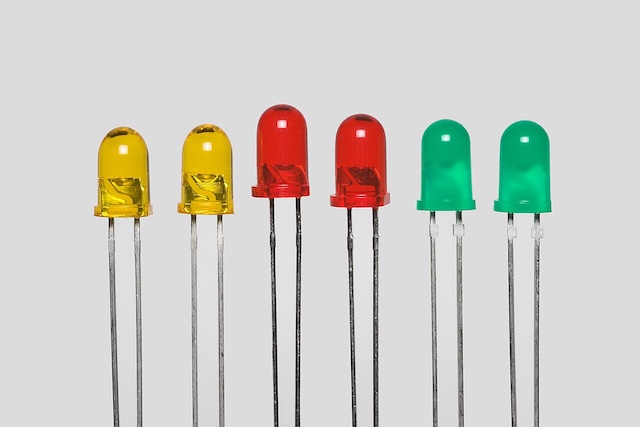
Light emitting diodes (yellow, red green)
Photo: Afrank99, licence: CC BY-SA 2.0
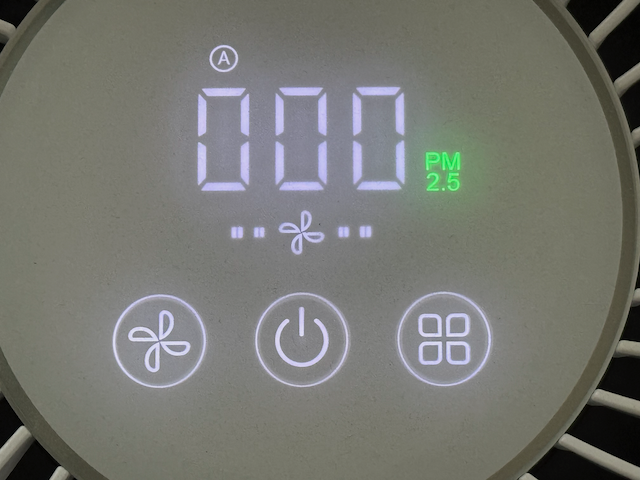
LED Display
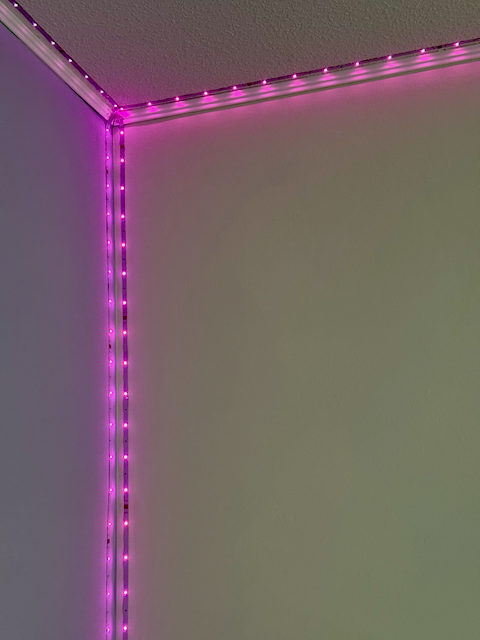
LED strip (SMD LEDs)
2 What can it do?
A light emitting diode converts electrical energy into visible light, infrared or ultraviolet. It serves as an indicator element, for lighting or for signal transmission. Light emitting diodes are characterized by high efficiency, a long service life and low heat generation compared with incandescent bulbs.
3 How does it work?
The light emitting diode is a diode made of a semiconductor material with a direct band gap. When it is operated in the forward direction, electrons and holes recombine in the pn junction. In the process, the energy is not released as heat, as in a resistor, but in the form of photons.
- The wavelength (colour) depends on the semiconductor material used.
- The forward voltage is typically between 1.8 V (red) and 3.5 V (blue/white).
4 What does it look like inside?
Inside, the semiconductor chip sits on a reflector carrier, and a bond wire connects the contact pads to the terminal legs. The package focuses the light and protects the chip; in through-hole light emitting diodes it is often shaped like a lens. High-power light emitting diodes additionally have cooling surfaces. In RGB LEDs, three light emitting diodes (red, green, blue) are combined, which light up individually or together depending on the applied input signal; when all three light up, the light is perceived as white.
5 What role does it play in teaching?
The light emitting diode serves as an example of the relationship between electric current, semiconductor physics and light emission. It illustrates the difference between ohmic loads (e.g. a heating resistor) and non-linear components. In laboratory exercises, it is frequently used as an optical indicator.
6 What role does it play in practice?
Light emitting diodes are the standard component for lighting and display. You find them in displays, signal lights, vehicle lighting, street lamps and in optical communication systems. Their high energy efficiency and robustness have almost completely displaced incandescent bulbs and many fluorescent lamps.
Symbols
Letter codes in schematics:
- light emitting diode as a lamp (lighting): E
- light emitting diode as an actuator (display): P
- also possible and quite common: letter code D (with the addition ‘LED’ or a symbol)
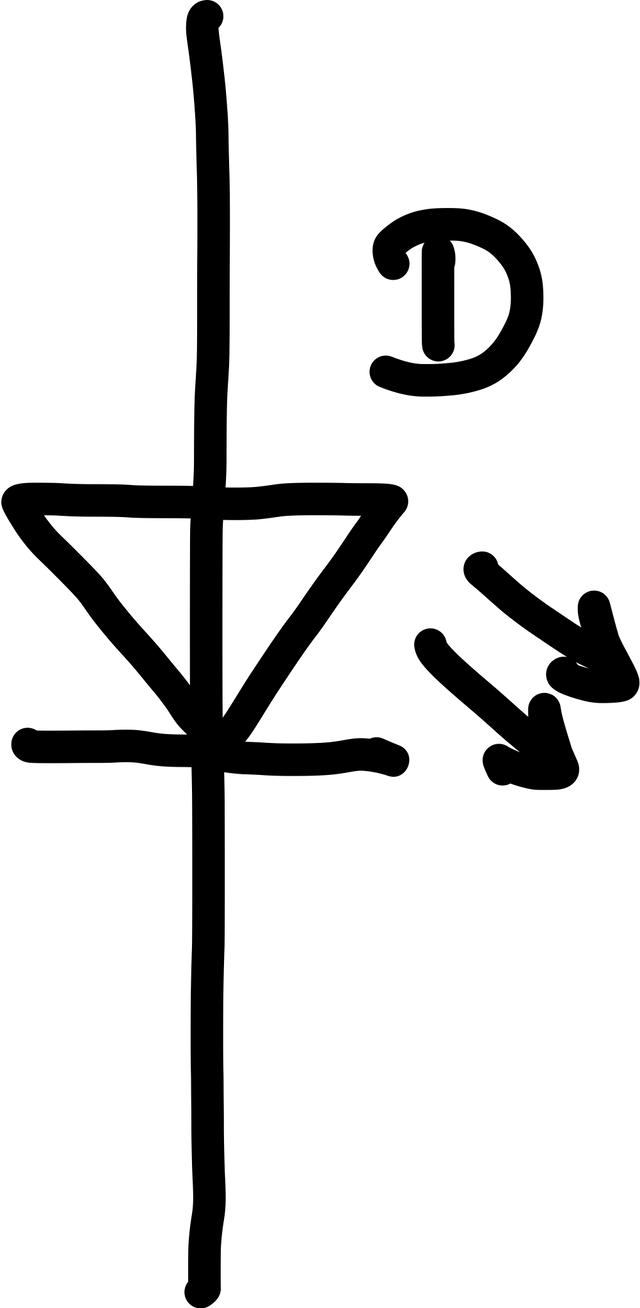
Calculations
- Current limiting by means of a series resistor
- Resistance at the operating point