
Prof. Dr. Thorsten Jungmann (last updated 2026-10-25)
1 What does it look like?
A BCD clock (German: BCD-Uhr) shows the time with single light emitting diodes (LEDs) instead of digits. The clock in the photo is a curved stand made of aluminium sheet. On its front, 20 blue LEDs stand in six columns; a cable leaves the clock at the back.
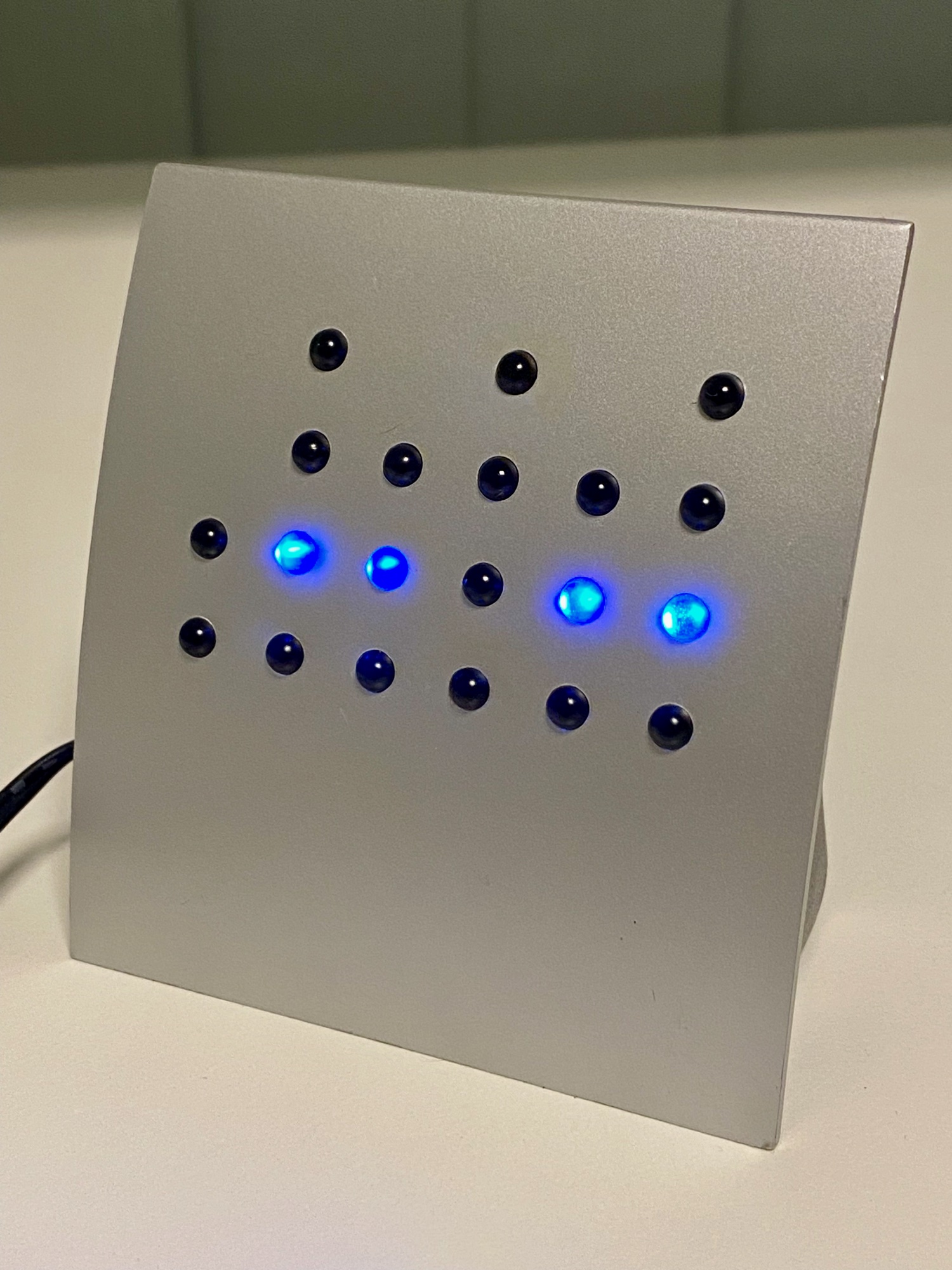
BCD clock
Six columns for the tens and units of the hours, the minutes and the seconds
2 What can it do?
The clock shows hours, minutes and seconds in the binary-coded decimal (BCD) code: each column shows one decimal digit, and each LED of a column stands for one weight. From the bottom to the top, the weights are 1, 2, 4 and 8. Whoever reads the clock adds the weights of the lit LEDs of each column. The columns have 2, 4, 3, 4, 3 and 4 LEDs, because the tens of the hours never exceed 2, and the tens of the minutes and seconds never exceed 5.
3 How does it work?
A microcontroller does not drive all 20 LEDs at the same time. An analogue multiplexer/demultiplexer of type HEF4051 switches the six columns on one after another, so fast that the eye sees all lit LEDs at once. For each column, the microcontroller applies the BCD code word of its digit. This principle, in which several signals share the same electric lines one after another, is called time-division multiplexing (German: Zeitmultiplex).
4 What does it look like inside?
The circuit board carries the 20 LEDs, six transistors, two push-buttons labelled MIN and HR, a switch labelled DIM and several integrated circuits, among them the microcontroller PIC16C505, the HEF4051 and a crystal labelled 4.000M.
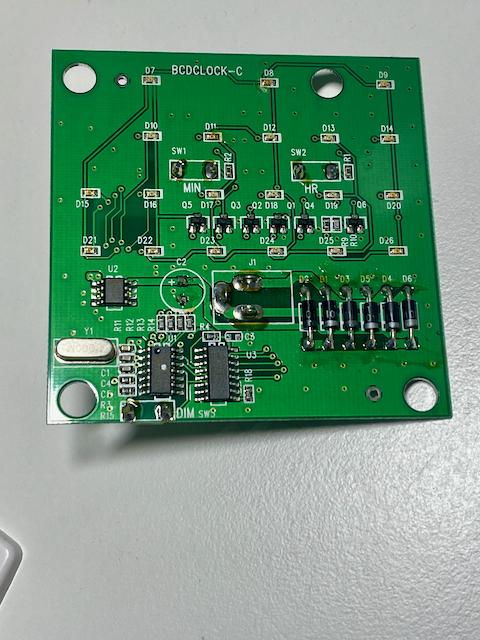
Circuit board of the BCD clock
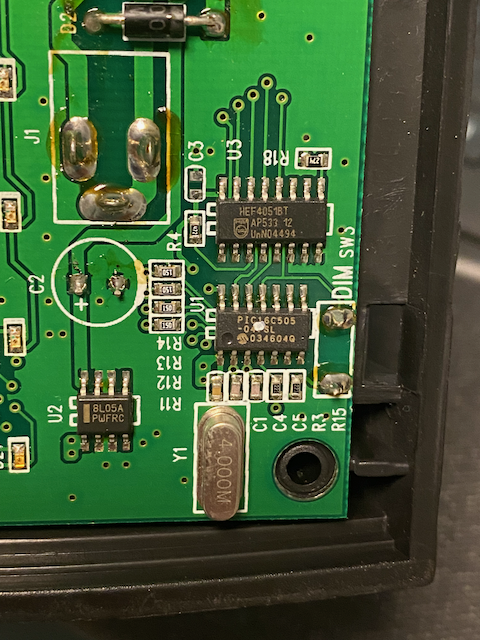
Section of the circuit board
U3: HEF4051, U1: microcontroller PIC16C505, Y1: crystal
5 What role does it play in teaching?
From the lesson DET-05 on, the BCD clock is the third application example of the module Digital Electronics (DET), next to the smartphone and the heat pump. It shows the BCD code without a code converter, in contrast to a 7-segment display, and a multiplexer/demultiplexer at work.
6 What role does it play in practice?
As a gadget, the BCD clock shows that a display does not have to show digits. Displays with many LEDs or several digits are often driven in the same way, column by column, so that a few electric lines suffice.
Symbols
- In schematics, the clock as a whole has no symbol of its own; its LEDs, transistors and integrated circuits have their own symbols.
Calculations
- Reading the time: add the weights 8, 4, 2 and 1 of the lit LEDs of each column.