
Prof. Dr. Thorsten Jungmann (last updated 2025-09-03)
An insulator (German: Isolator) serves to prevent electric current flow. It is characterized by a very high resistivity or, equivalently, a very low specific conductance.
1 What do they look like?
An insulator consists of a non-conductive material such as glass, ceramic, plastic or rubber. Insulators occur as components in the form of spacers, housings or sheaths. In practice, almost all electrical conductors are surrounded by insulators (e.g. the insulation of an electric line or the plastic housing of a plug). In transformers, special oil is often used as an insulator as well.
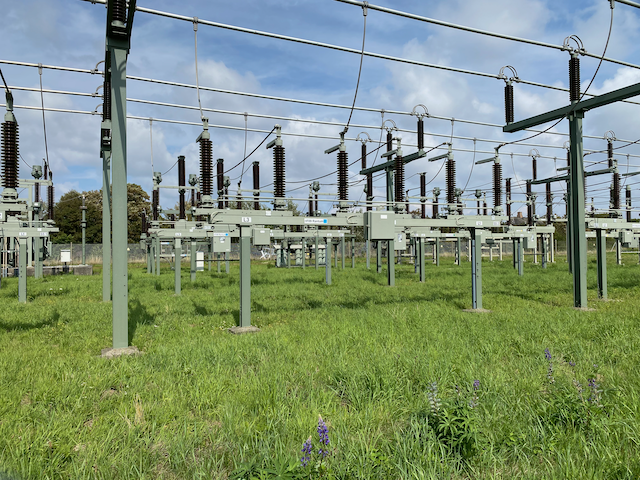
High-voltage insulators in a substation
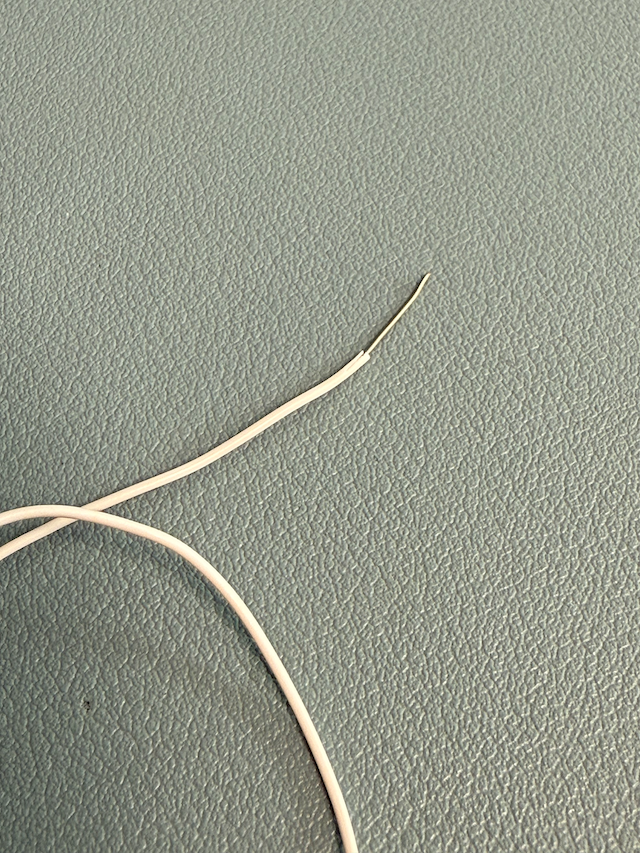
Plastic insulation of an electric line
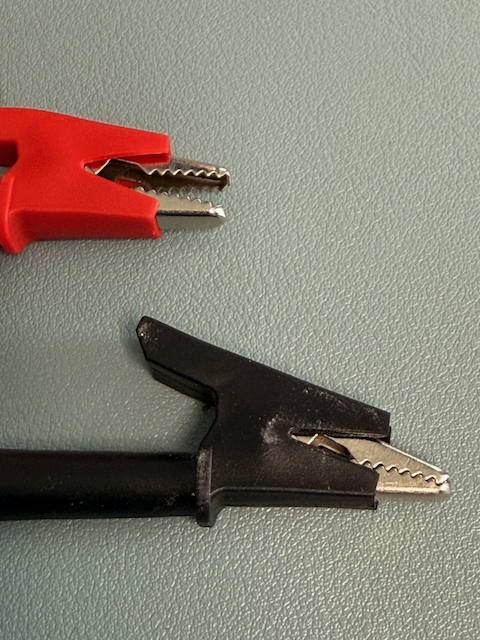
Plastic insulation of crocodile clips
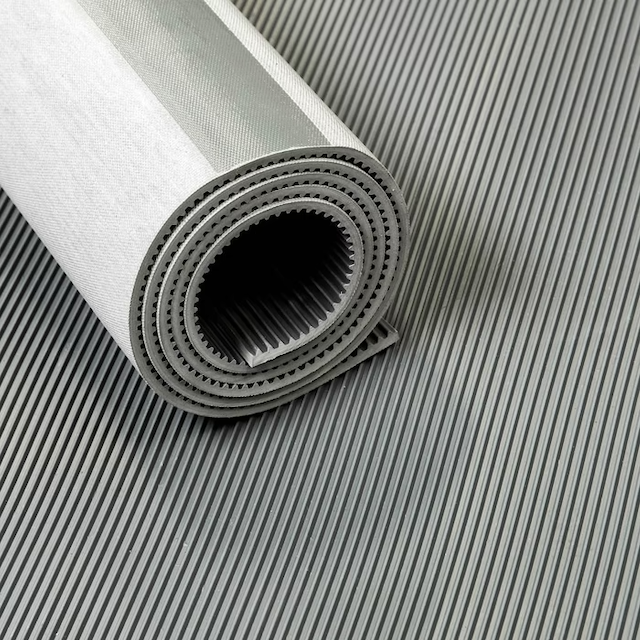
Rubber insulating mat
Source: Gummimatten-Kaufhaus
2 What can they do?
Insulators prevent uncontrolled current flow. They ensure that electrical conductors remain separated from one another and from their surroundings.
- Insulators on electric lines protect against short circuits and electric shocks.
- Insulators in switchgear assemblies maintain clearances and prevent flashovers.
- Housing insulation protects users and devices.
- Insulating mats are part of occupational safety and protect against electric shocks on contact with live parts of an installation.
3 How do they work?
In insulators, the electrons are firmly bound to their atoms and cannot move freely. As a result, there are no freely moving charge carriers, and consequently no current can flow.
Only at very high electric field strengths (breakdown strength) does ionization occur, and the insulator becomes conductive. This limits the maximum voltage that an insulator can safely withstand. A breakdown usually destroys the insulator.
4 What do they look like inside?
At the atomic level, an insulator consists of a crystal or molecular lattice without free electrons. Typical materials:
- Plastics (PVC, PE, PTFE) → insulation of electric lines and cables
- Glass, ceramic → high-voltage insulators, spacers
- Rubber → flexible insulation, protective sleeves and mats
5 What role do they play in teaching?
Insulators are the counterpart class to conductors and semiconductors. Students learn that the three classes of materials are defined by their resistivity or their conductivity:
- Conductor: very low resistance, very high conductivity
- Insulator: very high resistance, very low conductivity
- Semiconductor: intermediate position, controllable conductivity
6 What role do they play in practice?
Insulators are indispensable for safety during the installation and operation of electrical installations. They protect people from electric shock and prevent short circuits. Without them, electrical conductors could not be fastened anywhere. Their selection depends on withstand voltage, temperature resistance, mechanical stability and chemical resistance.
Examples: insulators in overhead power lines, cable sheaths in buildings, insulating materials in printed circuit boards, insulating housings of plugs, devices and tools.
Symbols
- Insulators are usually not shown separately in schematics, but are implicitly contained in electric lines and housings. If they are shown, then with the letter code U.
- In high-voltage diagrams, spacers or insulators are drawn schematically as insulating dividing lines or circles.
Calculations
Material properties (German: Materialkennwerte):
| Resistivity in | Breakdown strength in | |
|---|---|---|
| Air | - | |
| Quartz glass | ||
| Porcelain | ||
| Polyvinyl chloride (PVC, soft) | ||
| Polycarbonate (PC) | ||
| The values are rounded and apply at room temperature () and atmospheric pressure (). |