
Prof. Dr. Thorsten Jungmann (last updated 2025-08-28)
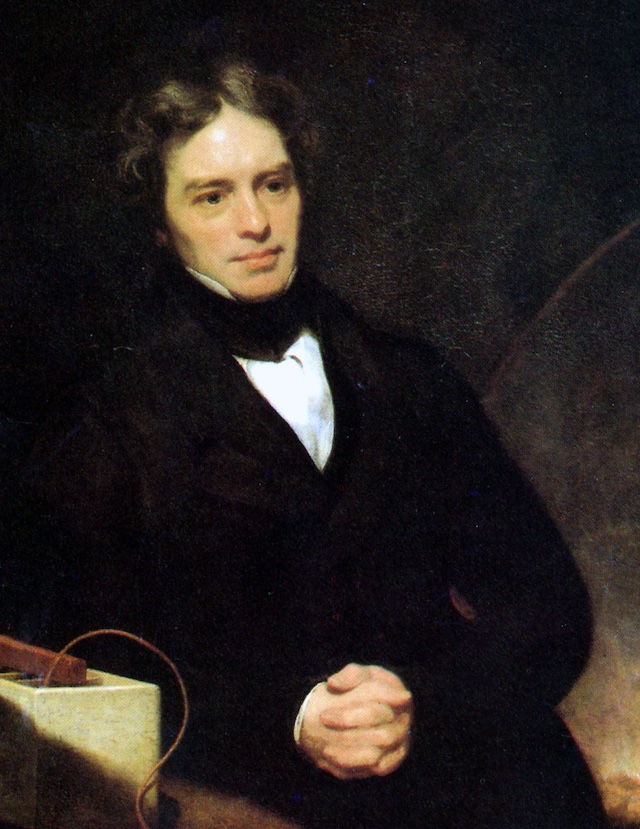
Michael Faraday (1791–1867) was one of the most important experimental physicists and pioneers of electrical engineering. Despite his humble origins – he first learned the bookbinding trade – his curiosity and exceptional talent for experimentation made him one of the most influential researchers of the 19th century. His most important contributions include the discovery of electromagnetic induction, the fundamental principle behind the conversion of motion into electric current. With his experiments, Faraday laid the foundation for the construction of generators, transformers and electric motors.
Faraday made fundamental contributions to the study of electricity, in particular to the understanding of capacitors and to the description of the relationships between electric charge, voltage and stored energy. His experiments and theoretical considerations led to the SI unit of capacitance, the farad (F), being named after him.
Faraday also recognized that a voltage arises when an electrical conductor ‘cuts’ a changing magnetic field. His most famous experiments, from the year 1831, showed: if, for example, a magnet is moved through a coil of wire – or the coil around a stationary magnet – a current is induced in the coil. This law of induction (‘Faraday’s law’) is to this day the basis for the generation of electrical energy in power stations and is found in countless technical applications of electrical engineering.
In chemistry, too, Faraday did groundbreaking work: he formulated the laws of electrolysis, coined terms such as electrode, anode, cathode and ion, and showed that chemical and electrical forces are closely connected with one another. His experiments and his vivid description of force fields had a lasting influence on the development of the field concept in physics.
Many components and effects bear his name today – for instance the Faraday cage for protection against electric fields or the Faraday effect in optics. Faraday’s research continues to have a fundamental influence on electrical engineering and the natural sciences to this day.
Reference and further reading:
https://en.wikipedia.org/wiki/Michael_Faraday
Image source: Wikipedia