
Prof. Dr. Thorsten Jungmann (last updated 2026-05-04)
Capacitance (German: Kapazität) describes the ability of a capacitor to store electric charge. The greater the capacitance, the more charge can be stored at the same voltage. Capacitance is therefore a measure of the ‘holding capacity’ of a capacitor for electric charge.
1 Quantity symbol and unit
The quantity symbol of capacitance is . It is given in the unit farad, named after Michael Faraday, with the unit symbol F.
(read: ‘The unit of capacitance is the farad.’)
The farad is a derived SI unit. 1 farad is very large – in practice, much smaller units are usually used.
Capacitance is defined as the ratio of the stored electric charge to the applied voltage :
This formula shows that a capacitor with a large capacitance can store more charge at the same voltage than a capacitor with a small capacitance.
Water analogy: Imagine a capacitor as a water tank. The capacitance corresponds to the base area of the tank. A tank with a large base area (large capacitance) can hold more water (corresponds to the charge) at the same water level (corresponds to the voltage) than a narrow tank.
Capacitance is constant over time. In time-dependent circuits (e.g. during charging and discharging), the capacitance stays the same; only the charge, voltage and current at the capacitor change over time.
2 Practical and worked examples
2.1 Capacitor in a DC circuit
When a capacitor is charged via a resistor, the voltage rises exponentially:
where:
- the voltage across the capacitor as a function of time
- the operating voltage (final voltage)
- Euler’s number ()
- the time
- the resistance
- the capacitance
- the time constant
2.2 Energy in a capacitor
The energy stored in a capacitor is calculated as follows:
where:
2.3 Capacitance of a parallel-plate capacitor
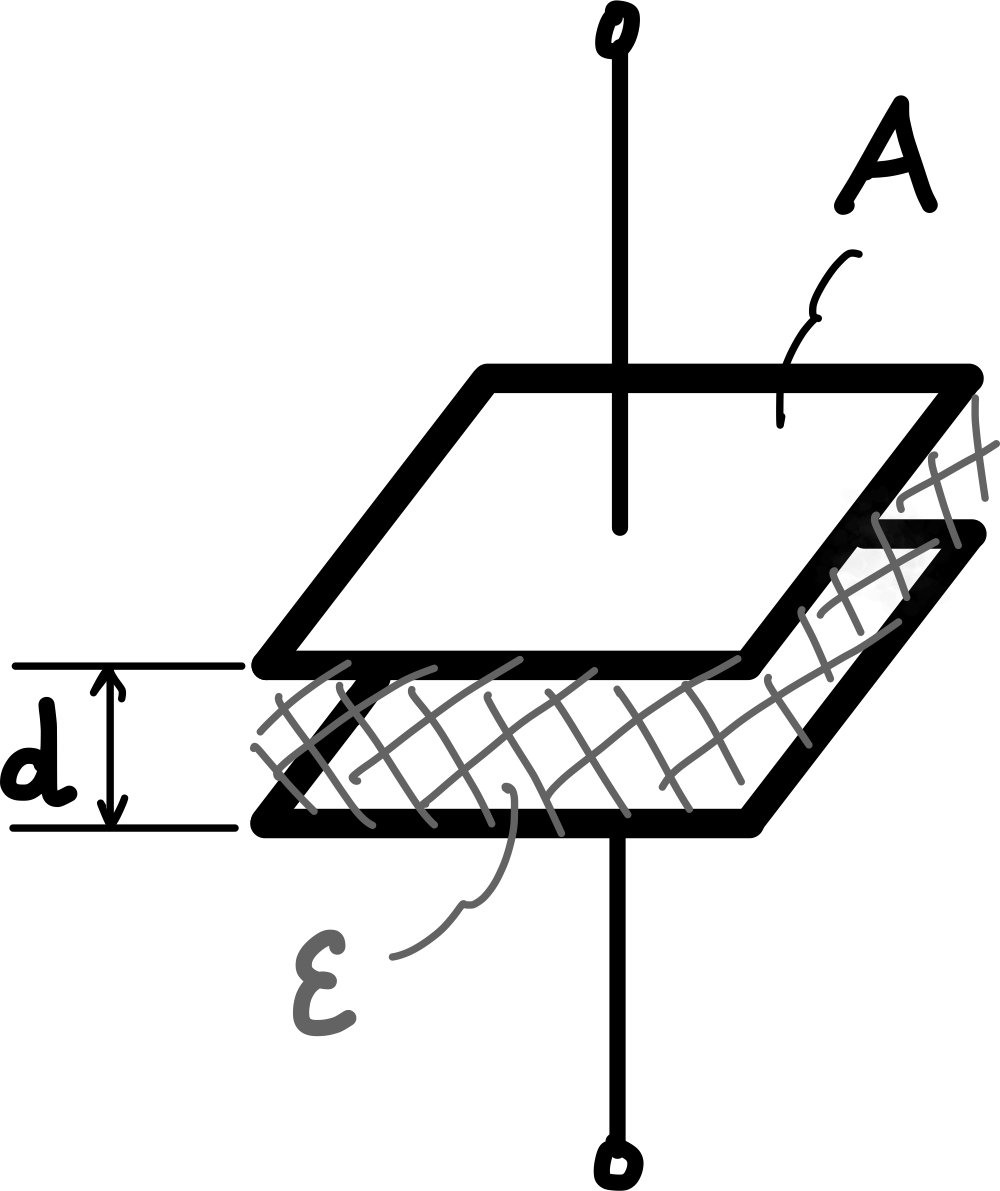
For an ideal parallel-plate capacitor, the following applies:
where:
- the permittivity
- the electric field constant ()
- the relative permittivity of the dielectric (dimensionless)
- the plate area in
- the plate separation in
This formula shows that larger plates and a smaller separation result in a larger capacitance.
3 Typical orders of magnitude
Capacitance values in practice span many orders of magnitude:
- Picofarad (): small ceramic capacitors, cable capacitances
- Nanofarad (): film capacitors in electronics
- Microfarad (): electrolytic capacitors, motor capacitors
- Millifarad (): large electrolytic capacitors
- Farad (): supercapacitors (Goldcaps)
Example: While the capacitance between two traces on a circuit board is only a few picofarads, supercapacitors used as energy storage devices can reach several farads.
4 Example phrasings
- ‘The electrolytic capacitor has a capacitance of 470 µF.’
- ‘For interference suppression, a 100 nF capacitor is connected in parallel.’
- ‘The cable capacitance of the cable is 150 pF per metre.’
- ‘The motor capacitor for the washing machine is rated at 8 µF.’
- ‘Supercapacitors reach capacitances of several farads.’
5 Related quantities
- The electric charge in a capacitor is calculated from:
- The stored energy in a capacitor:
- The capacitive reactance with alternating current:
- The time constant during charging/discharging:
6 Relevant components
Capacitance is the characteristic property of the capacitor.