
Prof. Dr. Thorsten Jungmann (last updated 2026-03-01)
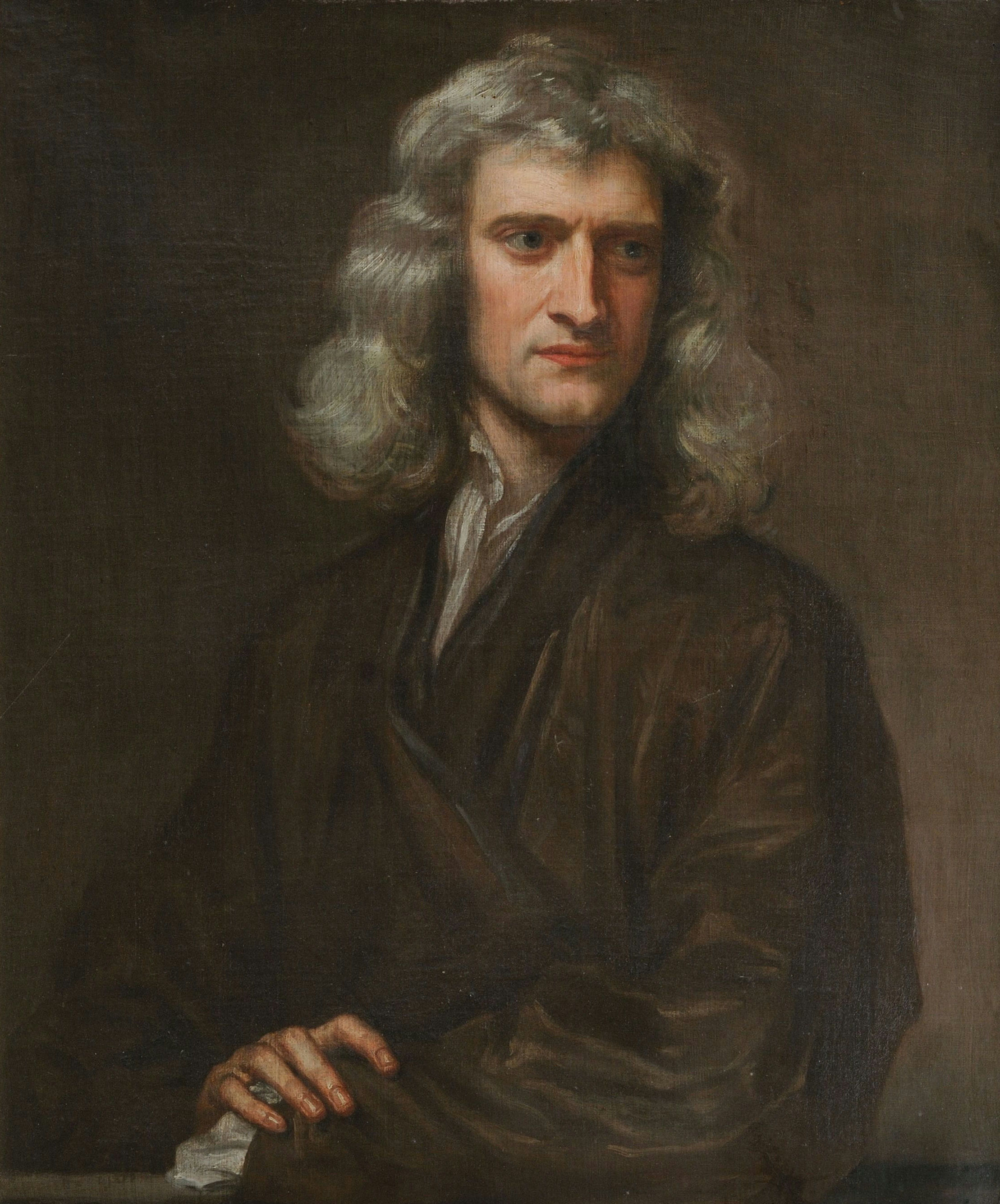
Isaac Newton (1643–1727) was an English mathematician, physicist, astronomer and natural philosopher who is regarded as one of the most influential scientists in history. His work laid the foundation for classical mechanics and influenced physics and engineering – including electrical engineering – in a fundamental way.
Newton’s principal work ‘Philosophiae Naturalis Principia Mathematica’ (1687) formulated the three laws of motion (Newton’s axioms) and the law of gravitation. These laws describe the relationship between force, mass and acceleration and form the basis for understanding mechanical and electromechanical systems. The SI unit of force, the newton (N), is named after him and also plays a central role in electrical engineering – for example in calculating the Lorentz force on current-carrying conductors in a magnetic field, which determines the operating principle of electric motors and generators.
Another important contribution of Newton’s is the development of infinitesimal calculus (differential and integral calculus), which he developed independently of Gottfried Wilhelm Leibniz. These mathematical tools are indispensable in electrical engineering: they make it possible to describe time-varying quantities such as currents and voltages, to analyse AC circuits and to formulate Maxwell’s equations, which are based on differential equations.
Newton also did pioneering work in optics. He showed that white light is composed of a spectrum of different colours, and developed the first reflecting telescope (Newtonian telescope). His corpuscular theory of light did contradict the later wave theory, but it contributed substantially to the scientific debate that ultimately led to the modern understanding of electromagnetic radiation.
Newton’s mechanistic world view and his strictly mathematical methodology had a lasting influence on the whole of natural science. His concept of action at a distance – that forces can act over distances – was not superseded until the 19th century, by the field theory of Faraday and Maxwell. Nevertheless, Newton’s mechanics remains the central tool for numerous applications in electrical engineering, for example in calculating electromechanical systems and the motion of charged particles.
Reference and further reading:
https://en.wikipedia.org/wiki/Isaac_Newton
Image source: Wikipedia