
Prof. Dr. Thorsten Jungmann (last updated 2025-08-28)
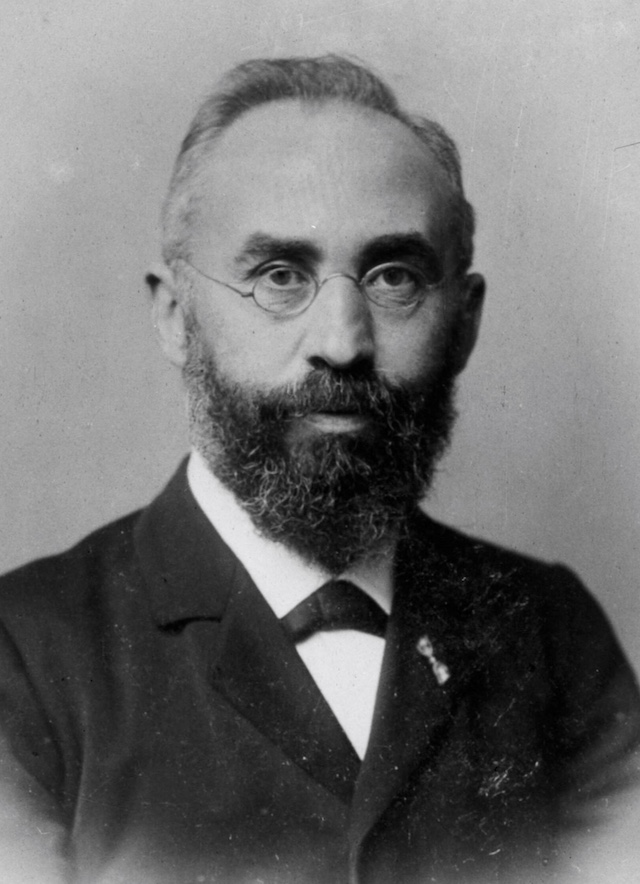
Hendrik Antoon Lorentz (1853–1928) was a Dutch physicist and one of the most important theorists of his time. Lorentz was professor of theoretical physics at the University of Leiden and worked on an electron theory of the conduction of electricity. In 1902 he received the Nobel Prize in Physics jointly with Pieter Zeeman. Lorentz investigated the interactions of electricity, magnetism and optics. His work initiated the transition from classical to modern physics and fundamentally influenced the development of the understanding of space and time.
Lorentz developed groundbreaking theoretical foundations for the electrodynamics of moving bodies, which later served as the starting point for Einstein’s special theory of relativity. Among other things, the Lorentz force is named after him. It describes the force that acts on a moving electric charge when it is in a magnetic field. The mathematical formula is:
where:
- is the electric charge in C,
- is the electric field strength in ,
- is the velocity in
- is the magnetic flux density in .
The Lorentz force plays a central role in many applications of electrical engineering and physics, for example in the electric motor, the generator or the mass spectrometer.
Reference and further reading:
https://en.wikipedia.org/wiki/Hendrik_Lorentz
Image source: Wikipedia