
Prof. Dr. Thorsten Jungmann (last updated 2025-08-28)
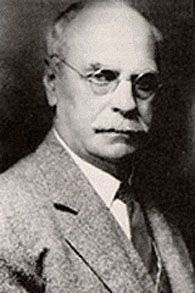
Edwin Herbert Hall (1855–1938) was an American physicist who became scientifically famous through the discovery of the Hall effect in 1879. During his doctoral thesis at Johns Hopkins University, Hall observed that in a current-carrying conductive material a voltage arises transverse to the direction of the current when the material is exposed to a perpendicular magnetic field. This transverse voltage is called the Hall voltage and is due to the fact that the charge carriers flowing in the electric current (mostly electrons) are deflected sideways by the so-called Lorentz force.
Today the Hall effect is a fundamental method for investigating the properties of materials, in particular:
- Determination of the type of charge carrier and its density in semiconductors (distinction between n-type and p-type).
- Measurement of magnetic fields by means of Hall-effect sensors, which are used in many modern devices.
- Measurement of currents with clamp-on ammeters in which Hall-effect sensors are installed.
Edwin Hall later also did research on thermoelectric and galvanomagnetic phenomena and worked as a professor at Harvard University. His discovery fundamentally changed the understanding of electricity and magnetism and is still used intensively in research and technology today.
Reference and further reading:
https://en.wikipedia.org/wiki/Edwin_Hall
Image source: Wikipedia