
Prof. Dr. Thorsten Jungmann (last updated 2025-08-28)
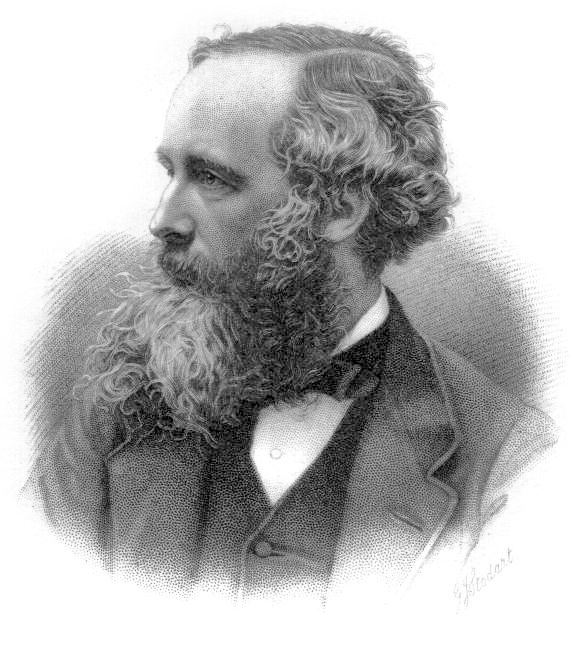
James Clerk Maxwell (1831–1879) was a Scottish physicist who is regarded as one of the most important pioneers of electrical engineering and of modern physics. He is especially famous for formulating Maxwell’s equations, which are named after him – a system of four fundamental equations that describe the behaviour and the interaction of electric and magnetic fields. With them, Maxwell laid the foundation for classical electrodynamics and opened up a new understanding of the laws of nature.
Maxwell recognized that electric and magnetic fields cannot be considered in isolation, but are two sides of the same physical phenomenon – electromagnetism. He also showed that changes in these fields propagate through space in the form of electromagnetic waves at the speed of light. His theory led to the revolutionary insight that light, too, is an electromagnetic wave. This connection between electromagnetism and optics shapes our physical view of the world to this day.
In 1865, Maxwell presented his famous field theory in complete form for the first time. In particular, the introduction of the so-called displacement current was his central innovation: with it, Maxwell was able for the first time to capture the dynamics of electric and magnetic fields mathematically and to explain their ability to propagate as waves. Only with these equations did it become clear that electromagnetic waves (e.g. radio waves, light waves) are a general phenomenon in nature – confirmed experimentally some two decades later (1886–1888) by Heinrich Rudolf Hertz.
Maxwell’s influence extends beyond electrical engineering: he also left a lasting mark on the kinetic theory of gases, on statistical mechanics and on colour photography. He is regarded as a ‘bridge builder between mathematics and physics’ and is ranked as similarly important as Newton or Einstein.
His work revolutionized technology and science: whether generators, electric motors, wireless communication or optics – Maxwell’s theories are to this day the basis for numerous applications in electrical engineering, physics and the engineering sciences.
Reference and further reading:
https://en.wikipedia.org/wiki/James_Clerk_Maxwell
Image source: Wikipedia