
Prof. Dr. Thorsten Jungmann (last updated 2025-08-28)
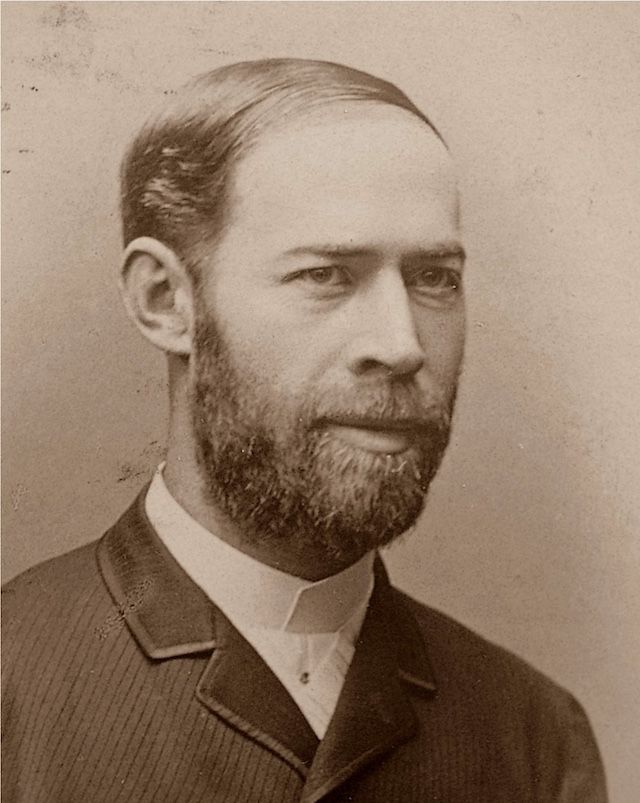
Heinrich Rudolf Hertz (1857–1894) was an eminent German physicist who was the first to provide experimental proof of the existence of electromagnetic waves – precisely those waves whose existence had been predicted theoretically by James Clerk Maxwell. He thereby laid the physical foundation for wireless transmission, radio, television and all wireless communication technologies, including mobile communications. Hertz grew up in Hamburg in a respected family, studied first engineering and then physics in Munich and Berlin, and later became assistant to Hermann von Helmholtz. In 1885 he became a professor at the Technische Hochschule Karlsruhe.
From 1886 onwards he carried out the experiments that made him world-famous: with a so-called ‘Hertzian dipole’ – two metal rods with a spark gap – Hertz succeeded in generating and detecting electromagnetic waves in the laboratory. He used a receiving loop in which sparks could be observed as soon as sparks jumped at the transmitter. This groundbreaking experiment impressively confirmed Maxwell’s theory and showed that light, too, is – physically speaking – an electromagnetic wave.
Through further experiments, Hertz was able to show that electromagnetic waves can be reflected, refracted and polarized like light and that they propagate at the speed of light. The waves he generated had wavelengths of to – a range that is central to radio and television technology today. Practical applications, such as wireless telegraphy and broadcasting, were developed only after Hertz’s death by other researchers such as Guglielmo Marconi, Alexander Popov and Ferdinand Braun.
In honour of Heinrich Hertz, the international unit of frequency, the hertz (Hz), was named after him. To this day, his name symbolizes the link between experimental basic research and modern communication technology.
Reference and further reading:
https://en.wikipedia.org/wiki/Heinrich_Hertz
Image source: Wikipedia