
Prof. Dr. Thorsten Jungmann (last updated 2025-08-28)
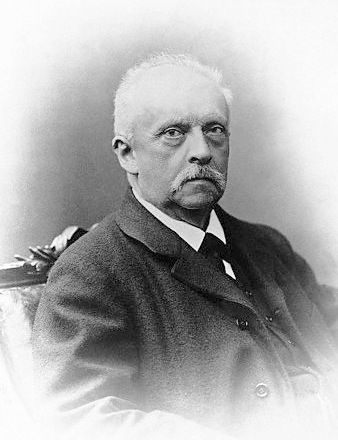
Hermann von Helmholtz (1821–1894) was one of the most versatile German natural scientists of the 19th century and a typical polymath of his time. Originally a physician, he became famous through his research and inventions in numerous scientific disciplines. Helmholtz had a particularly formative influence on physics, electrical engineering and physiology.
Probably his greatest contribution to physics and electrical engineering is the clear formulation of the law of energy conservation: energy can neither be created nor destroyed, but only converted from one form into another (colloquially ‘consumed’). To this day, this principle is the foundation of all fields of science and technology.
Helmholtz also described and disseminated the Helmholtz superposition principle, the application of the superposition principle (or superposition method) in electrical engineering. The principle states that in a linear electrical network with several sources (voltage sources or current sources), the effect of all sources on a particular point of the electric circuit is equal to the sum of the effects that each individual source causes separately – with the others switched off. In doing so, voltage sources are replaced by short circuits and current sources by open circuits; the internal resistances are retained. Helmholtz explained this principle on a sound mathematical and physical basis: it holds in all linear systems, because the effects (e.g. currents or voltages) in such systems behave additively (‘additivity’). The method thus considerably simplifies the analysis of complex electric circuits.
Helmholtz had a direct influence on electrical engineering practice with the so-called ‘Helmholtz coil’: this special arrangement of two identical coils aligned in parallel generates a particularly homogeneous magnetic field and is to this day a standard instrument in experimental physics and electrical engineering. Terms such as Helmholtz resonator, Helmholtz differential equation and Helmholtz theorem also go back to him.
Besides his scientific research, Helmholtz was also a committed organizer of science: as the first president of the Physikalisch-Technische Reichsanstalt in Berlin-Charlottenburg, he made a decisive contribution to Berlin developing into an internationally leading centre of physical and technical research towards the end of the 19th century.
Helmholtz thus stands not only for groundbreaking contributions to energy conservation and thermodynamics, but also for the interweaving of theory, experiment and technical application that is typical of the transition to modern electrical engineering.
Reference and further reading:
https://en.wikipedia.org/wiki/Hermann_von_Helmholtz
Image source: Wikipedia