Prof. Dr. Thorsten Jungmann (last updated 2025-09-02)
1 What does it look like?
A heating device (German: Heizgerät) with heating rods contains one or more elongated heating elements that are mounted in a housing. From the outside, you often see only the bare rods or the cover through which heat is released to the surroundings.
There are two typical designs:
- Metal heating rods (German: Metall-Heizstäbe): resistance wire (e.g. made of nickel-chromium) in a metal tube, electrically insulated by magnesium oxide.
- Quartz rods: resistance wire in a quartz glass tube, mostly for emitting infrared radiation.
An electric grill is, technically speaking, also a heating device.
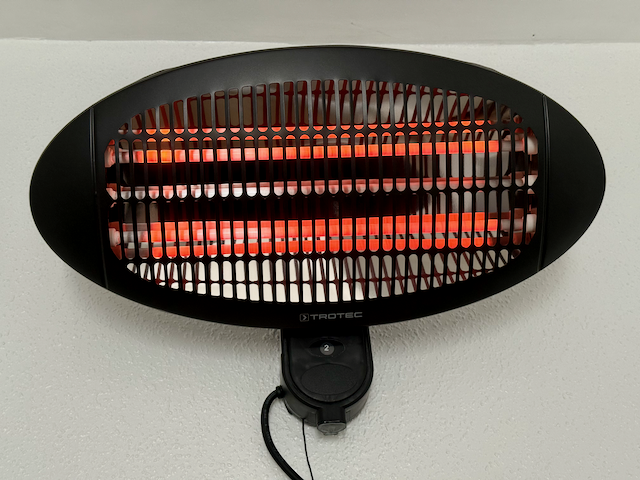
Infrared radiant heater
Trotec IR 2000 S. Rated power: 2 000 W. 3 heat settings, 3 quartz rods, here: setting 2.
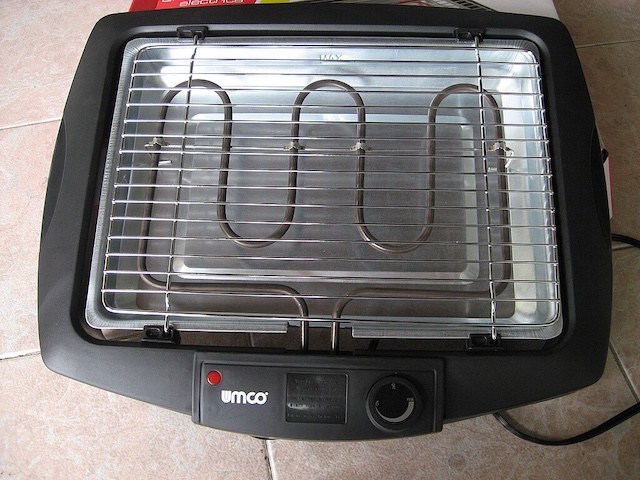
Electric grill
Source: Diana 8220, CC BY-SA 3.0 https://creativecommons.org/licenses/by-sa/3.0, via Wikimedia Commons

2 What can it do?
A heating device converts electrical energy into heat. This heat can be released to the surroundings by thermal conduction and convection (classic heating rods) or by thermal radiation (quartz rods). Applications range from hot-water boilers and fan heaters to infrared radiant heaters for the terrace or bathroom.
3 How does it work?
The electric current flow in the resistance wire produces heat.
- In the metal heating rod, the heat is transferred to the metal tube and from there released to water, air or other media.
- In the quartz rod, the heat is released mainly as infrared radiation outwards through the quartz glass, so that areas or people are heated in a targeted way.
4 What does it look like inside?
- Metal heating rod: inside, a resistance wire, embedded in magnesium oxide powder for insulation and thermal conduction, enclosed by a metal tube.
- Quartz rod: resistance wire directly in a quartz glass tube that is heat-resistant and transparent to infrared radiation.
5 What role does it play in teaching?
Heating devices with heating rods illustrate the conversion of electrical energy into thermal energy. They are examples of a purely ohmic load, since current and voltage are in phase and no reactive power arises. They are likewise a good example of the application of Joule’s law.
6 What role does it play in practice?
They are used in many areas:
- Metal heating rods: in boilers, washing machines, instantaneous water heaters and electric fan heaters.
- Quartz rods: in infrared radiant heaters, mushroom heaters, terrace heaters and industrial drying systems.
Symbols
- Letter code in schematics: E
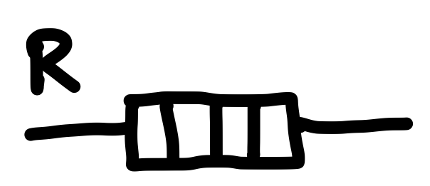
- The heating rod is modelled as a resistor.
- It can be represented as a special heating resistor.