
Prof. Dr. Thorsten Jungmann (last updated 2025-08-28)
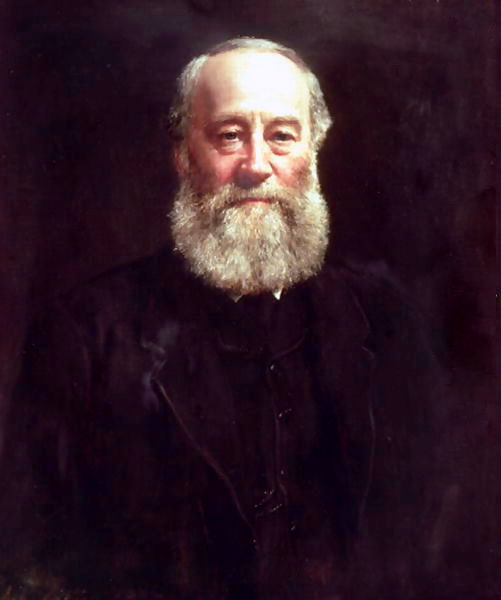
James Prescott Joule (1818–1889) was an English physicist whose groundbreaking experiments on the connection between mechanical work, electrical energy and heat laid the foundation for the law of energy conservation.
Joule first investigated the efficiency of electric motors and in doing so discovered Joule’s law, which is named after him: the heat produced when electric current flows through a conductor is proportional to the square of the current and to the resistance of the conductor.
His most important contribution was the experimental determination of the mechanical equivalent of heat: Joule showed that a certain amount of mechanical work corresponds exactly to a certain amount of heat. He demonstrated this, among other things, with the famous ‘Joule’s falling-weight experiment’, in which the heating of water by kinetic energy was measured. In this way he proved that mechanical work and heat can in principle be converted into each other – a central building block of the law of energy conservation. In addition, Joule played a major part in the development of thermodynamics.
In honour of James Prescott Joule, the international unit of energy, the joule (J), was named after him. His findings are still fundamental to physics, technology and electrical engineering today and make him one of the most important scientists of the 19th century.
Reference and further reading:
https://en.wikipedia.org/wiki/James_Prescott_Joule
Image source: Wikipedia