
Prof. Dr. Thorsten Jungmann (last updated 2025-11-23)
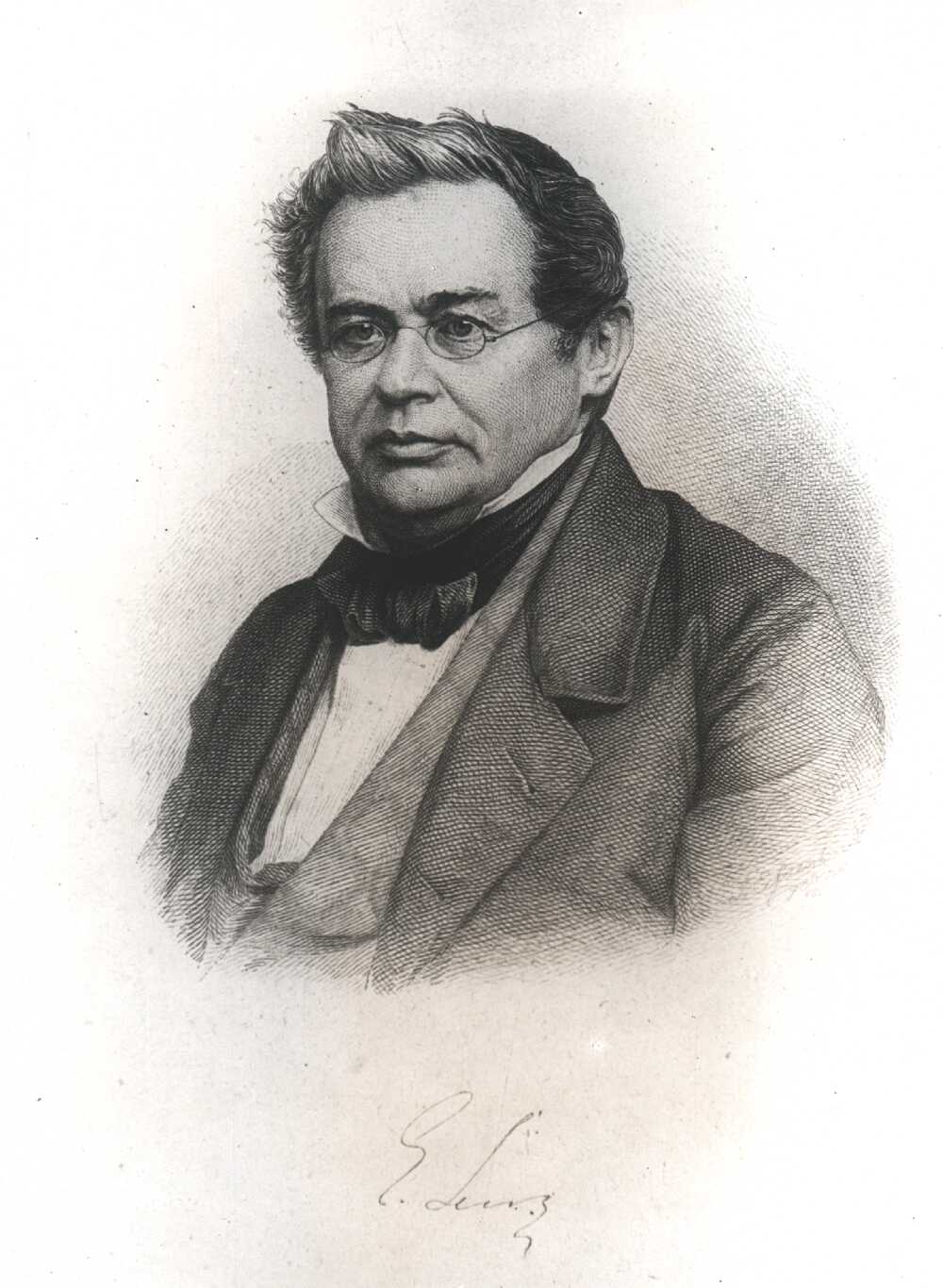
Heinrich Friedrich Emil Lenz (1804–1865) was a Baltic German physicist who became known in particular for his work in the field of electromagnetism.
After his studies and an early academic career in Dorpat (now Tartu) and Heidelberg, Lenz worked mainly as a professor and later as rector at the University of Sankt Petersburg. He undertook numerous research expeditions, among other things to survey geophysical phenomena and the oceans, and received several awards for his achievements in science.
Lenz worked intensively on electromagnetic induction, which had been discovered by Michael Faraday. In 1833 he formulated the principle known today as Lenz’s law (German: Lenz’sche Regel), which states: when the magnetic field changes, an induced current always arises in such a way that its own magnetic field opposes the cause of the electromagnetic induction. Lenz’s law is a vivid expression of the law of energy conservation and is of central importance for understanding generators, eddy current brakes and all electromagnetically induced effects.
Besides this law, Lenz investigated the temperature dependence of electrical resistance, developed measuring methods for magnetic fields and, together with James Prescott Joule, shaped the Joule–Lenz law of Joule heating. He was also a research pioneer in the fields of electroforming and the Peltier effect. As a mathematician and experimental physicist, Lenz decisively advanced Russian and European physics. His findings are still the foundation of electrical power engineering today.
Reference and further reading:
https://en.wikipedia.org/wiki/Emil_Lenz
Image source: Wikipedia