
Prof. Dr. Thorsten Jungmann (last updated 2025-10-21)
Relates to EE1-02 Electrical quantities and units, terms, symbols and models
Task
A case fan is designed for connection to DC. A series resistor reduces the operating voltage of the fan to so that the fan runs more slowly and more quietly. In low-noise operation, a current of is measured.
a) Sketch the electric circuit and enter all electrical quantities.
b) Calculate the resistance of the fan at this operating point and enter the value in the schematic as well. Here, you only calculate the resistance of the fan in operation, without the series resistor.
c) Using the calculated fan resistance, calculate the current for operation without the series resistor (at ).
Solution
Given
Given explicitly:
- Supply voltage
- Voltage across the fan (reduced)
- Current in low-noise operation
Given implicitly:
- Voltage across the series resistor
Required
a) Circuit sketch with the quantities entered
b) Resistance of the fan in ohms ()
c) Current with direct connection to in amperes ()
a) Circuit sketch
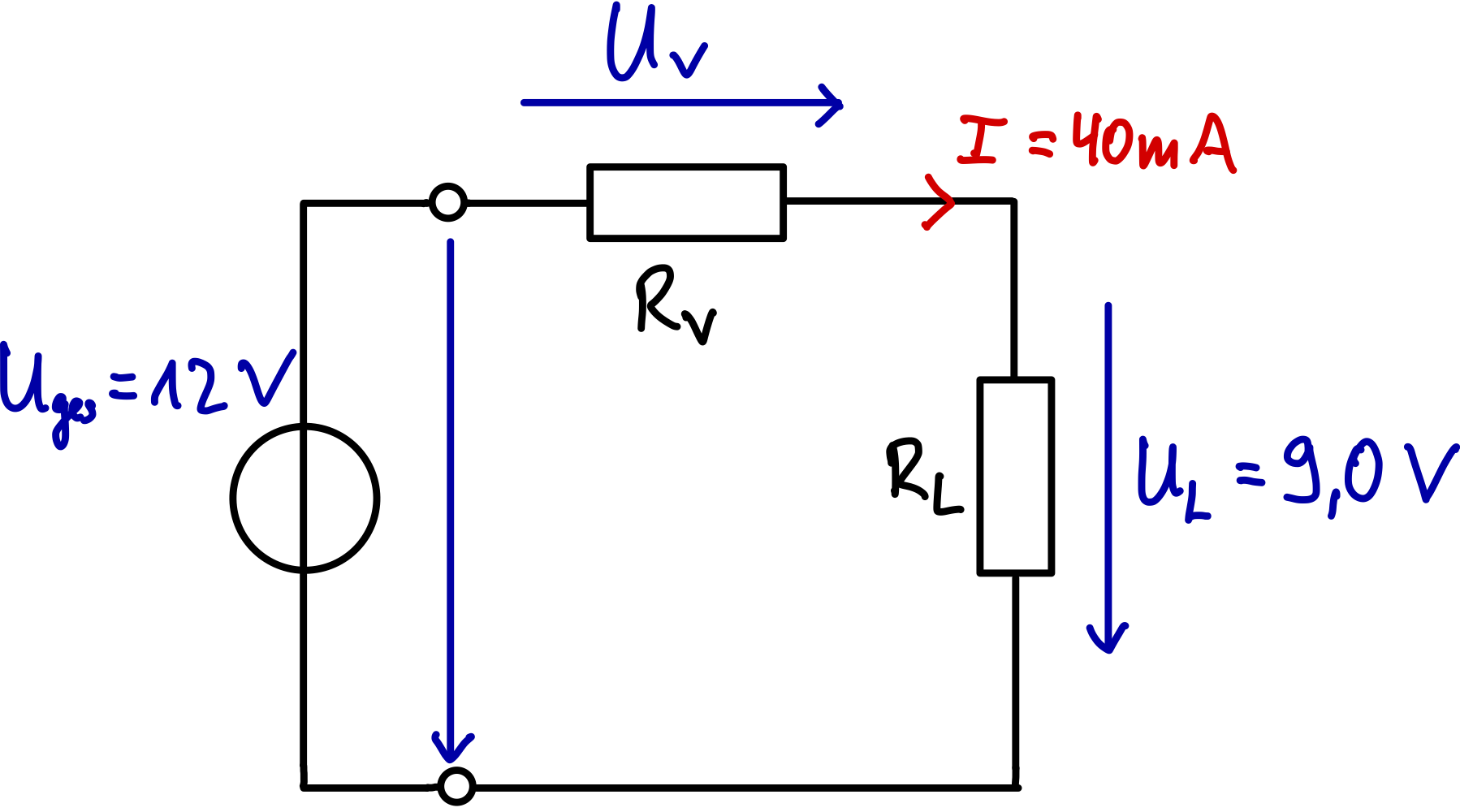
The electric circuit consists of a voltage source () to which the series connection of the series resistor and the fan is connected.
Quantities entered:
- (supply voltage)
- (voltage across the fan)
- (current through the series connection)
- (series resistor)
- (fan resistance)
b) Resistance of the fan
According to Ohm’s law:
Resistance of the fan:
The resistance of the fan is or, rounded to the correct precision, .
Calculating the series resistor
From the voltage across the series resistor, you can also calculate its value:
c) Current with direct connection to 12 V
Without the series resistor, the full voltage is applied to the fan:
With direct connection to , a current of flows through the fan.
Rotational frequency and loudness
The current increases from to (by ). This leads to a higher rotational frequency and thus to louder operation. The series resistor throttles the fan so that it runs more quietly – however, the excess power of about is converted into heat in the series resistor.