
Prof. Dr. Thorsten Jungmann (last updated 2025-09-02)
1 What does it look like?
A multimeter (German: Multimeter) is a portable measuring instrument in a rectangular housing with a digital or analogue display. It has a rotary switch for selecting the measuring function, several jacks for test leads and a display (usually LCD). It comes with two flexible test leads with test probes or crocodile clips.
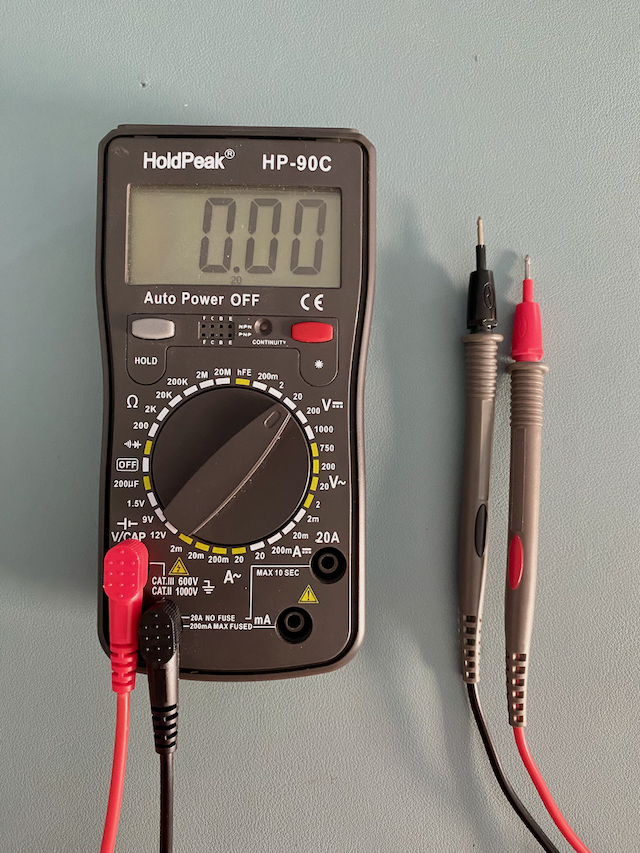
Digital multimeter with test leads
here: setting and connections for voltage measurement
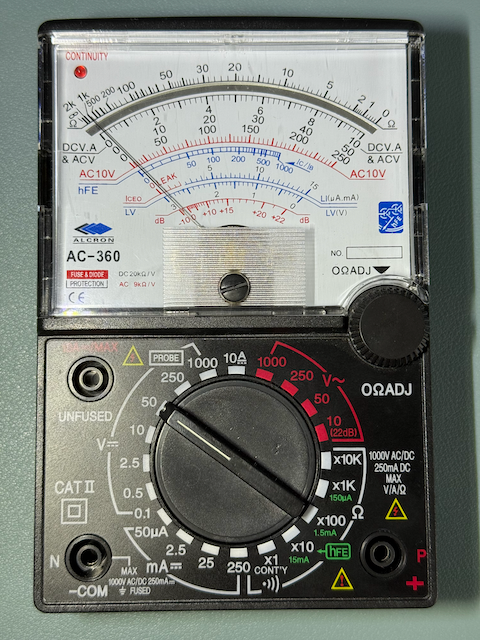
Analogue multimeter
2 What can it do?
A multimeter combines several measuring instruments in one. Typical basic functions are:
- measurement of electric voltage (direct and alternating voltage),
- measurement of electric current (direct and alternating current),
- measurement of electric resistance.
In addition, many instruments offer functions such as:
- continuity test with acoustic signal,
- diode test,
- capacitance and frequency measurement,
- temperature measurement with a probe.
3 How does it work?
A multimeter passes the measuring current through internal measuring circuits, which use different components depending on the function:
- voltage measurement: high internal resistance, so as not to load the electric circuit,
- current measurement: low-resistance shunt resistor for measuring the current via the voltage drop,
- resistance measurement: small internal test voltage, current measurement and calculation according to Ohm’s law.
Digital multimeters work with A/D converters, which process the signal electronically and show it on the display.
4 What does it look like inside?
Inside there are precision resistors, shunts, measuring amplifiers, a microcontroller with A/D converter and the power supply (usually a battery or rechargeable battery). Mechanical controls such as rotary switches or push-buttons control the internal measuring paths.
The video linked below shows the inner workings of the digital multimeter pictured above very clearly.
Analogue multimeters contain a moving-coil meter, which consists of a permanent magnet and a rotatably mounted coil with a pointer. When current flows through the coil, it generates a magnetic field that interacts with the field of the permanent magnet and produces a torque. The deflection of the pointer is proportional to the coil current. Restoring springs ensure that the pointer returns to the zero position. By means of series resistors or shunts, different measurement ranges for voltage, current and resistance can be realized.
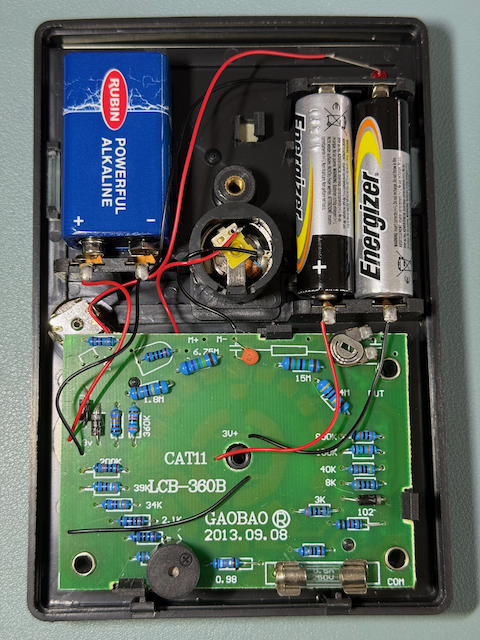
Inner workings of the analogue multimeter pictured above
5 What role does it play in teaching?
The multimeter is the most important measuring instrument in the laboratory and in exercises. It allows you to check fundamental quantities such as voltage, current and resistance and is indispensable for building, checking and troubleshooting electric circuits.
6 What role does it play in practice?
Multimeters are standard in electrical engineering, electronics, workshops and households. They are used for diagnosis, troubleshooting and checking electrical quantities in almost all fields – from the electrician building control cabinets to the electronics technician developing printed circuit boards.
For reliably establishing the absence of voltage, a voltage tester is to be preferred to the multimeter, because its lower input resistance allows a more robust measurement.
For measuring larger currents, special measuring instruments are used, above all clamp-on ammeters, which measure the current without contact and without opening the electric circuit.
Symbols
- Letter code in schematics: P
In schematics, the multimeter is drawn as a voltmeter or an ammeter, depending on its setting.
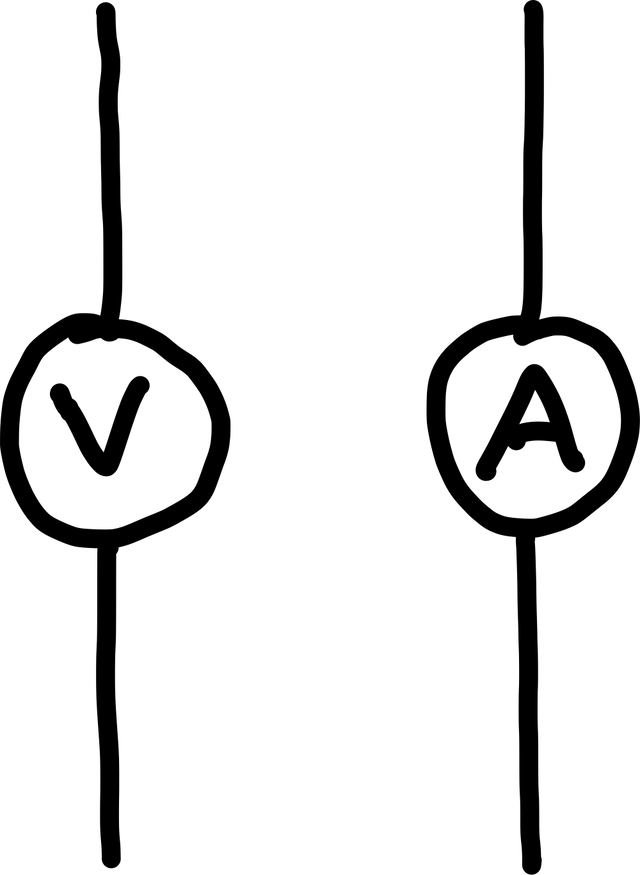
Calculations
- Measurement error due to internal resistance (current-error or voltage-error circuit)