
Prof. Dr. Thorsten Jungmann (last updated 2025-09-04)
1 What does it look like?
An energy meter (German: Energiezähler, also Arbeitszähler) is a device in a rectangular housing (dark or light grey) that is usually mounted on a mounting rail in the meter cabinet. From the outside you can see a register or a digital display that shows the electrical energy (electrical work) drawn from the grid (‘consumed’). Typical devices have sealable covers, terminals for the electric lines, and a manufacturer’s seal and a verification seal. Modern electronic meters additionally have optical interfaces, light emitting diodes that indicate the metering pulses and often communication modules for remote reading.
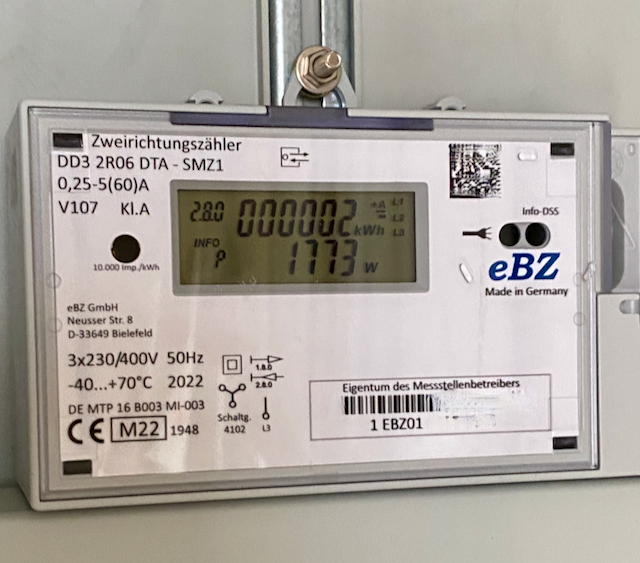
Energy meter
Smart meter, three-phase, bidirectional meter; with communication interfaces
2 What can it do?
The energy meter measures the electrical work that a load or an installation draws from the power grid or feeds into it. It is usually stated in kilowatt-hours (kWh).
- Household meters record the total consumption in flats or buildings.
- Dual-tariff meters (German: Zweitarifzähler) distinguish, for example, between daytime and night-time electricity.
- Bidirectional meters (German: Zweirichtungszähler) record both the electricity drawn from the grid and the electricity fed into it, e.g. from a photovoltaic system.
- Smart Meter are electronic meters with a communication interface that transmit measured values to the energy supplier or to a smart meter gateway and in some cases also provide load profiles and additional data.
3 How does it work?
The operating principle is based on the simultaneous measurement of current and voltage and the integration of their products over time:
- Electromechanical Ferraris meters (German: Ferraris-Zähler): current and voltage windings generate a rotating field that drives an aluminium disc. The rotational frequency is proportional to the instantaneous power, and the revolutions add up to the electrical work.
- Electronic meters: current and voltage signals are digitized, and a microcontroller calculates the instantaneous power and sums it up to the work. Smart meters additionally have communication modules for data transmission.
4 What does it look like inside?
A Ferraris meter contains current and voltage windings, a rotatably mounted aluminium disc, a permanent magnet as an eddy current brake and a mechanical register. Electronic meters contain current transformers, voltage dividers, a measuring and computing unit (microcontroller or ASIC), a display and, where applicable, communication interfaces such as infrared, M-Bus, LAN or radio (e.g. Wi-Fi, LTE). Bidirectional meters have extended software and measuring electronics that record energy flows in both directions separately.
5 What role does it play in teaching?
The energy meter illustrates the difference between instantaneous power and integrated electrical work. It shows clearly how current and voltage measurement are combined to record energy consumption or feed-in. In exercises, students can read off how different loads or generators affect the meter reading, and learn how consumption, savings and feed-back are balanced.
6 What role does it play in practice?
Energy meters are indispensable for billing electricity consumption and feed-in in households, commerce and industry.
- Classic household meters are used for billing electricity consumption.
- Dual-tariff meters support different tariff models.
- Bidirectional meters are standard today for PV systems, combined heat and power stations or other generators, because they record consumption from the grid and feed-in separately.
- Smart Meter enable remote reading, monitoring of the load profile and integration into intelligent grids (‘Smart Grids’), and support more efficient control of energy flows.
Symbols
- Letter code: Z
- Schematic symbol: rectangle with register or display, sometimes labelled ‘kWh’