
Prof. Dr. Thorsten Jungmann (last updated 2025-12-01)
1 What does it look like?
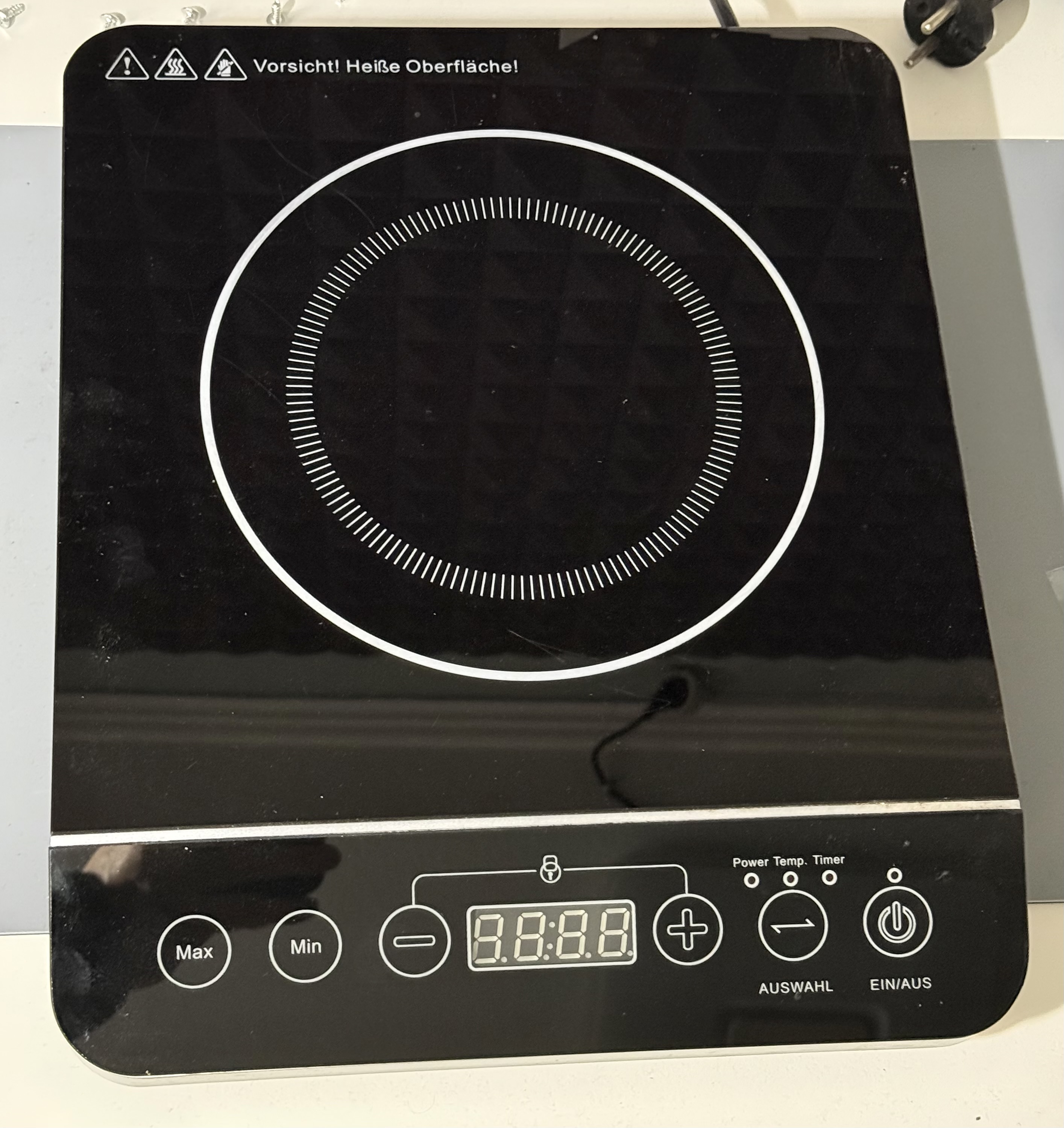
The induction hob (German: Induktionskochplatte) has a smooth, black glass surface with a central cooking zone marked in white. The control strip is located in the lower area and consists of touch-sensitive buttons and a digital display. The housing is flat, rectangular and mainly black, with a mains connection on the side and subtly rounded edges. There are ventilation slots in the sides and the base.
2 What can it do?
The induction hob heats pots and pans quickly and efficiently by generating heat directly in the metal base of suitable cookware. It offers several power levels, temperature control and a timer.
All functions can be controlled precisely via the touch-sensitive buttons, and the display shows power, temperature or time clearly. Automatic pot detection and safety functions such as overheating protection are also integrated.
3 How does it work?
The induction hob first converts the 230-volt mains voltage into a direct voltage and uses an electronic inverter to generate a high-frequency alternating field from it. This field flows through a flat coil directly beneath the glass surface. If a suitable pot is standing on the cooking zone, the alternating magnetic field penetrates its base and generates eddy currents and magnetic losses in it – this is exactly where the heat is produced. The power is controlled electronically, for example by switching the high frequency or by adjusting the resonant circuit.
Sensors monitor current and temperature. To detect whether a suitable pot is standing on the hob, test pulses are sent through the coil and its inductance is measured; only then is power applied to the coil.
The push-buttons in the control panel work capacitively. The capacitance of the metal spirals changes when a finger touches the glass plate above the spiral, because this changes the permittivity. The change in capacitance is evaluated electronically and passed on to the microcontroller as a signal.
4 What does it look like inside?
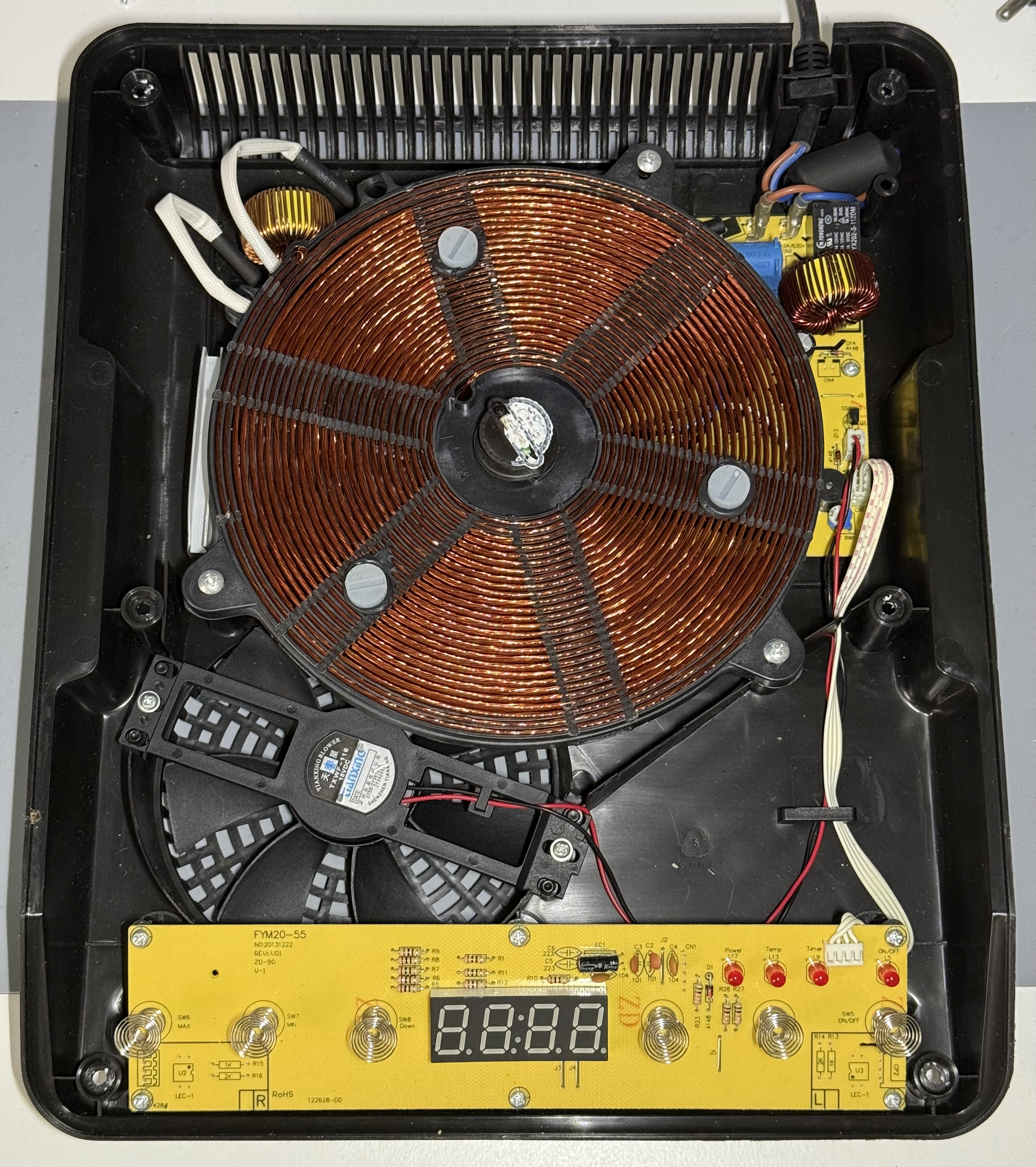
Beneath the glass ceramic, the large, flat copper coil lies in the centre – directly beneath the marked cooking zone. To the left of it sits the fan, which cools the electronics by drawing warm air out of the housing, which flows in afterwards through the slots in the rear of the device. A temperature sensor sits in the centre of the large coil.
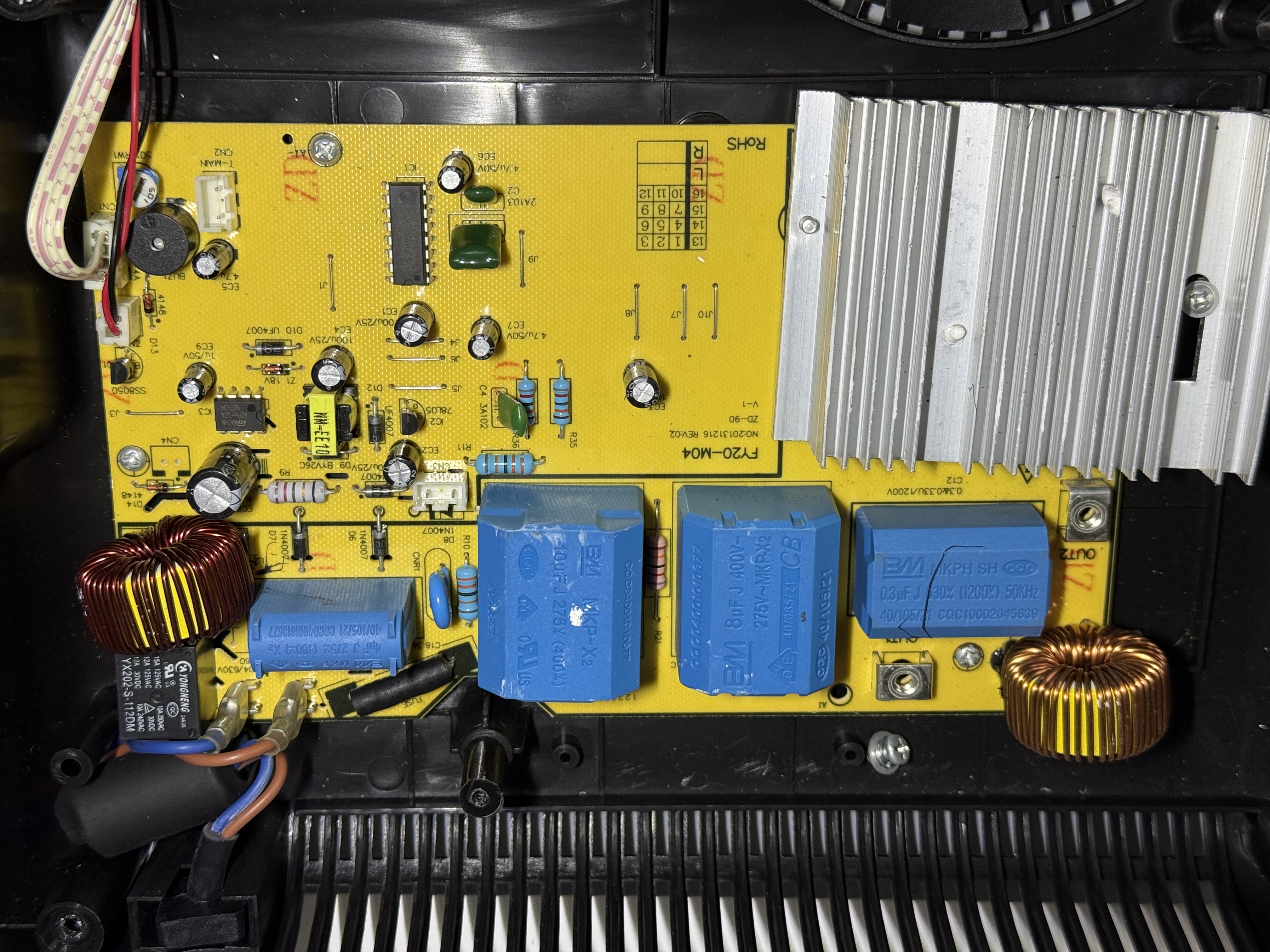
The large power circuit board lies in the rear area of the hob: at the top right are the mains relay and mains filter (consisting of the smallest of the four blue film capacitors and the inductor). At the bottom left sits the solid heat sink with the power IGBT, as well as the resonance capacitors placed above it; different power levels can be achieved by switching these in and out.
The control section is located in the lower right area of the same circuit board. A rectifier electric circuit provides the operating voltage for the control section, including the microcontroller (16-pin IC). The microcontroller evaluates the signals from the control panel and the sensors, controls the fan and generates the square-wave signal, which is then amplified and serves to switch the power stage (IGBT). It also controls the switching out and in of the resonance capacitors.
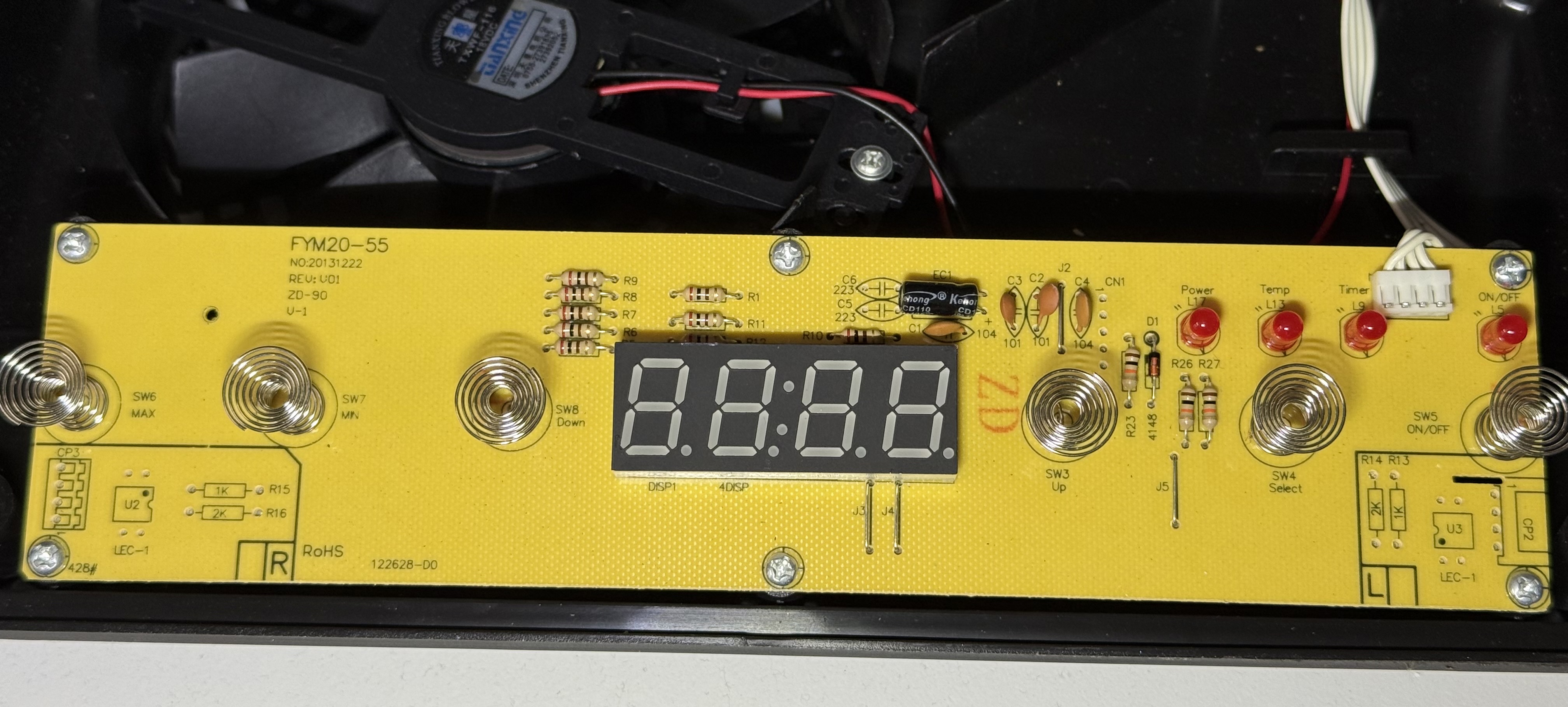
In the front area, the separate front circuit board with light emitting diodes, a light emitting diode display and capacitive sensor buttons is arranged directly beneath the control strip.
All assemblies are connected via connectors and together ensure that the 230-volt supply is turned into the high-frequency magnetic field that heats the pot.
5 What role does it play in teaching?
The induction hob allows you to follow all the fundamentals of electrical engineering in an application-oriented way. It serves as an example of electromagnetic induction, eddy current losses and hysteresis losses. The push-buttons in the control panel are an example of the use of variable capacitance in capacitive sensors. The power and control electronics exemplify the application of the fundamentals of electronics.
6 What role does it play in practice?
The induction hob is used to heat suitable pots and pans quickly. It can be connected to a standard household socket-outlet and used in addition to the cooker. The principle applies equally to complete induction hobs that consist of several such plates.
Symbols
An equivalent circuit diagram was not created because of the complexity of the system.
Calculations
No calculations are carried out for this device.