
Prof. Dr. Thorsten Jungmann (last updated 2025-11-07)
1 What does it look like?
A case fan (German: Gehäuse-Lüfter) consists of a plastic frame, usually square, with integrated mounting holes and a central rotor with several blades. On the rear there is a small electric motor with electronics, from which a multi-core electric line is led out (2–4 cores for supply and signals). Typical sizes are 40 mm to 140 mm edge length.
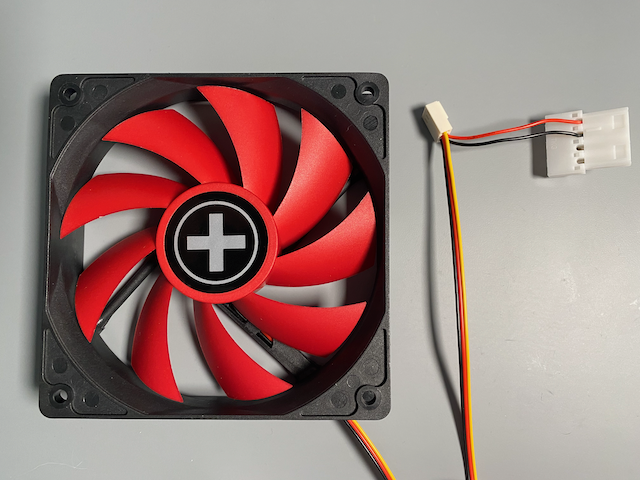
2 What can it do?
The fan cools electronic components by moving air through the case or over heat sinks. Typical applications are:
- cooling of processors and graphics cards,
- case ventilation in computers and servers,
- cooling of power supplies or other electronic assemblies.
3 How does it work?
A case fan is a small electric motor with rotor blades:
- The motor winding is driven electronically (usually as a brushless DC motor with Hall-effect sensors).
- The rotor carries permanent magnets, which are set in rotation by the rotating magnetic field.
- The rotation of the blades produces a directed air flow.
Depending on the design, the fan additionally supplies a rotational frequency signal (tachometer signal) and/or a PWM control input enables rotational frequency control.
4 What does it look like inside?
Inside there are:
- a multi-pole winding on the stator,
- permanent magnets in the rotor,
- bearings (usually plain or ball bearings) for low-friction rotation,
- small control electronics with Hall-effect sensors or a commutation circuit.
5 What role does it play in teaching?
The case fan is a vivid example of the application of brushless DC motors. It illustrates the principles of electromagnetic rotary motion, of commutation without brushes, and the relationship between electrical power, mechanical power and efficiency.
6 What role does it play in practice?
Case fans are indispensable in computer and electronics cooling. They are used wherever heat has to be dissipated reliably: from PCs and laptops through servers and routers to industrial electronics. Reliable cooling extends the service life and prevents damage from overheating.
Voltage divider for noise reduction
I ordered a case fan for a computer with two expensive adapters for noise reduction (‘silent’ and ‘ultra silent’), only to find that the manufacturer had simply inserted a or a resistor into a piece of electric line and fitted it with plugs. I can produce this solution for less than 1 euro once I have understood the principle of the voltage divider.
Symbols
Letter codes in schematics:
- with regard to the controllable flow: G
- with regard to the electric motor: M
Calculations
- Series resistor for controlling the rotational frequency