A press in a car factory may move down only if its guard is closed (A) and the operator presses its two buttons, one with each hand (B and C). The output is Y, ‘press may move down’. Subtasks a) and b) are based on exercises in the textbook by LaMeres [5, pp. 84–85].
a) Set up the truth table of Y.
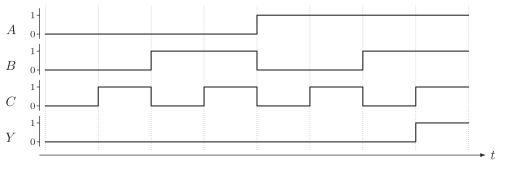
b) Sketch the timing diagram of Y when the inputs A, B and C run through all eight combinations one after another, in the order of the truth table and each for the same time. Assume an ideal gate without delay.
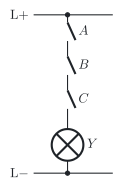
c) Draw the contact logic of Y between the rails L+ and L−.
the inputs A (‘guard closed’), B and C (‘button pressed’); all three are needed
the output Y, ‘press may move down’
b) the inputs run through all eight combinations in the order of the truth table, each for the same time; ideal gate
Known:
Truth table: all 2n combinations of the inputs in ascending order, like a binary count (DET-02); the AND gate (DET-02) and gates with more than two inputs (DET-02)
Timing diagram (DET-02); contact logic: a normally open contact stands for the variable, contacts in series stand for AND (DET-02)
Required
a) the truth table of Y
b) the timing diagram of Y
c) the contact logic of Y
a) Truth table
The press may move down only if all three conditions are met. This is the AND operation with three inputs (DET-02, 3.4):
Y=A⋅B⋅C
With three inputs, the truth table has 23=8 rows, in ascending order like a binary count and numbered from row 0 to row 7 (DET-02, 2.2):
A
B
C
Y=A⋅B⋅C
0
0
0
0
0
0
1
0
0
1
0
0
0
1
1
0
1
0
0
0
1
0
1
0
1
1
0
0
1
1
1
1
Check with the rule of the AND gate: a product of 0s and 1s is 1 only if every factor is 1, which is the case only in row 7 ✓
b) Timing diagram
In the timing diagram, the inputs run through the eight rows of the truth table one after another, each for the same time (DET-02, 2.7): A keeps its value for four sections at a time, B for two and C for one, as in the columns of the truth table. Section by section, the output follows the column Y:
Y is 0 in the first seven sections and rises to 1 only in the last one, where A, B and C are all 1.
Check: each of the eight sections agrees with the row of the same number in the truth table; Y is 1 in one section only ✓
c) Contact logic
In contact logic, a normally open contact stands for its variable, and contacts in series stand for AND (DET-02, 2.5). The three normally open contacts therefore lie in series with the lamp Y, which lights only if all three are actuated:
Check with row 6 of the truth table, A=1, B=1 and C=0: the open contact C interrupts the series, and the lamp stays out, Y=0, as in the table ✓
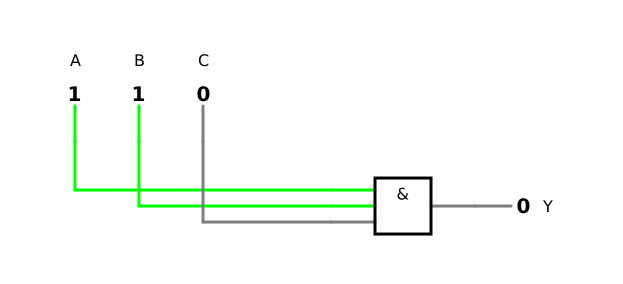
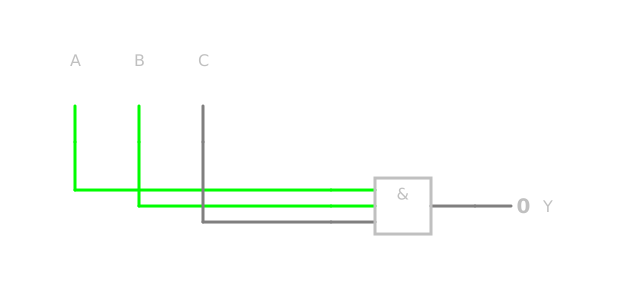
In the simulation, you can check all three subtasks: switch the inputs through the eight combinations and compare Y with the truth table, the timing diagram and the contact logic. At the start, A and B are 1, but C is 0, and Y shows 0, as in row 6.