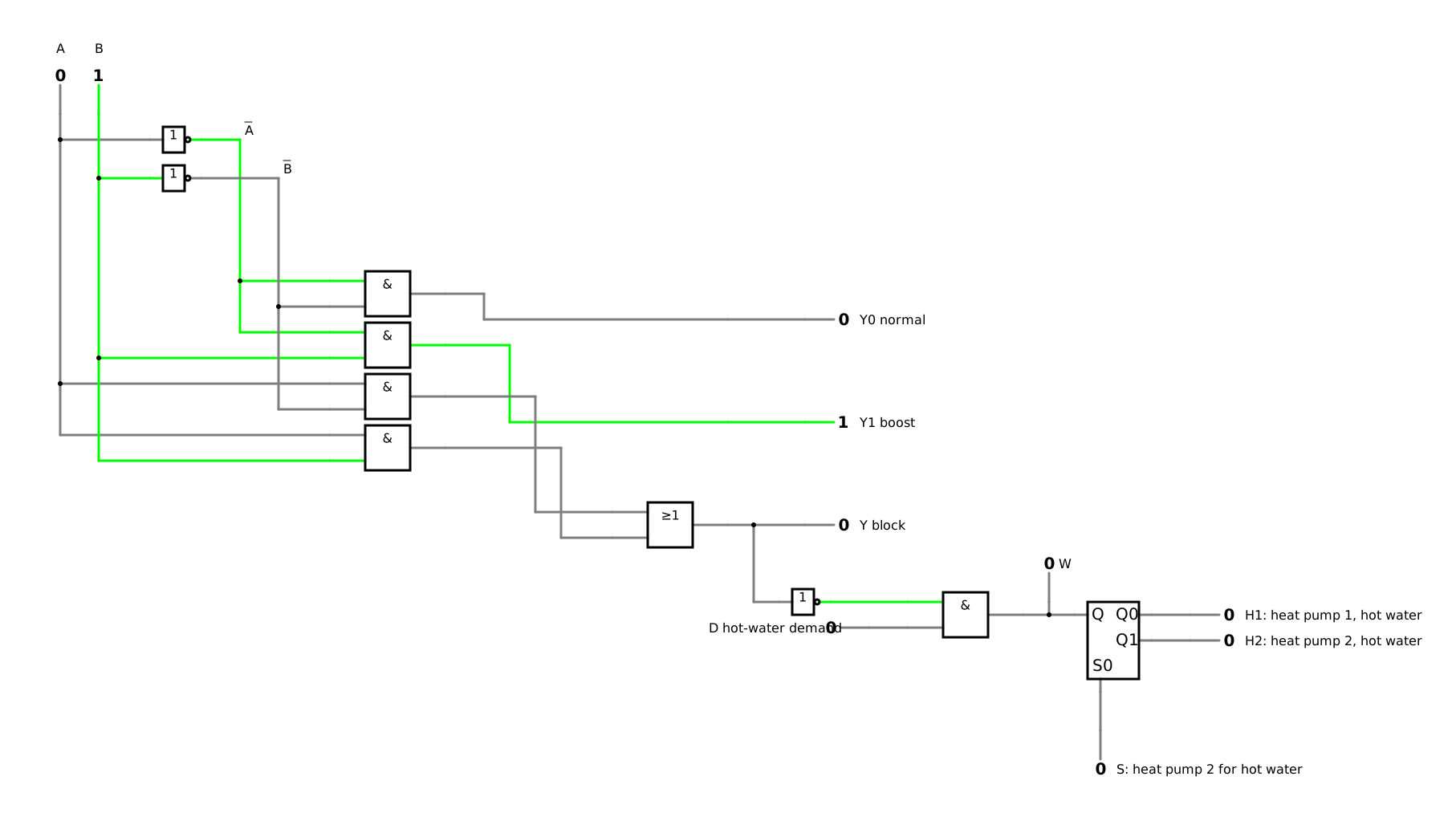
In our example system, the energy manager tells the heat pump over the two switching signals A and B of Smart Grid Ready (SG Ready) what it wants: block (1:0), normal operation (0:0) or boost (0:1). The controller turns the two signals into its operating states. In simplified form, you follow this path from the energy manager to the hot water.
The energy manager has three inputs, of which exactly one is to be 1: I0 for normal operation, I1 for boost and I2 for block. Its encoder delivers the outputs EA and EB, which drive the signals A and B.
a) Design the encoder: set up the truth table with don’t cares, and give the minimized expressions of EA and EB.
b) By mistake, block and boost are requested at the same time. What does your encoder send, and what would this code word mean?
c) Change the encoder so that block has priority over boost, and EA and EB can never be 1 at the same time. Give the expressions.
The controller side is given as a simulation. A 2-to-4 decoder with a lockout forms the outputs Y0 (normal operation), Y1 (boost) and Yblock, as in the lesson. In boost, the hot water is heated to the upper set point of 54.0 °C instead of the normal 52.5 °C; multiplexers with the select input Y1 choose between the two set points. For the hot water, the input D is the hot-water demand. It is passed on as W only if there is no block. A 1-to-2 demultiplexer routes W to the heat pump that is defined for hot water: to H1 for S=0 and to H2 for S=1.
d) Fill in the gaps for the signals A and B. Check the outputs of the decoder in the simulation.
A
B
Code word means
Y0
Y1
Yblock
Selected set point
0
0
normal operation
1
0
0
52.5 °C
0
1
boost
0
1
0
block
0
1
1
start command, locked out
e) Fill in the gaps for the hot water. Check your table in the simulation.
Row
A
D
S
W
H1
H2
0
0
0
0
0
0
0
1
0
0
1
2
0
1
0
1
3
0
1
1
0
1
4
1
0
0
5
1
0
1
0
0
6
1
1
0
0
7
1
1
1
0
f) In which rows does a heat pump go on heating the house while the other one heats the hot water? In which rows does neither of them receive a demand, even though D=1, and why?
The hot water in the cascade with partial priority (DET-05)
Required
a) the truth table and the expressions of the encoder
b) what the encoder sends for block and boost at the same time, and what it means
c) the expressions with block having priority
d) the complete table for A and B
e) the complete table for the hot water
f) the rows in which one heat pump goes on heating, and those in which the block stops the demand
a) The encoder
Exactly one input is 1, so only three rows are specified; the other rows never occur and become don’t cares, marked X, as in the encoder of the lesson (DET-05, 4.1):
Row
I2
I1
I0
Wanted
EA
EB
0
0
0
0
–
X
X
1
0
0
1
normal operation
0
0
2
0
1
0
boost
0
1
3
0
1
1
–
X
X
4
1
0
0
block
1
0
5
1
0
1
–
X
X
6
1
1
0
–
X
X
7
1
1
1
–
X
X
The don’t cares allow the largest loops. EA has its only 1 in row 4, and the loop may grow over the don’t cares up to all rows with I2=1. EB has its only 1 in row 2, and the loop may grow to all rows with I1=1:
The input I0 is not needed, because its code word is 0:0 (DET-05, 4.1). The encoder has no input for the start command either: this is the lockout at the transmitter.
b) Block and boost at once
With I2=1 and I1=1, both outputs become 1: EA=1 and EB=1. The encoder sends the code word 1:1, the start command (DET-05, 3.2). This is exactly the code word that must never act in our system. As long as exactly one input is 1, it does not occur; as soon as block and boost coincide, it does.
c) Block with priority
A priority encoder encodes only the active input with the highest priority (DET-05, 4.1). Block has priority, so EB may be 1 only without a block:
EAEB=I2=I1⋅I2
Now every row of the table is defined, and row 6, with block and boost at once, gives the code word 1:0:
Row
I2
I1
I0
EA
EB
0
0
0
0
0
0
1
0
0
1
0
0
2
0
1
0
0
1
3
0
1
1
0
1
4
1
0
0
1
0
5
1
0
1
1
0
6
1
1
0
1
0
7
1
1
1
1
0
The two outputs are never 1 at the same time, so the start command cannot occur any more ✓
d) From the two signals to the set point
Each output of the decoder is 1 for its code word, and the OR gate leads 1:1 into the block (DET-05, 3.2):
Y0Y1Yblock=A⋅B=A⋅B=A⋅B+A⋅B=A
The select input of the multiplexers is Y1. So they pass the upper set point only in boost, and the normal set point otherwise (DET-05, 5.1):
A
B
Code word means
Y0
Y1
Yblock
Selected set point
0
0
normal operation
1
0
0
52.5 °C
0
1
boost
0
1
0
54.0 °C
1
0
block
0
0
1
52.5 °C
1
1
start command, locked out
0
0
1
52.5 °C
In the rows with A=1, the multiplexers pass the normal set point, because Y1=0. In this simplified circuit, it has no effect there: the block stops the demand, as e) shows.
e) The hot water
The block stops the demand, and the demultiplexer routes what remains (DET-05, 5.2):
WH1H2=D⋅A=S⋅W=S⋅W
Row
A
D
S
W
H1
H2
0
0
0
0
0
0
0
1
0
0
1
0
0
0
2
0
1
0
1
1
0
3
0
1
1
1
0
1
4
1
0
0
0
0
0
5
1
0
1
0
0
0
6
1
1
0
0
0
0
7
1
1
1
0
0
0
f) Reading the table
In the rows 2 and 3, there is a demand without a block. The demultiplexer starts the hot-water operation of the heat pump that S selects. The heat pump whose output stays 0 remains free for the heating: the partial priority of the lesson (DET-05, 5.2).
In the rows 6 and 7, there is a demand as well, but A=1 means a block, so W=0, and neither heat pump receives the demand.