
Prof. Dr. Thorsten Jungmann (last updated 2025-10-26)
Relates to EE1-04 Resistance
Task
From a large online department store, you order a cable reel of copper electric line with a cross-section of to run the electric heater in the garden shed. You notice that the heater does not heat the garden shed as well as when you run it from a socket-outlet in the house.
What technical cause could explain why the actual thermal power differs from the value stated on the packaging?
a) Sketch the electric circuit and locate the potential cause.
b) What conductor resistance does the cable reel have at 20 °C?
c) Calculate the voltage drop across the electric line while the heater is operating. What voltage is actually present at the heater?
d) What power does the heater draw, and how much does it emit as heat ()?
e) Check your assumption from a).
f) Why should you always fully unwind a cable reel before use?
Solution
→
(≈ 8.4 % below rated value)
(conductor loss)
Solution
Given
Given explicitly:
- Cable length (single): (outgoing and return conductors → )
- Conductor cross-section:
- Material: copper
- Rated power of the heater: (at )
Known:
- Resistivity of copper (20 °C):
- Conductor resistance:
- Ohm’s law/power:
- Electric circuit: source – electric line – heater
Required
a) Sketch of the electric circuit & cause
b) Conductor resistance at
c) Voltage drop and terminal voltage at the heater
d) Power drawn by the heater and thermal power emitted
e) Plausibility check of the assumption from a)
f) Why fully unwind the cable reel?
a) Electric circuit & cause
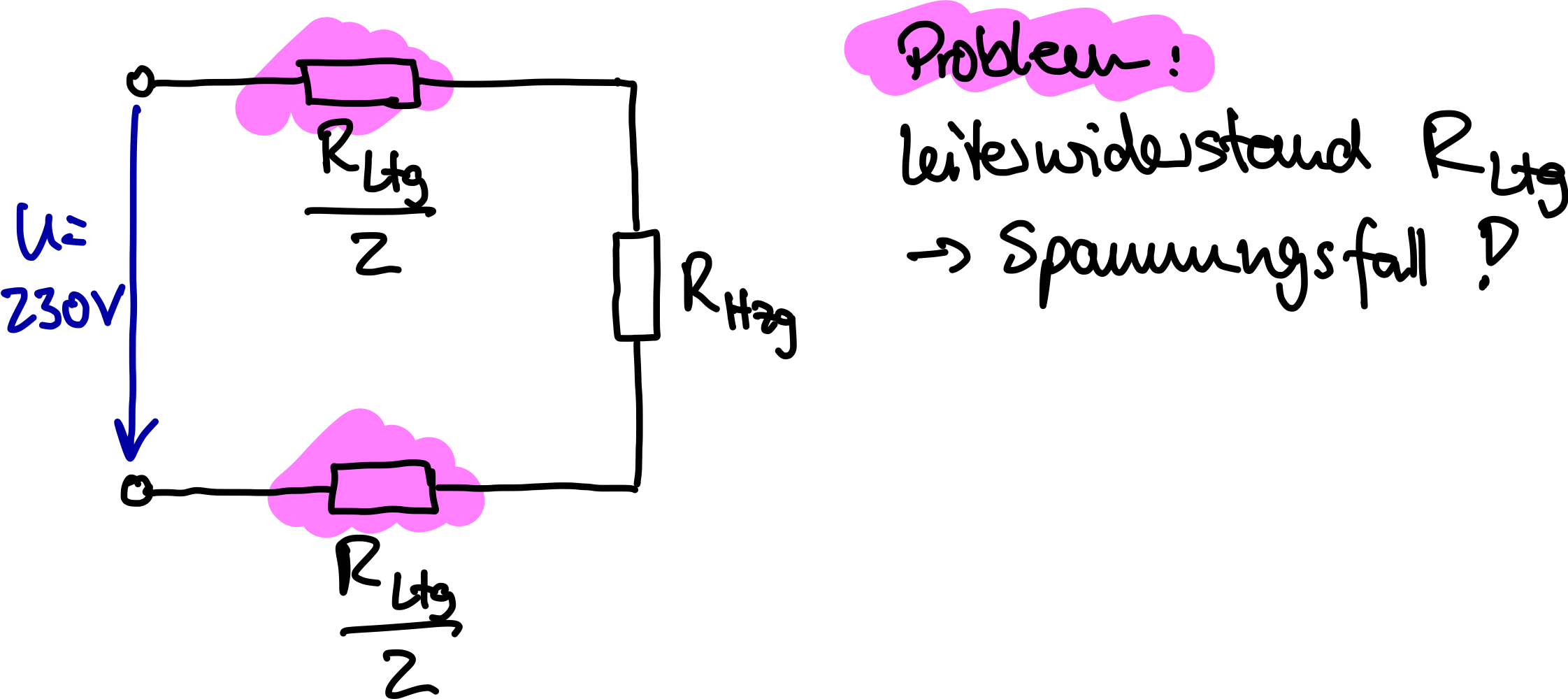
- Cause: voltage drop across the finite conductor resistance → lower terminal voltage at the heater → lower power.
b) Conductor resistance (20 °C)
Double length (outgoing and return conductors):
c) Voltage drop and terminal voltage
Heater resistance from the rated values (at , ):
Current during operation (series connection of and ):
Voltage drop across the electric line:
Terminal voltage at the heater:
d) Power drawn by the heater
(Relative deviation: below rated power.)
e) Checking the assumption
- Voltage drop:
- Power reduction (resistive load, ):
→ Confirmed: the lower heating power is caused by the voltage drop across the long electric line.
Side calculation (loss in the electric line):
The electric line is a middling heater, of the order of an electric heating pad.
f) Why fully unwind?
- Wound up on the reel, the electric line is hardly cooled → the losses () cause heat to build up → risk of overheating/fire.
- With the outgoing and return conductors close together, inductive effects are largely compensated; the main problem is the thermal load (not the magnetic field).
→ Therefore: always fully unwind the cable reel.