
Prof. Dr. Thorsten Jungmann (last updated 2025-12-07)
Relates to EE1-02 Electrical quantities and units, terms, symbols and models
Task 1: Electric charge and current
Mark the correct statement(s):
a) Electric charge is a conserved quantity and can neither be created nor destroyed.
b) A current of 1 ampere means that exactly 1 coulomb of electric charge flows through a cross-section per second.
c) Electrons carry a positive elementary charge of +1.602·10⁻¹⁹ C.
d) The technical current direction is opposite to the actual direction of motion of the electrons in metallic conductors.
Solution
a), b), d) are correct
Task 2: Voltage and electric potential
Mark the false statement(s):
a) The voltage between two points is the difference between their electric potentials.
b) The electric potential is an absolute quantity that is uniquely determined without a reference node.
c) Voltage can only be measured between two different points, not at a single point.
d) In a closed electric circuit, the sum of all voltages is always zero (Kirchhoff’s voltage law).
Solution
b) is false
Task 3: Power and energy
Mark the correct statement(s):
a) The power indicates the energy converted per unit of time.
b) The efficiency can take values greater than 100 % if the losses are negative.
c) A kilowatt-hour (kWh) is a unit of energy, not of power.
d) For an ohmic resistor, the power loss is calculated using .
Solution
a), c), d) are correct
Task 4: Quantities and units
Match the electrical engineering quantities (left) to the correct units (right):
| Quantity | Unit | |
|---|---|---|
| A) Electric charge | 1) V (volt) | |
| B) Electric current | 2) J (joule) | |
| C) Voltage | 3) S (siemens) | |
| D) Electric energy | 4) W (watt) | |
| E) Power | 5) C (coulomb) | |
| 6) Ω (ohm) | ||
| 7) A (ampere) |
Solution
A→5, B→7, C→1, D→2, E→4
Task 5: Quantity symbols and meaning
Match the quantity symbols (left) to their physical meaning (right):
| Quantity symbol | Meaning | |
|---|---|---|
| A) | 1) Electric field strength | |
| B) (phi) | 2) Conductance | |
| C) | 3) Electric charge | |
| D) (eta) | 4) Current density | |
| E) | 5) Electric potential | |
| 6) Efficiency | ||
| 7) Current | ||
| 8) Resistance |
Solution
A→3, B→5, C→7, D→6, E→4
Task 6: Schematic symbols and components
Match each schematic symbol to its primary function in the electric circuit:
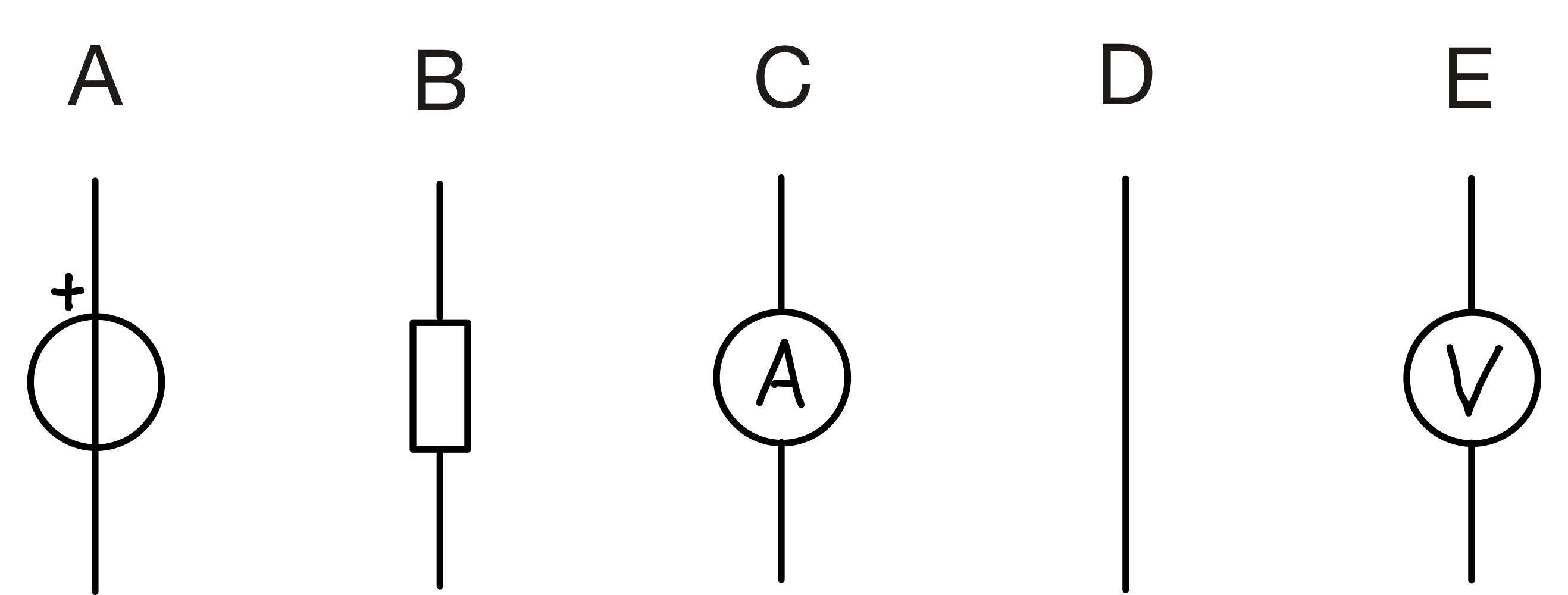
| Primary function |
|---|
| 1) Converts electric energy into magnetic energy |
| 2) Interrupts/closes the electric circuit |
| 3) Conducts electric current |
| 4) Provides electric energy |
| 5) Indicates voltage |
| 6) Indicates current |
| 7) Stores electric charge |
| 8) Limits the current flow |
Solution
A→4 (voltage source), B→8 (resistor), C→6 (ampere meter), D→3 (conductor), E→5 (voltmeter)